
Lieferung heute & morgen

Qualitätsgarantie

Willkommens-Angebote freischalten: KOSTENLOSE Lieferung | Bis zu 80 % RABATT | Kostenlose 30-Tage-JoyPlus-Testphase
App herunterladen
Your own ice maker promises chilled drinks at the touch of a button—perfect for spontaneous parties, relaxed barbecues, or as a practical addition to your home bar. However, the market is flooded with models whose marketing claims often fail to deliver in practice. Before making a decision, it's crucial to understand the common pitfalls to avoid a bad investment.
As your Joybuy Product Recommendation Officer, I'm here to help you separate relevant facts from exaggerated marketing hype. This guide focuses on the three most common problems buyers encounter and shows you what truly matters when making your selection.
Many home-use machines entice buyers with impressive performance specs that quickly disappoint in daily use. Pay close attention to these three points:
To find the right machine for your needs, you should focus on objective, measurable criteria.
The claim "9 ice cubes in 6 minutes" sounds impressive, but it's only half the story. More important is the combination of cycle time, water tank volume, and the size of the ice collection basket. A small ice maker with a 1.3-litre tank and a 0.4 kg basket will frequently pause production because it either needs a water refill or the ice needs to be removed. Therefore, always evaluate capacity in the context of your typical usage.
Dimensions and weight are crucial for where you plan to use it. For a home ice maker that will sit permanently on the countertop, its measurements are important for assessing the required space. If you're looking for a portable ice maker for camping or use in an RV, a low weight and an integrated carrying handle are essential features. Check the product dimensions (L x W x H) and empty weight carefully.
An ice maker with a self-cleaning function reduces effort but doesn't replace manual care. Look for models where the ice basket and, ideally, the water tank are easily removable and accessible. A drain plug at the bottom of the unit is also a practical detail for completely draining residual water after use or cleaning to ensure hygiene.
Here are some recommendations tailored to specific user profiles that take the aforementioned pitfalls into account.
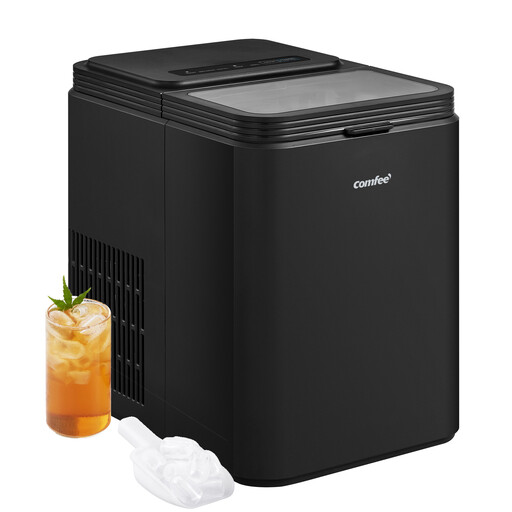
Why This Fits Their Persona: This model is ideal for home use when you occasionally entertain guests. Its capacity is sufficient for small gatherings, and its compact dimensions (295.7 x 213 x 295 mm) ensure it fits on most kitchen countertops. The choice between two ice cube sizes offers flexibility for different drinks.
The production volume of up to 12 kg/24h is realistic for occasional needs. Since the focus is on spontaneous drinks, the fast initial ice production after 6 minutes is more relevant than a high, continuous daily output.
Two selectable ice cube sizes for different needs; compact, space-saving design; includes a self-cleaning function for simplified maintenance.
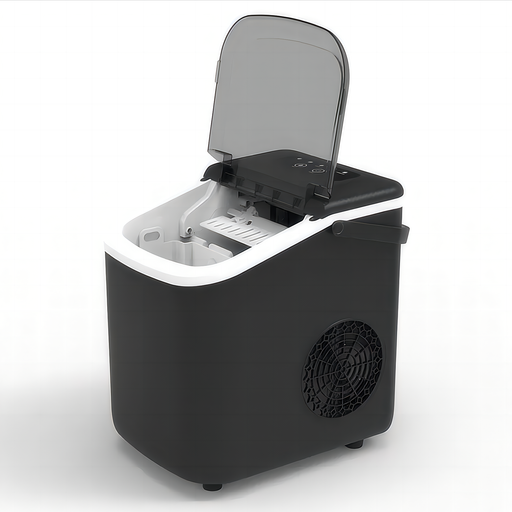
Why This Fits Their Persona: Specifically designed for mobile use. The integrated carry handle and compact dimensions make it easy to transport to the campsite, into an RV, or to the next garden party. Operation is simple and only requires a power outlet.
The focus is clearly on portability, not maximum continuous output. The integrated drain plug is especially practical for mobile use, as it simplifies draining residual water before transport and ensures hygiene on the go.
Integrated carry handle for easy transport; quiet operation that won't be disruptive in smaller environments like an RV; simple operation and cleaning.
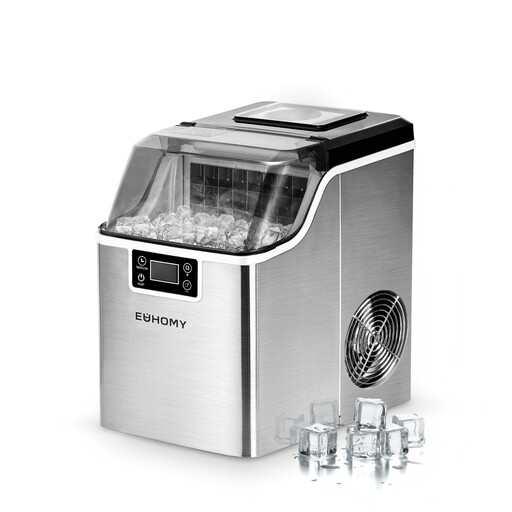
Why This Fits Their Persona: For users with high ice demand, such as in small offices, home bars, or at large family gatherings. The high production capacity and large 3.2-litre water tank allow for longer, uninterrupted ice production. The ability to attach a water bottle is a standout feature for maximum convenience.
This model directly addresses the pitfall of unrealistic production volumes: its dual water supply (manual or via bottle) minimises interruptions for refilling and makes it possible to actually utilise the high daily output of up to 20.5 kg.
Two water filling methods for high autonomy; high production capacity for demanding users; timer function and adjustable ice cube thickness.
We have compiled a complete, up-to-date list of products that fully meet these strict selection criteria and all relevant safety standards.
Even with self-cleaning models, a manual deep clean is recommended every 2 to 4 weeks, depending on usage frequency and water hardness. Wipe the interior with a mild solution of water and vinegar or a specialised cleaner, and rinse thoroughly. This prevents limescale buildup and germ growth.
Power consumption is relatively moderate. Most home-use machines have a power rating between 100 and 150 watts. However, energy is only consumed during the active cooling cycle. Some models, like those from EUHOMY, advertise energy-saving compressors that can further reduce consumption.
It is not recommended to leave water in the tank for extended periods, especially if the machine will not be used for several days. Stagnant water can lead to the formation of a biofilm. Empty the water tank using the drain plug after use and allow the interior to dry to ensure proper hygiene.