
Lieferung heute & morgen

Qualitätsgarantie

Willkommens-Angebote freischalten: KOSTENLOSE Lieferung | Bis zu 80 % RABATT | Kostenlose 30-Tage-JoyPlus-Testphase
App herunterladen
An ice maker can chill drinks in a short time without ice cube bags taking up space in the freezer. However, not every compact appliance provides a practical solution for everyday use. If you only look at high daily output or an especially short first production time, you can easily overlook important details.
Three typical buying pitfalls are:
Many appliances produce their first batch of bullet ice cubes after around 6 to 13 minutes. This is convenient when you want drinks quickly. For a party with several people, however, production capacity over 24 hours is also important. An ice maker producing 12 kg per day is designed for regular household use, offices or smaller events.
The actual quantity depends on factors including room temperature, water temperature, the selected ice cube size and pauses caused by a full container. Daily output should therefore be regarded as a comparison figure, not as a guaranteed amount available immediately.
A larger tank means less frequent refilling. For compact appliances, capacities in the selection range from around 0.9 to 2.2 litres. The ice container is separate and only stores the finished cubes temporarily. If the ice melts in the container, the water either flows back into the appliance or needs to be emptied, depending on the design.
For an ice maker for home use, 1.2 to 1.5 litres is often sufficient. A larger tank can be useful when camping or during longer periods of use. It is also important to fill the appliance only with clean drinking water and to keep the ventilation openings clear.
A compact ice maker should have sufficient clearance from walls and heat sources when placed on a worktop. The external dimensions are therefore important before buying. For mobile use, weight and a carrying handle also matter.
A rating below 45 dB or around 40 dB describes the operating noise level according to the respective manufacturer’s specifications. This can be relevant when choosing a quiet ice maker for an office or living area. Automatic shut-off when the ice container is full and a low-water indicator prevent unnecessary operation.
Two ice cube sizes increase the range of uses. Smaller bullet ice cubes, for example, are suitable for drinks that only need to be chilled for a short time, while larger versions are better for drinks where the ice should remain in the glass for longer. If you need more choice, you can also find appliances with three sizes.
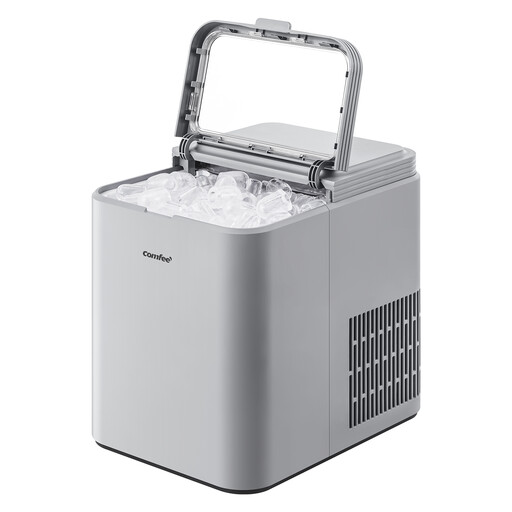
Why this product suits this profile: This appliance combines a compact design with a stated output of up to 12 kg per 24 hours, making it suitable for drinks at home, in the office or in a motorhome.
The specifications state the production time, a 1.3-litre tank and a separate 0.4 kg ice container. This makes it possible to assess output and actual storage capacity separately.
First ice cubes in around 6 minutes, two sizes, a self-cleaning function, plus an ice container and ice scoop included.
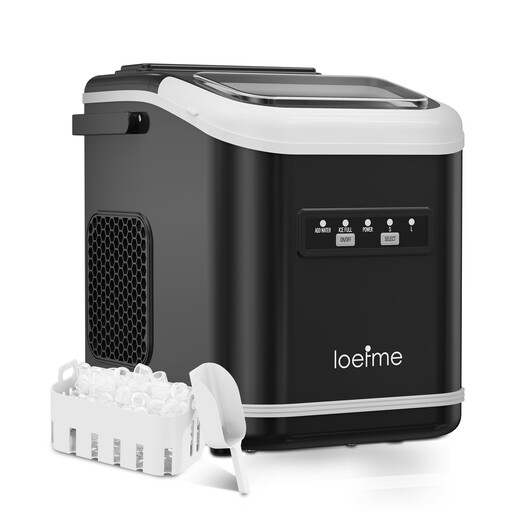
Why this product suits this profile: The combination of a 1.4-litre water tank, two ice cube sizes, a carrying handle and a stated noise level of 40 dB makes it suitable for regular use in the kitchen, motorhome or when entertaining guests.
Alongside daily output, the product data states the weight, tank capacity and noise level. This means mobility, storage capacity and operating noise are not described solely using general advertising terms.
Around 9 bullet ice cubes per cycle, up to 12 kg per 24 hours, an automatic cleaning programme and a carrying handle, with a stated weight of 6.4 kg.

Why this product suits this profile: The visible front, 1.5-litre water tank and design for use in the kitchen, when camping, in a motorhome or at parties appeal to users who want to use the appliance flexibly.
The controls include separate modes for small and large ice cubes, as well as cleaning. Water-level and full-ice indicators make operating pauses easy to understand.
Stated production of up to 12 kg per day, 6 to 8 minutes per cycle, automatic cleaning over 30 minutes and a side drain.
Place the ice maker on a level, stable surface and leave the side and rear ventilation openings unobstructed. Before using it for the first time, clean the appliance according to the instructions and fill it with drinking water. After it has been unused for a longer period, changing all the water is recommended.
Depending on the model, self-cleaning is started using a button or by pressing and holding the on/off button. It supports routine maintenance but does not replace wiping out the tank and container. Always unplug the appliance before carrying out any manual cleaning. Appliances with compressors must not be opened or structurally modified without authorisation.
For mobile use, bear in mind that a portable ice maker requires a suitable power supply. In a motorhome or when camping, check in advance that the socket, inverter and appliance power consumption are compatible. An ice maker is not automatically suitable for outdoor use in damp conditions.
We have put together a complete, regularly updated list of products that fully meet these strict selection criteria and the safety regulations applicable in the EU.
Its lifespan depends on how often it is used, cleaning, water quality, ventilation and how the compressor is handled. A general figure in years is therefore not meaningful. Regular care, sufficient clearance from the wall and following the operating instructions can reduce strain on the appliance.
Running costs mainly comprise electricity, drinking water and, where applicable, cleaning products. For a reliable estimate, power consumption, actual operating time and the electricity tariff are the key factors. A high daily output does not automatically mean that the appliance has to operate continuously at full capacity.
Many models switch off when the container is full or the water level is low. Even so, the appliance should not be left running unattended for long periods. Finished ice cubes should be removed, and any remaining water should be drained after use according to the instructions.