
Lieferung heute & morgen

Qualitätsgarantie

Willkommens-Angebote freischalten: KOSTENLOSE Lieferung | Bis zu 80 % RABATT | Kostenlose 30-Tage-JoyPlus-Testphase
App herunterladen
An ice maker for your home, office, parties or motorhome promises ready-made ice without taking up valuable freezer space. However, claims such as “ice cubes in 6 minutes” or “12 kg of ice per day” are only meaningful if the water tank, collection basket, noise level and cleaning requirements also suit your actual needs.
The most common poor purchases come down to three points:
For occasional drinks, a smaller compact ice maker with a water tank of around 1 to 1.5 litres is usually sufficient. For family gatherings, cocktail evenings or regular use in the office, the daily output is also important. Figures such as 12 kg of ice per day are based on the manufacturer’s conditions and continuous operation. They should not be confused with a one-off reserve of ice.
You should also check:
A portable ice maker with a carry handle is practical for camping and motorhomes. However, mobile use requires a suitable, stable and level surface. The power supply should be compatible with the relevant vehicle or camping connection.
Many machines are bullet ice makers. Their hollow, cylindrical ice pieces have a larger surface area than solid cubes, allowing them to cool drinks comparatively quickly. For soft drinks, iced coffee or cocktails, having two selectable sizes can be useful. Under the same conditions, larger ice pieces typically melt more slowly, while smaller pieces can chill drinks more quickly.
An ice maker with two ice-cube sizes offers greater flexibility, but is not automatically suitable for every application. If you need crushed ice for cocktails or desserts, bear in mind that an ice maker generally does not produce ready-made ice flakes. An alternative is a separate crushed-ice tray maker, which is used in the freezer.
An ice maker with a self-cleaning function makes basic maintenance easier. Look for a clearly explained cleaning programme, an easily accessible drain and removable parts. Only use clean drinking water and make sure the ventilation openings remain unobstructed.
The following practical rules apply when positioning the machine:
The noise level in decibels is also relevant. Levels below 45 or 50 dB may be more comfortable in a kitchen, office or motorhome than louder models. However, the perceived noise depends on the surface, room and operating conditions.
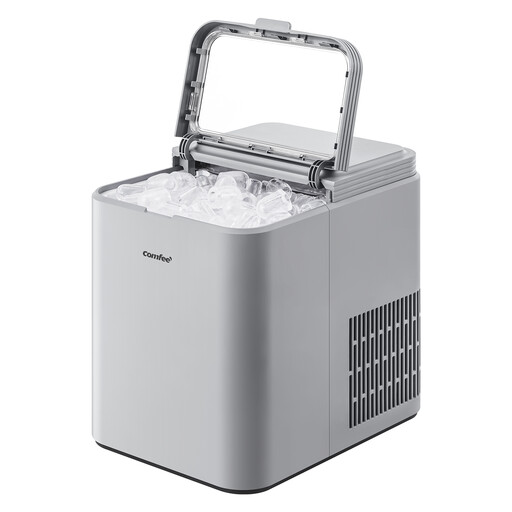
Why this product suits the profile: This machine combines a compact design with a 1.3-litre water tank, making it suitable for kitchens, offices and occasional celebrations. According to the product information, the first ice cubes are ready after around 6 minutes.
The specifications state both the daily output and the tank and basket capacities. This makes it easier to assess your needs rather than focusing solely on the short cycle time.
Two ice-cube sizes, self-cleaning function, removable ice basket and ice scoop; dimensions: approximately 29.6 × 21.3 × 29.5 cm.

Why this product suits the profile: This ice maker features sensors for low water levels and a full ice basket, as well as an automatic cleaning function. This makes it easier to use regularly at home.
The cleaning process is described as a dedicated 30-minute cycle. The side drain also helps to remove residual water effectively.
Two ice-cube sizes, production of 9 ice cubes in approximately 6 to 8 minutes, a stated daily output of up to 12 kg and an operating noise level below 50 dB.
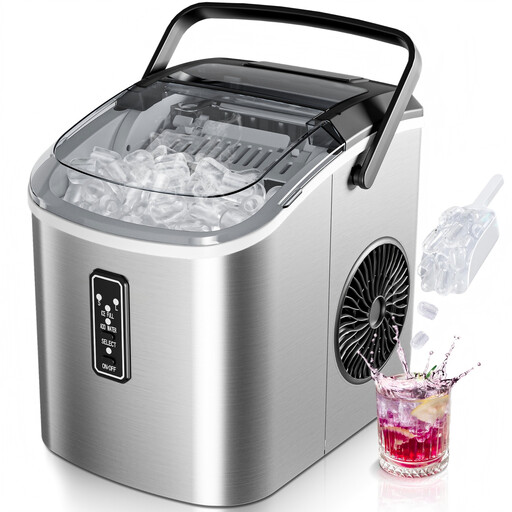
Why this product suits the profile: With a carry handle, a weight of around 6.3 kg and two bullet ice-cube sizes, this model is suitable for kitchens, offices, parties, as well as camping and motorhome use.
The instructions explicitly mention clean drinking water, unobstructed ventilation openings and positioning on a level surface. This is particularly important when the machine is moved frequently.
Stated production of approximately 9 ice cubes in 6 to 12 minutes, up to 12 kg per day, self-cleaning function and a noise level below 45 dB.
We have put together a complete, regularly updated list of products that fully meet these strict selection criteria and the safety regulations applicable in the EU.
The running costs of an ice maker depend mainly on power consumption, operating time, water consumption and maintenance. The wattage alone does not show how much energy is needed per kilogram of ice. For a realistic assessment, you can measure consumption over several operating cycles using a plug-in energy meter.
A compressor machine should not run continuously without a break when the ice basket is already full. Sensors can stop production, but it is still sensible to remove finished ice cubes promptly. Regularly emptying, drying and descaling the machine in accordance with the manufacturer’s instructions can help to reduce deposits. If the machine will not be used for an extended period, it should be emptied completely and left open to dry.
Compact machines often state that the first batch is ready after around 6 to 8 minutes. The actual time depends on the water temperature, room temperature, ice-cube size and condition of the machine. Larger ice cubes generally take longer than smaller ones.
There is no single standard service life. It depends on build quality, frequency of use, ventilation and cleaning. Keeping the water tank clean and dry and the ventilation openings clear helps support trouble-free operation. The manufacturer’s warranty and maintenance instructions are the deciding factors.
For households that regularly need chilled drinks, cocktails or ice for celebrations, an ice maker can be worthwhile by producing ice as needed. If you only use ice occasionally and have enough freezer space, freezer bags or an ice-cube tray may be more economical. The key factors are how often you use it, the available space and the effort required for cleaning and storage.