
Lieferung heute & morgen

Qualitätsgarantie

Willkommens-Angebote freischalten: KOSTENLOSE Lieferung | Bis zu 80 % RABATT | Kostenlose 30-Tage-JoyPlus-Testphase
App herunterladen
An ice maker can chill drinks in just a few minutes, making it practical for homes, offices, parties or motorhomes. However, product claims such as “fast”, “compact” or “quiet” are only meaningful when they are backed up by the technical specifications. Focusing solely on daily output or the lowest price can easily mean overlooking important limitations.
A specification such as 12 kg of ice in 24 hours describes a theoretical or manufacturer-stated daily output under specific conditions. In everyday use, room temperature, water temperature, ice cube size and pauses affect the actual quantity. The ice basket is also usually much smaller than the daily output. For a party, you should therefore check how many ice cubes are produced per cycle and when the basket needs to be emptied.
A quiet ice maker should be advertised with a specific noise level. Values of around 40 to 50 dB may be suitable for a kitchen, office or campsite, but they do not mean silent operation. The compressor and fan may be more or less noticeable during the cooling process. If you want to use the appliance in a living area or at night, you should take the stated dB rating and the surface it will stand on into account.
An ice maker with a self-cleaning function makes maintenance easier, but it does not automatically remove every deposit. Drinking water can leave behind minerals, while residual water and moisture mean that the basket still needs to be cleaned. The self-cleaning function should therefore be viewed as an additional programme step, not a complete substitute for wiping, emptying and drying the appliance.
Many compact appliances produce so-called bullet ice cubes. These hollow, rounded cubes are suitable for soft drinks, iced coffee and cocktails. Key points include:
For an ice maker for home use, a tank capacity of 1.2 to 1.5 litres is often sufficient. A larger tank reduces the need for refilling, but it also often increases the weight and footprint. Users of an ice maker for camping and motorhomes should also consider the transport weight, carrying handle and available space.
A stated output of 12 kg per day is useful when several batches are needed one after another. For occasional drinks, a smaller appliance will be sufficient. It is also important to have indicators for low water and a full ice basket, so that operation is not interrupted unnecessarily.
A compact ice maker needs sufficient space at the sides and rear to allow heat to escape. Ventilation openings must not be blocked by walls, cupboards or other objects. Before buying, you should therefore compare the appliance’s dimensions with the available space on your kitchen worktop, office trolley or in your motorhome’s storage area.
Only clean drinking water should be used. The housing, mains plug and cable must not be immersed in water. Disconnect the appliance from the mains before cleaning or carrying out maintenance manually.
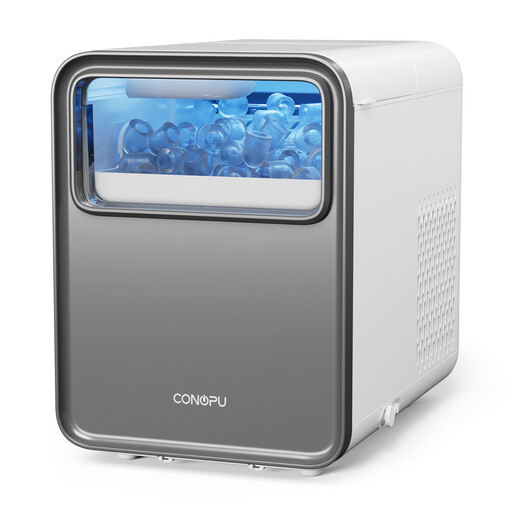
Why this product suits the profile: This appliance combines a compact design with two ice cube sizes, making it suitable for kitchens, offices or occasional celebrations. According to the product specifications, it produces 9 bullet ice cubes in around 6 to 8 minutes, with a daily output of up to 12 kg.
The low-water and full-basket indicators make the actual operating limits clear. The stated noise level of under 50 dB also provides a specific benchmark rather than an unsupported claim of quiet operation.
1.5-litre water tank, compact dimensions of 35 × 23 × 30 cm and a 30-minute self-cleaning programme.
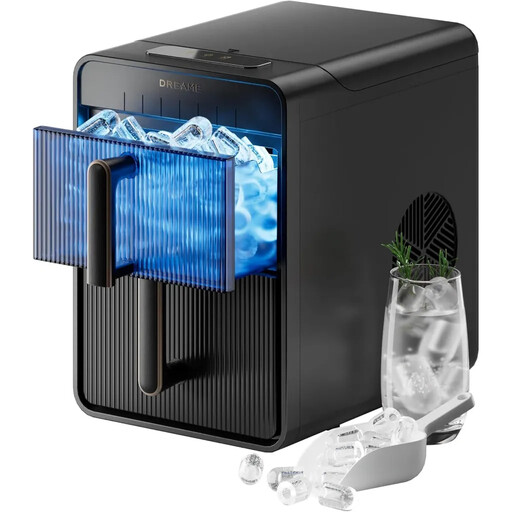
Why this product suits the profile: The digital touch controls, two sizes and 2.0-litre water tank are ideal for households that regularly need ice for drinks and guests. The product description states that the first batch is ready after around 6 minutes, with production of up to 15 kg per 24 hours.
The full-basket and low-water sensors help prevent unnecessary idle periods. Before buying, check the conflicting output figures in the listing directly – 12 kg in the name, but up to 15 kg in the description.
1-kg ice basket, touch display, automatic cleaning and a weight of 7.5 kg for flexible use in the kitchen.
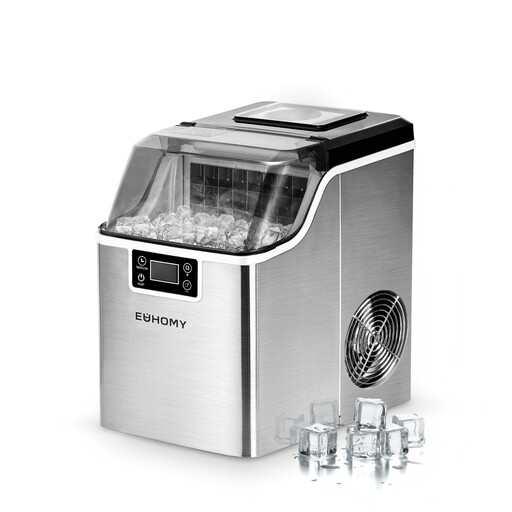
Why this product suits the profile: The 3.2-litre water tank and stated capacity of up to 24 ice cubes per cycle are designed for frequent use at celebrations, in larger kitchens, offices or bars. For motorhomes, the available space should be checked in particular.
The description points out that the cubes in a batch may be joined together and need to be separated before use. The variable production time of around 13 to 25 minutes should also be taken into account.
Manual or optional filling using a water bottle, automatic 20-minute cleaning and a stated noise level of around 45 dB.
We have put together a complete, regularly updated list of products that fully meet these strict selection criteria and the safety regulations applicable in the EU.
A portable ice maker should be placed on a stable, level surface. After filling it with drinking water, select the desired cube size. The ice basket is not a freezer compartment: depending on the room temperature, the cubes will remain solid there for only a limited time. A freezer compartment is required for longer-term storage.
For maintenance, we recommend:
Running costs depend on electricity consumption, the price of water and how long the appliance is used. A higher daily output is not automatically more economical if only a few ice cubes are needed each day. A small tank may be sufficient for occasional use, while families and hosts can benefit from a larger supply.
Many compact models state a time of around 6 to 13 minutes. The actual time depends on factors including room temperature, water temperature, the selected size and the condition of the appliance. The first batch may take longer than subsequent cycles.
The service life depends on the compressor, build quality, frequency of use and maintenance. Emptying the appliance regularly, using clean drinking water, ensuring adequate ventilation and following the operating instructions can reduce the strain on the appliance. Without a binding statement from the manufacturer, it is not possible to give a reliable specific service life.
Consumption depends on the appliance’s power rating, compressor running time, ambient temperature and daily operating duration. For comparison, consider the electrical power in watts together with the planned usage time. An appliance with a high daily output may use more electricity during regular operation than a smaller model.