
Lieferung heute & morgen

Qualitätsgarantie

Willkommens-Angebote freischalten: KOSTENLOSE Lieferung | Bis zu 80 % RABATT | Kostenlose 30-Tage-JoyPlus-Testphase
App herunterladen
An ice maker can make preparing drinks, cocktails and a party much easier. However, advertising often creates unrealistic expectations. Claims such as “ice cubes in 6 minutes” or “12 kg per day” usually refer to specific operating conditions. Actual performance depends on factors including room temperature, water temperature, ventilation and the selected ice cube size.
The Joybuy Product Recommendation Officer selection therefore focuses on reliable product data rather than marketing promises.
An electric ice maker with a daily output of 12 kg does not automatically produce 12 kg at once. Many compact appliances have an ice basket holding around 0.4 to 1 kg. Once it is full, production stops on models with an ice-level sensor. For a party, you may therefore need to remove the ice regularly and store it temporarily in the freezer.
“9 ice cubes in 6 minutes” describes a production cycle under the conditions assumed by the manufacturer. Subsequent cycles may take longer, particularly in a warm environment or when the lid is opened frequently. If you need large quantities continuously, consider daily output, cycle time and basket capacity together.
An ice maker with a self-cleaning function can make a cleaning cycle easier. However, the water tank, ice basket, scoop and drain still need to be emptied and dried regularly. The function is also not the same on every appliance: some models run a short rinsing cycle, while others have a programme lasting around 30 minutes.
For impromptu drinks at home, a first batch in around 6 to 13 minutes is practical. A specification such as 12 kg of ice cubes per 24 hours is more useful as a comparison figure for capacity. When planning a party, you should also consider how many cubes the ice basket holds and how quickly a new cycle starts.
Bullet ice cubes are standard on many portable appliances. These hollow or partially hollow cubes can generally be made quickly and are suitable for soft drinks, iced coffee and cocktails. However, they differ from solid cubes made in a freezer in terms of shape, melting behaviour and intended use.
A tank holding 1.2 to 2.2 litres can reduce the need for frequent refilling. However, this specification does not indicate the amount of ice that can be stored: some of the water is converted into ice during production, while some remains in the system. For a compact ice maker, make sure its footprint is suitable for your worktop, shelf or camping kitchen. The side and rear ventilation openings also need sufficient clearance.
If you plan to use the appliance in a motorhome or while camping, you should also check its weight, carrying handle, power connection and whether you have a stable, level surface on which to place it. A portable ice maker is only practical if it can be transported safely and ventilated properly at its destination.
Two ice cube sizes allow you to adapt the ice to different drinks. Small cubes cool liquids quickly, while larger cubes may be better suited to certain cocktails or longer-lasting cooling. Some appliances offer three sizes, while others only provide S and L.
Manufacturer noise ratings in dB are a useful comparison point. Values of around 40 to 50 dB, for example, are quoted for several compact models. Actual noise levels may vary depending on the compressor, the surface underneath the appliance and the acoustics of the room. This is particularly relevant for bedrooms, offices and motorhomes.
You should also look for an automatic shut-off when the ice basket is full, a low-water indicator and easy emptying. Use only clean drinking water and follow the instructions in the user manual. Electrical appliances containing refrigerant must not be disposed of with normal household waste.
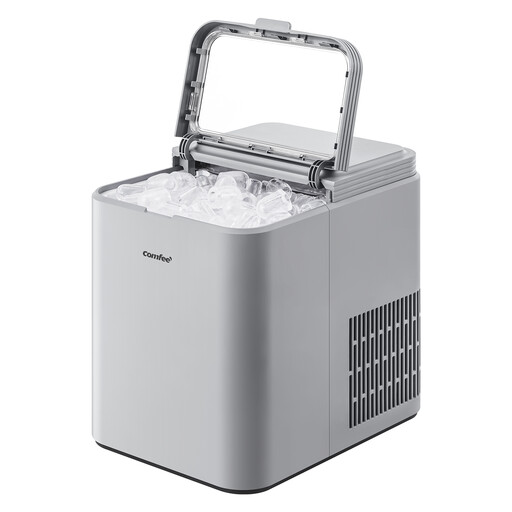
Why this product suits this profile: With its compact design measuring 295.7 × 213 × 295 mm, this appliance is suitable for kitchen worktops, offices and smaller households. According to the product specifications, it produces 8 ice cubes in around 6 minutes and up to 12 kg per 24 hours.
The product specifications state both the daily output and a 1.3-litre water tank and separate 0.4 kg ice basket. This makes it easier to assess production and storage capacity separately.
Two ice cube sizes, self-cleaning function, ice scoop and removable basket.
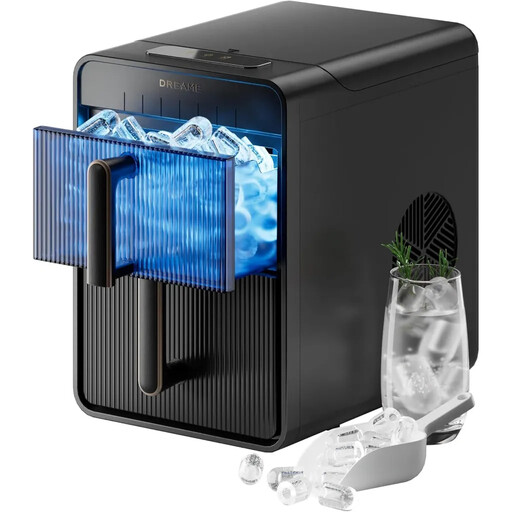
Why this product suits this profile: According to the product description, this model combines two ice cube sizes, touch controls, sensors for the water level and ice level, and a 1 kg ice basket. Its dimensions are 24.8 × 34.6 × 32.7 cm.
The specifications distinguish between cycle time, daily output and basket capacity. This makes planning easier when you regularly prepare drinks for several people.
Self-cleaning programme, touch display, 2.0-litre water tank according to the specification and a stated daily output of up to 15 kg.
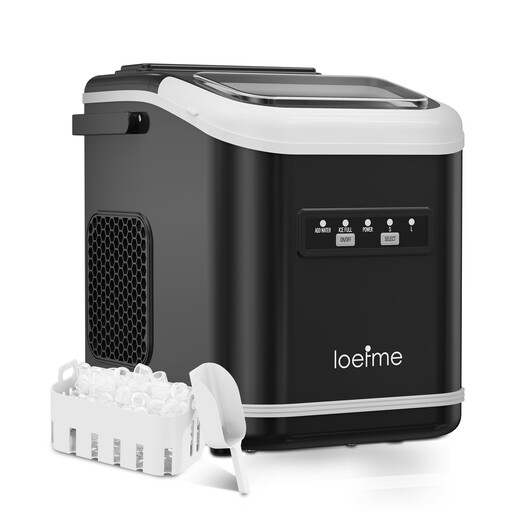
Why this product suits this profile: With a carrying handle, 1.4-litre water tank and stated weight of 6.4 kg, this appliance is designed for kitchens, motorhomes, camping and parties. According to the product specifications, it produces 9 bullet ice cubes in 6 to 13 minutes.
The stated noise level of 40 dB and the two sizes are useful comparison points for motorhomes, offices and extended use. Automatic cleaning reduces the number of additional steps required.
Up to 12 kg of production per 24 hours, S/L selection, carrying handle, ice tray and ice scoop according to the product description.
We have put together a complete, regularly updated list of products that fully meet these strict selection criteria and the safety regulations applicable in the EU.
Ongoing costs consist of electricity, water and, where necessary, cleaning products. Electricity consumption depends on compressor output, ambient temperature and operating time. A general monthly estimate is therefore not reliable without a specific consumption figure and electricity tariff. Check the energy data sheet or the manufacturer's stated power consumption.
To extend the appliance's service life, empty the water tank after use, dry the ice basket and do not leave the appliance standing with water in it for prolonged periods. The ventilation openings must remain unobstructed. Unplug the appliance before cleaning; the appliance, cable and plug must not be immersed in water.
Many compact appliances state that the first batch is ready after around 6 to 13 minutes. The actual time may vary depending on room temperature, water temperature, ice cube size and the condition of the appliance.
This depends on the appliance's electrical power consumption and operating time. For a clear estimate, multiply the power in kilowatts by the operating hours and your electricity price. Daily output in kilograms is not a direct measure of electricity consumption.
It is not possible to give a reliable fixed service life for every model. Regular cleaning, drinking water, sufficient ventilation, a level surface and following the user manual can help support reliable operation. If you notice unusual noises, leaks or error messages, stop using the appliance and contact customer service.