
Lieferung heute & morgen

Qualitätsgarantie

Willkommens-Angebote freischalten: KOSTENLOSE Lieferung | Bis zu 80 % RABATT | Kostenlose 30-Tage-JoyPlus-Testphase
App herunterladen
An ice maker can quickly provide a fresh supply of ice in the kitchen, office, motorhome or at a party. According to many product specifications, some models produce their first bullet ice cubes in as little as 6 to 13 minutes. However, water tank capacity, daily output, ice basket capacity, noise level and cleaning programmes can vary considerably.
To avoid a disappointing purchase caused by exaggerated marketing claims or impractical details, it is worth looking at the parameters that genuinely matter. The following recommendations from the Joybuy Product Recommendation Officer provide an objective overview of the most important features for different usage scenarios.
Claims such as “12 kg in 24 hours” or “up to 24 kg per day” describe a theoretical production volume under specific conditions. They do not mean that this quantity can fit continuously into the ice basket. A small storage basket must be emptied regularly; otherwise, the ice maker will stop production via a sensor.
For occasional drinks, a portable ice maker with a daily output of 10 to 12 kg is often sufficient. For family gatherings or frequent use, a larger model with greater water and ice capacity may be the better choice.
With some models, the first batch of bullet ice cubes may be ready after approximately 6 minutes. Subsequent cycles take longer depending on room temperature, water temperature and the selected ice cube size. In warm rooms, poorly ventilated motorhomes or direct sunlight, production times may increase.
Finding a fast ice maker therefore involves more than simply checking the number of minutes stated. Adequate clearance around the ventilation openings and a suitable location are equally important.
An automatic cleaning programme can help clean the water path and interior, but it does not replace emptying, drying and occasional wiping. Any remaining water should be removed after use. Only clean drinking water should be added to the tank; other liquids may damage the machine or affect ice quality.
Many models produce hollow bullet ice cubes. This shape is common among compact ice makers and is suitable for soft drinks, water, coffee or mixed drinks. Check the stated output per cycle, such as 9 ice cubes every 6 to 10 minutes.
An ice maker with two ice cube sizes offers greater flexibility: smaller cubes are ideal for quick chilling, while larger variants may be more practical for certain drinks. The selected size also generally affects cycle duration.
A 1.2- to 1.5-litre tank saves space but requires more frequent refilling. Models with capacities of 2.0 to 3.2 litres are better suited to longer operating periods. The ice basket should not be confused with a freezer compartment: the cubes remain chilled there, but may become softer over time depending on the room temperature.
Also check whether the machine has an ice-full sensor and a low-water indicator. These features reduce the need for frequent checks.
Measure your available worktop space before buying. Compact models, for example, may be around 21 to 25 cm wide and approximately 30 to 37 cm deep. For camping and motorhome use, weight is also important: models weighing around 6 to 8 kg are easier to reposition when fitted with a carrying handle.
The machine requires a stable, level surface, a grounded power outlet and sufficient clearance for ventilation. In a motorhome or tent, it should only be operated if the power supply and operating environment comply with the manufacturer’s specifications.
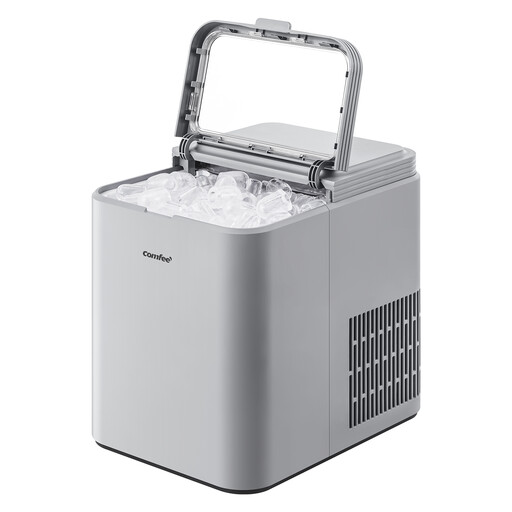
Why it is a good fit: With a 1.3-litre water tank, compact dimensions and two ice cube sizes, this model is designed for everyday use in the kitchen, office or smaller households.
The specifications list daily output, tank capacity and footprint separately. This makes it easier to assess the space requirements realistically.
According to the product description: up to 12 kg of ice per 24 hours, first ice cubes after approximately 6 minutes, self-cleaning function and ice scoop.
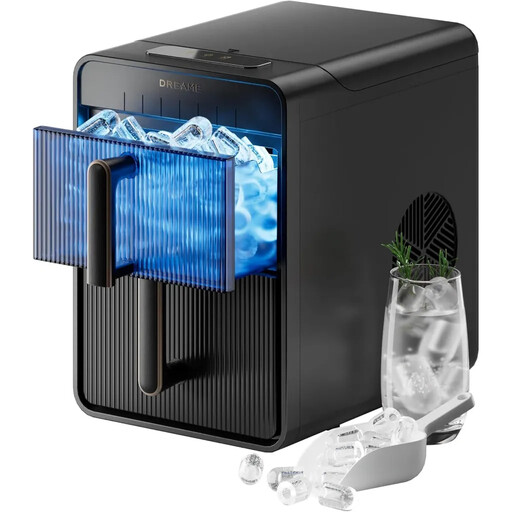
Why it is a good fit: This model combines two bullet ice sizes with touch controls, sensors for low water and a full ice basket, as well as a 2.0-litre water tank.
The product data specifies both cycle time and container and tank capacity. Nevertheless, the stated daily output should be understood as a manufacturer’s figure achieved under specific conditions.
According to the product description: first batch after approximately 6 minutes, up to 15 kg per 24 hours, 1 kg ice basket and 30-minute self-cleaning programme.
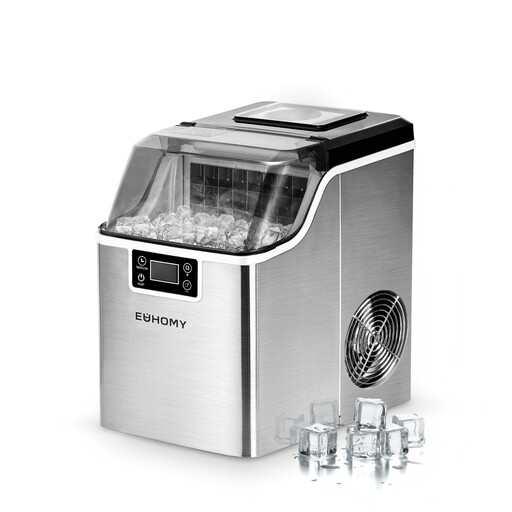
Why it is a good fit: The larger tank and higher stated production capacity make this model suitable for families, hosts, offices or anyone with a regular demand for ice.
The product description indicates temperature-dependent cycle times of approximately 13 to 25 minutes. This helps prevent unrealistic planning in warm conditions.
According to the product specifications: 3.2-litre water tank, up to 24 ice cubes per cycle, self-cleaning programme and two filling options.
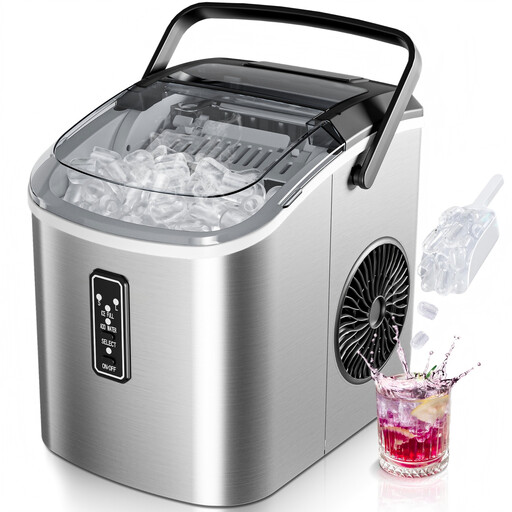
Why it is a good fit: A carrying handle, weight of approximately 6.3 kg, two bullet ice sizes and compact dimensions support mobile use in a motorhome, kitchen or at a campsite.
The specifications include weight, handle, noise level and tank capacity. This allows you to assess transport requirements and available space more accurately in advance.
According to the product description: approximately 12 kg daily output, operating noise below 45 dB, self-cleaning and warning indicators for water level and ice basket.
Power consumption depends on output, operating time, room temperature and the desired quantity of ice. An ice maker rated at 120 to 150 watts uses the corresponding amount of energy during active production; the actual cost depends on operating time and your individual electricity tariff. For occasional use, it is generally sensible to produce only the amount required and switch the appliance off afterwards.
Maintenance includes:
For an appliance used while camping or in a motorhome, you should also check the mains voltage, available installation space and ensure that it is positioned securely in a dry location.
The complete selection, with up-to-date product data, enables you to compare different appliances and features directly for use at home, in the office or on the go.
Service life depends on build quality, maintenance, operating duration and adequate ventilation. A compressor-powered appliance should not be operated continuously without breaks unless the operating instructions specifically permit this. Regular emptying, drying and descaling in accordance with the manufacturer’s instructions can help maintain reliable operation.
Costs can only be calculated using the actual power consumption, operating time and electricity price. The wattage shown on the rating plate is an indication, but not a complete measure of consumption over an entire day. Using the machine only for drinks or individual events helps limit usage-related running costs.
Yes, provided that the model is compatible with the available power supply and is placed securely on a level, dry surface. The ventilation openings must not be obstructed. When camping, you should also plan for an adequate supply of drinking water and empty the water tank after use to prevent stagnant water.