Class organisers serving drinks
If you’re serving several drinks in quick succession, plan your ice supply and replenishment for each serving round rather than relying solely on a high daily output figure.


For a weekend cooking class, work out how much ice you need for each serving round, then check the production cycle and basket capacity. A daily output in kilograms alone won’t tell you how much ice will be ready at a particular time. Bullet ice makers are an option for everyday cold drinks, while nugget or clear ice makers may be a better fit if the ice shape is part of your drinks concept. Remember to allow time for production and cleaning, and check that you have enough space.
If you’re serving several drinks in quick succession, plan your ice supply and replenishment for each serving round rather than relying solely on a high daily output figure.
If you only start shortly before the class begins, compare the time to the first batch with the production cycles that follow.
If your drinks need a particular type of ice, check that it suits your plans and how much lead time the machine requires.
First, work out how much ice you need for each serving round. Then you can assess whether the time to the first batch, ongoing supply, cleaning, ice shape and footprint suit your class.
Suitable if: You need ice for everyday cold drinks throughout the class. Consider the first batch, cycle time and basket capacity together.
Consider: A stated daily output doesn’t tell you whether the basket will be full for a particular serving round. A full basket or empty tank can also interrupt production.
Suitable if: Small nugget-shaped pieces are an essential part of your drinks. MEDION describes this ice shape for its LIFE Nugget MD 11960 model.
Consider: Choosing your preferred ice shape doesn’t replace planning for basket capacity, cleaning and replenishment for each serving round.
Suitable if: Clear cubes or crushed ice are part of your drinks concept. Klarstein says its Kristall 10031891 takes 27 minutes to make the first small cubes.
Consider: Waiting times and features vary by model. The specifications for Kristall 10031891 don’t automatically apply to other machines.
| Buying priority | What to check | Who is this important for? |
|---|---|---|
| Enough ice for each serving round | Plan your drinks and portions; compare basket capacity, production cycle and options for refilling. | If I need to serve several drinks in quick succession, having enough ice at the right time matters. Around 29% of consumers would prioritise having ice ready for busy serving periods. |
| Ice ready when the class starts | Distinguish the time to the first batch from the duration and output of subsequent cycles. | If I only start preparing shortly before serving, I want to know when the first batch will be ready and how quickly more will follow. Around 23% of consumers would prioritise getting started in good time. |
| Cleaning and ease of use | Check for a removable basket, a drain for residual water and the steps in the cleaning instructions. | If the machine will be used repeatedly over the weekend, I want parts that are easy to access and a clear cleaning process. Around 18% of consumers would prioritise easy cleaning and handling. |
| The right ice shape | Check the specific model to see whether it makes bullet, nugget or clear cubes, or crushed ice. | A particular ice shape matters for the drinks I’m planning; I don’t want to have to make do with an unsuitable alternative. Around 18% of consumers would prioritise their preferred ice shape. |
| Available worktop space | Check the external dimensions and height, and allow access to the tank and ventilation where you plan to put the machine. | If ingredients and other appliances already take up space, I want to position the ice maker so it fits while remaining easy to use. Around 12% of consumers would prioritise the space available. |
A figure in kilograms per 24 hours doesn’t tell you how much ice will be in the basket for a particular serving round. Production may also stop when the basket is full.
Compare basket capacity and production cycles separately from the daily output, and plan how much ice you need for each serving round.
Unold describes the Freeze 48935 function as flushing the water circuit. The German Federal Institute for Risk Assessment points out that objects which appear clean can still be contaminated with microbes.
Check the manual to see which parts you can access and what additional cleaning steps are needed.
The ice shape and time to the first batch vary by model. A high daily output figure doesn’t tell you whether the machine suits your drinks or when your class starts.
Decide which drinks and ice shape you need first, then compare the production process for each model.
The 120-watt ice maker is a useful point of comparison for regular bullet ice production and planning when it will be ready.
The Freeze 48935 is an example of an ice maker with a residual-water drain and rinse function for repeated use.
The LIFE Nugget MD 11960 is an option if small nugget-shaped pieces are an essential part of your planned drinks.
The Kristall 10031891 is an example of a clear ice maker, while the IceFestival 10046440 makes both cubes and crushed ice.
The KB14 is a useful point of comparison for a 2.1-l tank and two selectable cube sizes.
This selection includes worktop machines for bullet ice, as well as models that make clear cubes or offer additional ice functions. For each model, check which types of ice, connection requirements and production figures are relevant to your needs.
 No image available
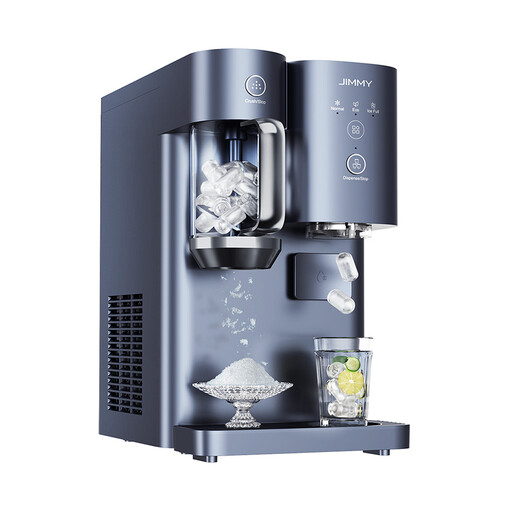
A good fit if you want clear cubes or crushed ice for your drinks and would like the ice dispensed straight into your glass.
The description lists clear cubes and crushed ice as selectable options. The machine cannot be used on its own and must be connected to a JIMMY Matrix M9 Pro water purifier.
 No image available
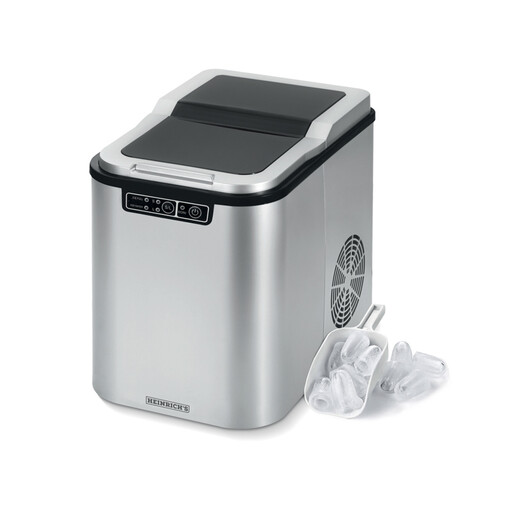
For regular batches of bullet ice, the product title states 9 ice cubes every 9 minutes.
The title lists two ice cube sizes, a 2.2-l water tank, a self-cleaning function and up to 12 kg of ice in 24 hours.
 No image available
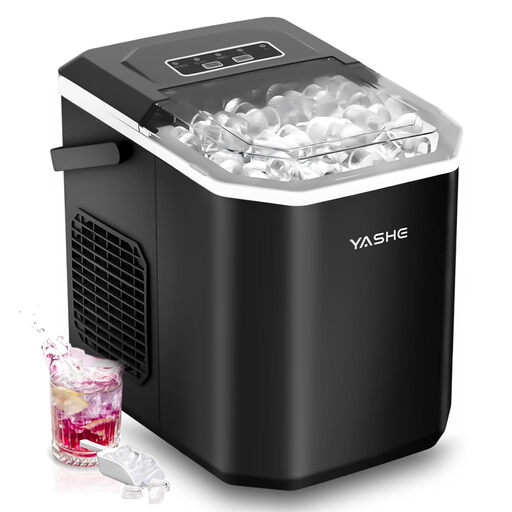
If you’d like to choose between two ice cube sizes for different drinks, the product title lists both options.
The title and description state that it makes 9 pieces of ice every 6 minutes. The title also lists up to 26 lb per day and a self-cleaning function.
 No image available
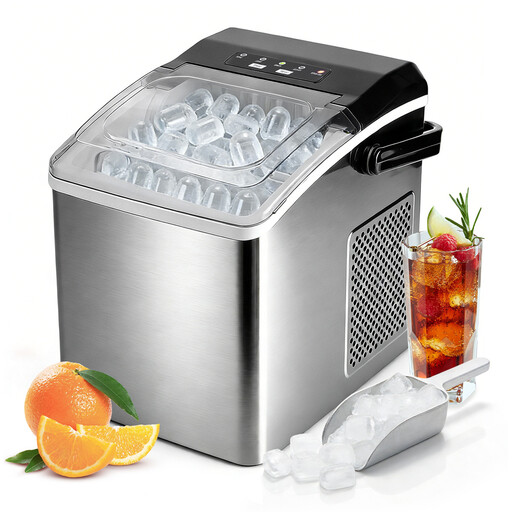
For regular batches, the description states that it makes 9 ice cubes every 6 minutes and offers two ice sizes.
The description lists a 1.3-l water tank, up to 12 kg per 24 hours, a self-cleaning mode, and indicators for a full basket and low water.
 No image available
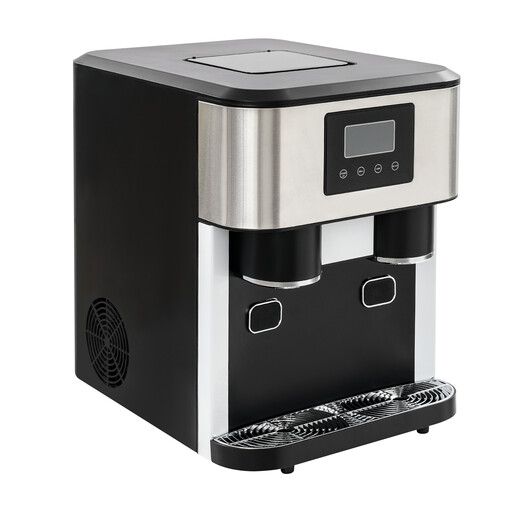
If you’d like crushed ice or chilled water as well as bullet ice, the description lists all three functions.
The description lists 16 bullet ice cubes every 7 to 9 minutes, a removable drip tray, and the option to fill it manually or connect it to a water supply.
Work out what you need based on the drinks you’re planning and the number of serving rounds. Compare this with the basket capacity and ongoing production. Without knowing the number of participants and the portion sizes, it isn’t possible to recommend a set quantity in kilograms.
The German Environment Agency recommends using fresh water from the cold tap when preparing food. The German Federal Institute for Risk Assessment points out that objects which appear clean can still be contaminated with microbes. Check the cleaning instructions for your specific machine: Unold describes the function on the Freeze 48935 as flushing the water circuit.
Regulation (EC) No 852/2004 sets out general hygiene rules for food business operators; for ice that comes into contact with food, Annex II specifies potable water. Whether this applies to your particular class depends on whether it is run as a food business. A machine’s features don’t exempt you from any hygiene requirements that may apply.
If a purchase is faulty, statutory consumer rights against the seller are separate from any voluntary guarantee. Electrical equipment must not be put in household rubbish; take it to an authorised return or collection point. Retailer take-back is subject to the applicable legal requirements.
The German Federal Network Agency lists CE marking, manufacturer details and German-language instructions among the points it checks when monitoring the market. A product listing title alone doesn’t prove that the specific machine has been assessed.