Hosts preparing an ice supply
If you want to have ice ready before your guests arrive, plan to make several batches and transfer them from the machine’s basket to the freezer in good time.


If you want ice ready before your guests arrive, plan separately for production capacity and basket capacity: MEDION points out that the daily production amount cannot be stored in the machine’s basket, so finished batches need to be transferred to the freezer for storage. For topping up during the evening, you’ll also need to consider cycle time, basket capacity and a suitable place to set up the machine. If you only need a small amount and can prepare it in advance, ice cube trays could be an alternative to buying another appliance.
If you want to have ice ready before your guests arrive, plan to make several batches and transfer them from the machine’s basket to the freezer in good time.
If you’ll be mixing more drinks while your guests are there, it’s worth considering how reliably you can make more ice, how long each cycle takes and when you’ll need to empty the basket.
If you’re planning to use a worktop that’s already occupied, check the machine’s dimensions, its setup requirements and the size of its ice basket.
A good fit if: you want to have plenty of ice ready before your guests arrive and have space in the freezer.
Bear in mind: you’ll need to remove batches repeatedly and freeze them separately.
A good fit if: you only need ice when mixing drinks and can leave the machine on the worktop.
Bear in mind: the first batch won’t replace a supply you’ve prepared in advance.
A good fit if: you only need a small amount, have plenty of time to prepare it and don’t want another appliance.
Bear in mind: you’ll need freezer space for the trays and time to fill them in advance.
When preparing an ice supply, production capacity and basket capacity are two different things. MEDION recommends removing finished ice from the machine’s basket and storing it in the freezer.
| Priority | What to check when buying | Who it matters to |
|---|---|---|
| Ice ready before guests arrive | Compare production capacity and ice basket capacity separately, and make sure you have freezer space. | If I want ice ready before my guests arrive, I’ll plan to remove and freeze several batches. Around 29 % of consumers put having an ice supply ready at the top of their list. |
| Topping up during the evening | Consider cycle time, the amount made per cycle and basket capacity together. | If you’re serving drinks while your guests are over, consider how often a new batch will be ready and when you’ll need to empty the basket. Around 23 % of consumers prioritise being able to make more ice as they go. |
| Space and setup | Check the dimensions and setup instructions for the specific model variant. | If my worktop is already being used for ingredients, I want to know whether there’s enough room for the appliance and the required clearance. Around 18 % of consumers put finding a suitable place to set it up at the top of their list. |
| Drinking water and cleaning | Check the care instructions and access to the tank, basket and drain; only use drinking water that is safe and hygienic. | If you’re making ice for drinks, you’ll want to be able to drain and clean the appliance and its water system thoroughly after use. Around 18 % of consumers make care and cleaning their main priority. |
| Cost and effort | Weigh up how often you’ll use it and how much ice you need against using ice cube trays you already own. | If I only need a small amount occasionally, I’ll weigh up buying another appliance against using trays and the freezer space I already have. Around 12 % of consumers put this effort at the centre of their decision. |
The stated daily production isn’t the same as the machine’s basket capacity. To build up a supply, you’ll need to remove finished batches and store them in the freezer.
Plan around the machine’s output over the period you need ice, as well as its basket capacity. MEDION specifically recommends freezing larger quantities separately.
Emptying the basket repeatedly takes time and uses up freezer space.
A short time to the first batch alone doesn’t tell you how much ice will be available throughout the evening.
Also compare the amount made per cycle, basket capacity and production over the period you’ll need ice.
For the KLAMER Ice Maker 120 Watt, the manufacturer specifies a minimum clearance of 20 cm all around the appliance. This applies to the model mentioned and shouldn’t be assumed to apply to other machines.
For the specific variant, check the dimensions as well as the guidance on clearance, heat sources and plug sockets.
If the spot isn’t suitable, you may have to move the appliance before your guests arrive.
The water-system rinse described for the Unold Freeze 48935 does not, by itself, demonstrate that the whole appliance is fully cleaned or disinfected.
Follow the care instructions for the specific model when draining and cleaning it, and check how easy it is to access the tank, basket and drain.
Even with a rinse function, allow time to drain and care for the appliance according to the instructions.
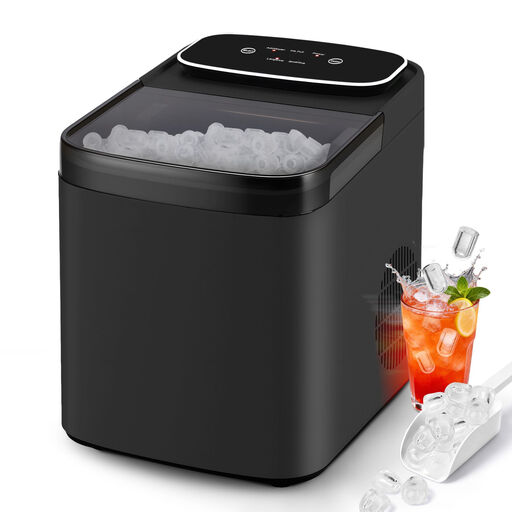
The 2-litre countertop machine described makes bullet-shaped ice in two sizes, making it worth considering if you’re planning to make batches one at a time.
The IceMaster Pro 3301 is listed with a 2.2-litre tank. Its production figures and footprint help you assess whether it’s right for your needs.
The Bartender Pro is worth comparing if its larger tank and removable ice container suit your plans.
The Freeze 48935 can be assessed by looking at its basket, tank, drain and water-system rinse specifications.
According to the manufacturer, the 120 Watt Ice Maker has a timer, makes two ice sizes and produces batches of ten cubes.
This Joybuy selection features countertop appliances for preparing several batches of ice before your guests arrive. Production figures and basket capacity should be considered separately: daily figures don’t tell you how much ice the machine can hold at one time.
 No image available
Two selectable ice sizes could be useful if you want different-sized cubes for different drinks.
The product title lists two ice sizes and a self-cleaning function. A cleaning function doesn’t replace following the care instructions.
 No image available
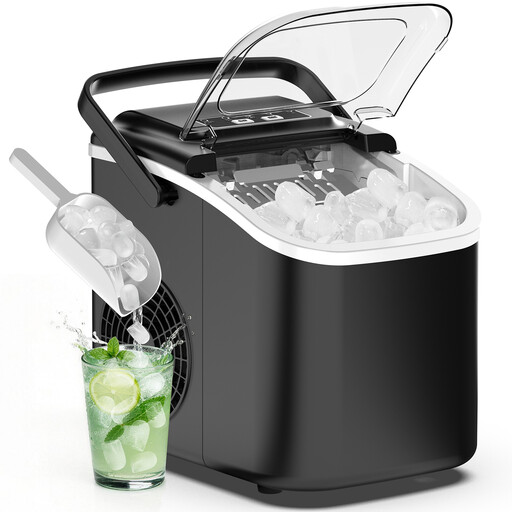
The stated daily capacity is a useful figure when planning how much ice to make over time, not how much will fit in the basket at once.
The title lists up to 12 kg per 24 hours, eight cubes in six minutes, two ice sizes and a food-grade inner container.
The product description also lists a self-cleaning function; check the care instructions for the specific appliance.
 No image available
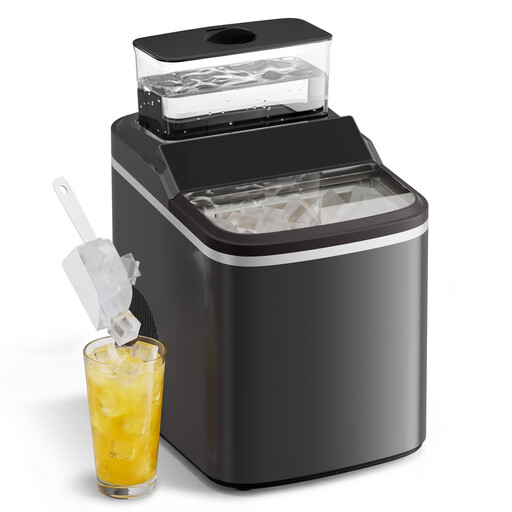
An external tank and stated ice basket capacity can be useful when planning several batches; daily capacity shouldn’t be confused with storage capacity.
The title lists a 1.5 l external water tank, a 0.75 kg ice basket, twelve cubes every 8–15 minutes and up to 18 kg per 24 hours.
The product description also lists a preset selection and automatic cleaning.
 No image available
The cycle and basket details help you plan repeated batches for your guests; daily capacity isn’t a measure of how much ice can be stored.
The title lists up to 14 kg per 24 hours, nine spherical ice cubes every 6–10 minutes, a 1.2 l water tank and a 0.5 kg ice basket.
The product description also lists two ice sizes and an automatic cleaning function.
 No image available
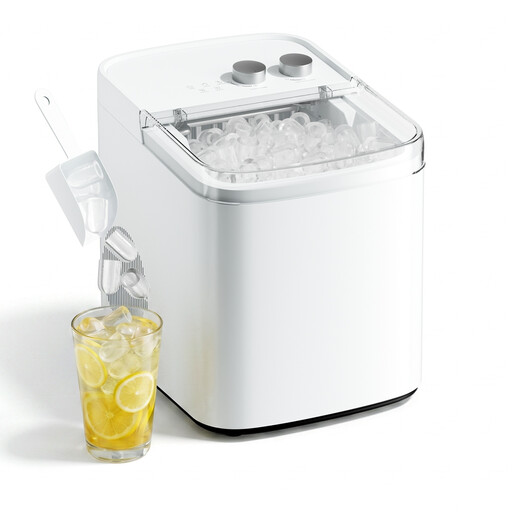
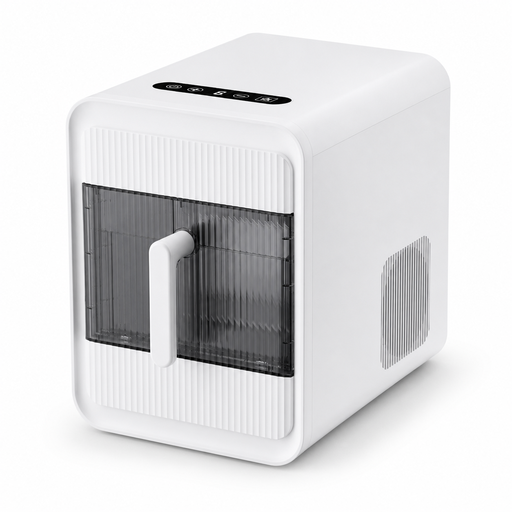
A removable ice drawer can make it easier to take out batches you’ve prepared in advance; remember to consider the space available where you’ll set up the appliance.
The product title lists a 1.5 l water tank, an infrared sensor, a touch control panel and a removable ice drawer.
The product description also lists a self-cleaning function and a white finish.
No. The amount produced over 24 hours isn’t the same as the machine’s storage capacity. MEDION points out that larger quantities need to be removed from the basket and put in the freezer to build up a supply.
Use drinking water that is safe and hygienic. The German Environment Agency recommends using fresh water from the cold tap when preparing food. If you’re unsure about your home’s plumbing, have its condition checked. Also follow the appliance’s instructions.
No. Unold describes the function on the Freeze 48935 as rinsing the water system; this doesn’t prove that the whole appliance is disinfected. Follow the instructions for the specific model variant when draining and cleaning it.
No. According to EU guidance, the manufacturer uses the CE marking to declare that the product meets the relevant requirements; there is no central EU body that issues a general CE certificate. Separate EU rules also apply to materials that come into contact with food.
Don’t put electrical appliances in your household rubbish. The German Environment Agency lists options for separate disposal, including a recycling centre or suitable take-back points at retailers.