What to look for when buying
Compact countertop ice maker
A good fit if: You want to make more ice regularly and have limited space where you plan to put the machine.
The trade-off: The models listed by ritterwerk and CASO have 0.8-l and 1-l tanks respectively, so you may need to refill them more often.
Larger countertop ice maker
A good fit if: You want to avoid frequent refills and have more worktop space available.
The trade-off: CASO lists a 2.2-l tank for the IceMaster Pro 3301, with the appliance measuring 24 × 36 cm wide and deep.
Ice cube tray in the freezer
A good fit if: You only need ice occasionally and already have space in your freezer.
The trade-off: A tray doesn’t need extra worktop space, but you’ll need to plan ahead and set aside room in the freezer.
When making fruit drinks with limited worktop space, the key considerations are where the machine will go, how quickly you can make more ice, maintenance and how often you’ll use it.
| What matters |
What to check when buying |
Who it matters to |
| Footprint and where you’ll put it |
Check the width, depth and height, as well as the lid opening, socket location and clearance required around the machine according to the instructions. |
If I have limited worktop space, I want to make sure the depth, lid opening and clearance will all fit too. Around 40% of consumers prioritise finding a suitable spot for the appliance. |
| A quick supply of ice |
Consider the amount of ice per batch, cycle time, tank and how to remove the finished ice separately. |
If I’m making several fruit drinks, I want to know when the next usable batch will be ready, not just the daily output. Around 30% of consumers prioritise a quick supply of ice. |
| Water and cleaning |
Check the cleaning instructions, water drain and removable parts; use fresh water that’s suitable for drinking. |
If I regularly make ice for drinks, I want to be able to maintain the water and accessible parts properly, following the instructions. Around 20% of consumers prioritise maintenance and water hygiene. |
| Occasional use |
Consider how often you’ll use it and how much freezer space is actually available before choosing a machine. |
If I’m only chilling a single glass now and then, I don’t want to fit another appliance on the worktop. I can plan ahead, as long as there’s room in the freezer. Around 10% of consumers prioritise an option that doesn’t need an extra appliance. |
Brands and models to consider
The details below relate to the models and product ranges listed; they aren’t a general assessment of the brands or a statement about availability.
ritterwerk
The BEEZER IceCube mini 952000 is designed for particularly narrow spaces.
- According to ritterwerk, the machine is 18.5 cm wide, 30.5 cm deep and 27.5 cm high. The tank holds 0.8 l; it also has two ice sizes and a self-cleaning function.
- The small tank may mean more frequent refills. Also check access to the lid and the clearance needed in the spot you have in mind.
CASO Design
The IceChef Compact and IceMaster Pro 3301 differ in areas including tank capacity and the space they take up.
- CASO lists a 2.2-l tank for the IceMaster Pro 3301 and appliance dimensions of 24 × 36 cm wide and deep. The technical table gives dimensions of 220 × 265 × 280 mm for the IceChef Compact.
- On the same CASO product page, the description gives different dimensions for the IceChef Compact—240 × 269 × 282 mm—and a different weight from the technical table. If space is tight, clarify the dimensions before buying.
Klarstein
The IceCraft 10046189 is a countertop ice maker for drinks.
- Klarstein lists a 1.3-l water tank, two ice sizes and an automatic cleaning programme.
- Before buying, check that the actual dimensions of the specific version fit the space you have available.
Arendo
The 2-l ice maker is an option to consider if you’re making several drinks.
- F.A.Z. Kaufkompass reports a measured cycle time of 6 minutes and 22 seconds for the 2-l version. This test result applies to the model tested.
- According to the test update dated 13 July 2026, the 1.8-l version was removed from the test because it was unavailable. Don’t assume it’s the same as the 2-l version.
Joybuy products
The following Joybuy models are countertop ice makers for drinks. Compare their external dimensions, tank capacities and batch figures with the space you have and the amount of ice you need.
 No image available
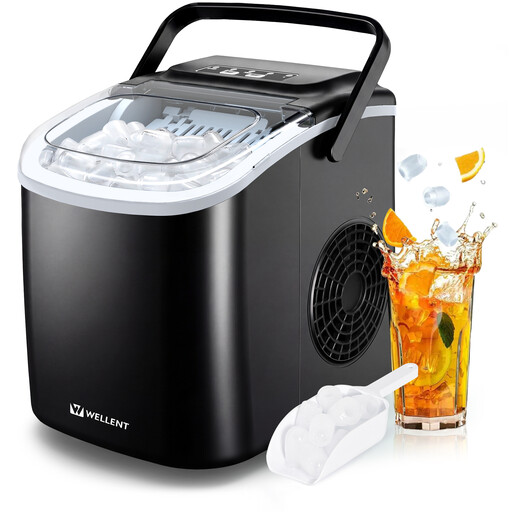
Ice maker with carry handle, 12 kg/24 h (Black)
The stated external dimensions make it easy to compare this model if you have limited space.
Dimensions: 20,2 × 28,1 × 26,4 cm. Water tank: 0,8 l; ice basket: 0,45 kg. The product title states 9 ice cubes in 6–10 minutes and a daily output of 12 kg/24 h.
View at Joybuy
 No image available
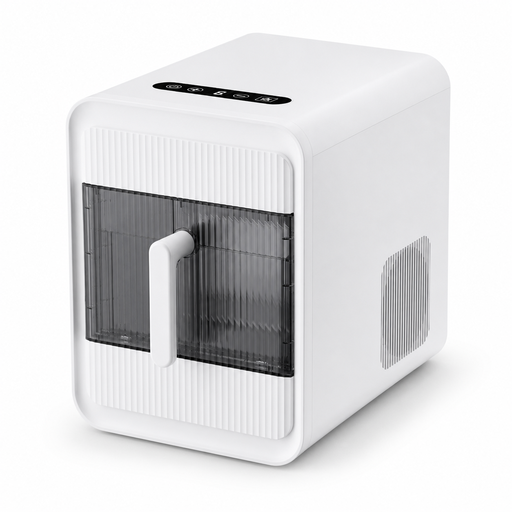
Compact ice maker (White), 1,5-l tank
The removable ice basket is useful if you want to portion out ice for drinks.
Dimensions: 230 × 292 × 300 mm. The tank holds 1,5 l; the product also lists square ice cubes and a first batch after 8–12 minutes. According to the product title, it has a control panel and a removable ice basket.
View at Joybuy
 No image available
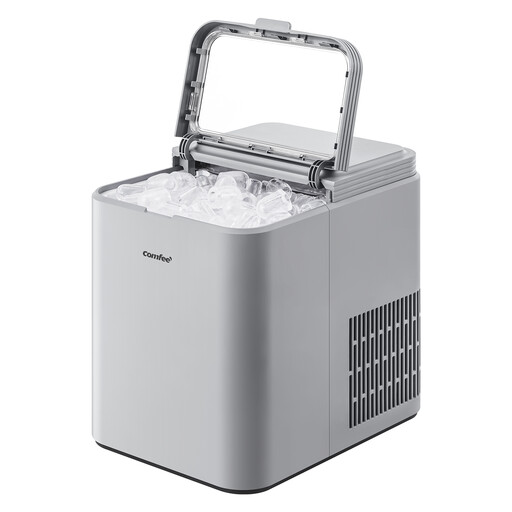
Comfee' RCI12GY1EU(E)
The stated dimensions and batch size can help you decide whether this model suits your worktop and the number of drinks you’re making.
Dimensions: 295,7 × 213 × 295 mm. The tank holds 1,3 l; the ice basket holds 0,4 kg. The listed specifications are 8 ice cubes in 6 minutes and two ice sizes.
View at Joybuy
 No image available
CONOPU countertop ice maker, 1,5-l tank
Check the external dimensions against your available space before choosing this model for a small worktop.
Dimensions: 35 × 23 × 30 cm. The tank holds 1,5 l. The product title lists 9 ice cubes in 6 minutes and two ice sizes; a basket and scoop are also included in the listing.
View at Joybuy
 No image available
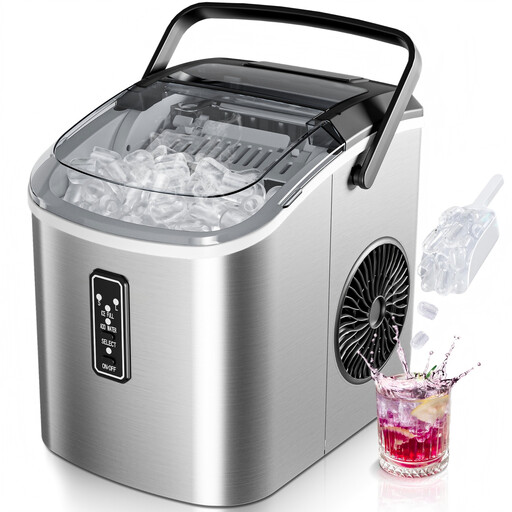
EUHOMY ice maker with 3,2-l tank
The larger tank may be useful when you’re making several drinks, but make sure the stated width of 36,6 cm will fit where you plan to put it.
Dimensions: 22,2 × 36,6 × 29,39 cm. The description lists 24 ice cubes in 13 minutes and a 3,2-l tank. The product information also states 9 ice cubes in 6 minutes; check which batch figure applies to the specific version before buying. According to the description, the 24 ice cubes made in one cycle are joined together and need to be separated by hand before use.
View at Joybuy
Frequently asked questions
How can I check whether an ice maker will fit in my small kitchen?
Measure the width, depth and height, and allow for access to the lid, a socket and the placement instructions for the specific model. For the CASO IceChef Compact, the technical table and description give different external dimensions. If space is tight, clarify the measurements before buying.
Can I use tap water to make ice for drinks?
According to Germany’s Federal Environment Agency, fresh tap water in Germany is safe to drink in almost all cases. Check for any issues with your own plumbing, use only water that’s suitable for drinking and follow the appliance instructions.
Does the self-cleaning function mean I don’t need to clean the ice basket?
No. A self-cleaning function doesn’t automatically take care of every accessible part. CASO and ritterwerk list these functions on certain models; follow the relevant instructions for changing the water and cleaning the machine.
What are my rights if the appliance develops a fault?
If you buy from a business seller in the EU, European Union consumer information states that you have a legal guarantee of at least two years from the date you receive the goods. This is separate from any voluntary manufacturer’s warranty. Keep your proof of purchase.
Is the CE mark an official quality award, and where should I take an old appliance?
No. For products that must carry the CE mark under relevant EU rules, the manufacturer uses it to declare conformity. According to Your Europe, no central EU body grants general approval for this. In Germany, old electrical appliances must not go in household waste; they should be returned separately, for example to a recycling centre or an appropriate collection point.


