
Lieferung heute & morgen

Qualitätsgarantie

Willkommens-Angebote freischalten: KOSTENLOSE Lieferung | Bis zu 80 % RABATT | Kostenlose 30-Tage-JoyPlus-Testphase
App herunterladen
An ice maker can conveniently provide fresh ice for drinks, parties, offices, motorhomes and camping trips. Unlike a freezer compartment, a compact ice maker can produce its first batch within just a few minutes, depending on the model. However, advertised specifications are not always directly comparable.
Before buying, you should therefore assess which performance factors really matter in everyday use. A high daily output alone, for example, says little about how quickly the first batch will be ready or how much ice the collection basket can hold.
Specifications such as “12 kg in 24 hours” generally describe a theoretical figure under certain ambient conditions. Actual output may depend on room temperature, water temperature, ventilation and operating time. For drinks prepared at short notice, the production time per cycle is therefore equally important.
A device that produces nine bullet ice cubes in six to eight minutes may be more practical for a small household than a model with a higher daily output but longer cycles.
An ice maker with a water tank is convenient, but standing water should not remain in the appliance for extended periods. Even an ice maker with a self-cleaning function does not eliminate all maintenance. The water tank, ice basket and drain must be emptied and cleaned regularly in accordance with the operating instructions.
Use clean drinking water only. Cleaning agents, juices and other liquids should not be added to the water tank unless the manufacturer expressly permits this.
A noise rating of around 40 to 50 dB can provide a useful reference, but it depends on the measurement method and surroundings. The compressor, fan and vibrations may be perceived differently from one compact ice maker to another. For bedrooms, open-plan kitchens or offices, it is worth checking both the stated decibel rating and the surface on which the appliance will stand.
For everyday drinks, three specifications are particularly important:
The stated daily output is not a guaranteed continuous figure for every environment. Warm ambient air or insufficient ventilation can slow production.
Many appliances produce what are known as bullet ice cubes. These hollow, rounded pieces of ice are suitable for soft drinks, water, beer and cocktails. Two selectable sizes offer greater flexibility: smaller ice cubes chill liquids quickly, while larger versions may melt more slowly, depending on the drink.
If you need ice cubes for a particular glass shape or extended cooling, check the product images and dimensions carefully. A bullet ice cube is not the same as a traditional, solid cube made in a freezer compartment.
A larger water tank reduces the need for refilling, but it does not automatically make the appliance more compact. Measure the available surface area, including the required ventilation clearance. Ventilation openings on the sides or rear must not be obstructed.
For mobile use, weight, carrying handle, power supply and container size are also important. A portable ice maker is generally suitable for transport, but it should be operated on a stable, level surface. For camping and motorhome use, you should also check whether the appliance’s power requirements are compatible with the available electrical supply.
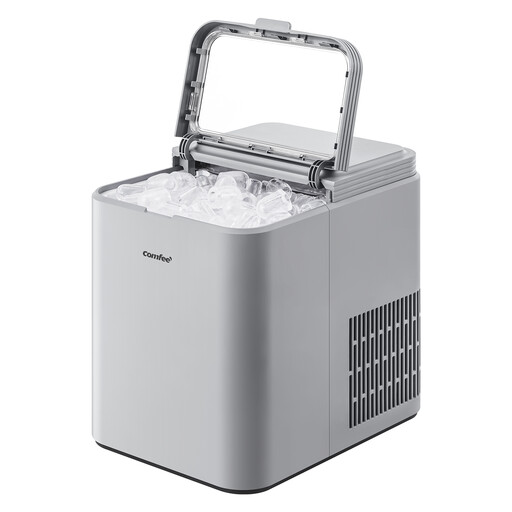
Why it fits the profile: This model combines a compact footprint with two ice cube sizes, making it suitable for kitchens, offices or smaller households.
The product specifications state both a first batch in around six minutes and a daily output of up to 12 kg. This makes immediate requirements and daily capacity easier to assess separately.
1.3-litre water tank, two ice cube sizes, self-cleaning function and dimensions of approximately 29.6 × 21.3 × 29.5 cm.
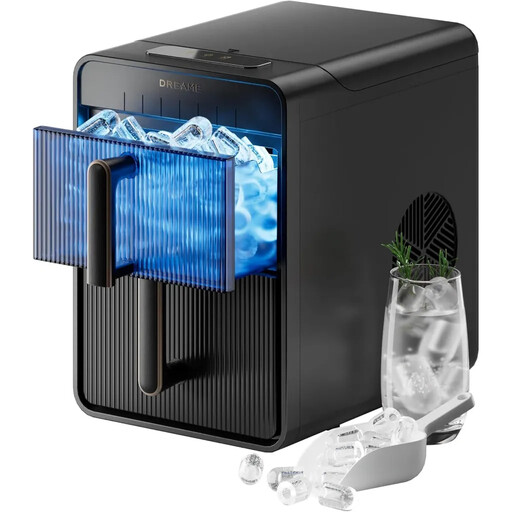
Why it fits the profile: The digital controls, larger ice basket and sensors appeal to users who regularly need ice at home.
The specifications distinguish between the first batch, produced in around six minutes, and subsequent cycles of approximately seven to nine minutes. This makes planning easier and more transparent.
Two ice cube sizes, 2.0-litre water tank, 1 kg ice basket, water and ice level sensors, plus a 30-minute self-cleaning programme.
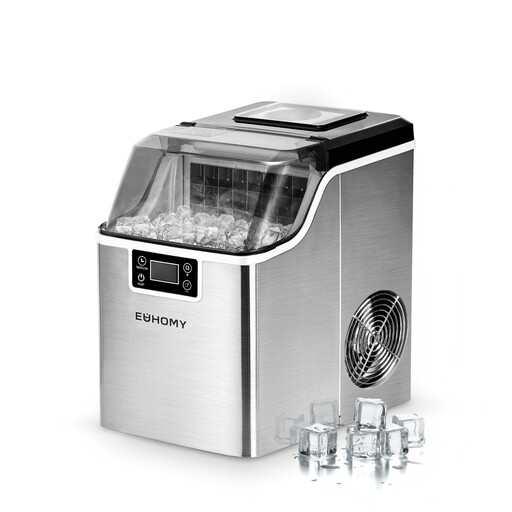
Why it fits the profile: The higher stated capacity and 3.2-litre water tank are designed for larger households, celebrations or moderate hospitality use.
The product description notes that the 24 ice cubes produced per cycle may be connected to one another. This should be taken into account before serving, using the included scoop.
3.2-litre water tank, up to 24 ice cubes per cycle, automatic cleaning, timer function and a stated noise level of approximately 45 dB.
The ongoing costs of an ice maker mainly consist of electricity, drinking water and, where applicable, cleaning requirements. Power consumption depends on the appliance’s output, ambient temperature, operating time and compressor efficiency. An accurate cost calculation is only possible using the specific model’s consumption figure and your own electricity tariff.
After use, we recommend:
An ice maker is not a freezer. The ice it produces will gradually melt in the basket and should be used promptly or transferred to a suitable freezer compartment.
Our complete selection includes additional models categorised by production volume, tank capacity, ice cube size and intended use.
Depending on the model and conditions, the first ice cubes are often ready after around six to ten minutes. Production may take longer in high room temperatures, with warm water or when ventilation is insufficient.
Service life depends on frequency of use, maintenance, water quality and compliance with the operating and safety instructions. Regular emptying, drying and cleaning can help reduce residue and odour build-up. Compressor or electrical circuit repairs should not be carried out yourself.
Many portable models are designed for kitchens, offices, camping and motorhomes. However, a stable, level surface, sufficient ventilation, drinking water and a compatible power supply are essential. Before use, you should also check the manufacturer’s specifications for ambient temperature and operating conditions.