People who make iced coffee together every day
If you regularly need ice in a shared kitchen, consider the water tank and ice basket separately, and agree who will refill the water, take out the ice and clean the parts.


If you only make iced coffee occasionally, ice cube trays in the freezer may be enough, provided you can plan ahead; F.A.Z. Kaufkompass also considers trays sufficient for the occasional cold drink. If you need ice at short notice or want to make several drinks in a row, a countertop machine may be more convenient. What matters is how long it takes to make the first batch, the actual basket capacity, cleaning, the space it takes up and how noisy it is. A high daily output doesn’t tell you how much ice the machine can hold at once.
If you regularly need ice in a shared kitchen, consider the water tank and ice basket separately, and agree who will refill the water, take out the ice and clean the parts.
If you want the first portion ready without having prepared a supply in the freezer, the time it takes to make the first batch matters more than the stated daily output.
If you share your worktop and plug socket with others, check the machine’s overall dimensions, the space needed to open it and remove the ice, and how noisy it is in use – not just whether it’s described as ‘compact’.
A good fit if: you only make iced coffee occasionally, can plan ahead and have freezer space.
The trade-off: you’ll need to have ice ready in advance for drinks you want at short notice or several portions at once.
A good fit if: you want to make ice for individual drinks without planning ahead and have limited worktop space.
The trade-off: with several people using it, a smaller tank or basket may mean refilling and emptying it more often.
A good fit if: several people make iced coffee in quick succession and there’s enough room to leave the machine set up.
The trade-off: according to the manufacturer, the Gastroback Bartender Pro 41143 has a 2,8-l water tank and a 1,5 kg ice basket, but its stated dimensions mean it needs space.
A good fit if: you specifically want small, nugget-shaped pieces of ice for your iced coffee.
The trade-off: choosing an ice shape is a matter of personal preference; a self-cleaning function doesn’t automatically replace the care recommended in the instructions.
When choosing a countertop ice maker for iced coffee in a shared kitchen in Germany, you’ll want to weigh up cleaning, refilling, space and the type of ice.
| Priority | What to look for when buying | Who is it important for? |
|---|---|---|
| Cleaning and shared use | Check the instructions, whether the basket can be removed and how easy it is to reach parts that come into contact with water. Agree who will look after the water, basket and scoop. A cleaning function doesn’t prove that the machine is germ-free. | If several people make iced coffee every day, I want to know who looks after the water, basket and scoop, so that sharing the machine is easy to manage. Around 36% of consumers put cleaning and shared use first. |
| First portion and replenishing the ice | Compare the time to the first batch, tank and basket separately. The manufacturer’s stated 6–13 minutes for the CASO IceMaster Pro 3301 is the preparation time, not the basket capacity. | If I make iced coffee on the spur of the moment or prepare several drinks in a row, I want to know when the first portion will be ready and how much ice I can take out. Around 29% of consumers prioritise a quick supply of ice. |
| Worktop space and noise in use | Check the machine’s dimensions, the space needed to open it and remove the ice, and where the plug socket is. The 50-dB figure for the SEVERIN EZ 7415 comes from the manufacturer and doesn’t reliably tell you how loud the machine will seem in your kitchen. | If I share my worktop with others or want to avoid noise, the machine needs to fit the available space and the way the kitchen is used. Around 21% of consumers put space and noise in use first. |
| Ice shape for iced coffee | Check the specific type of ice. According to COMPUTER BILD, there was little difference between the small and large cubes in its test of the CASO IceMaster Pro 3301. | If the shape of the ice matters in my drink, I want to know whether I’ll get bullet or nugget ice, and whether the selectable sizes are actually different. Around 14% of consumers prioritise ice shape. |
Daily output describes how much ice the machine makes over a longer period, not how much is available at once. MEDION explicitly distinguishes between the amount produced and the amount of ice that can be stored in the machine.
Compare basket capacity and production cycle separately. If you need to build up a supply, you’ll have to remove the ice and store it appropriately.
Building up a supply may mean emptying the basket and making room in the freezer.
In COMPUTER BILD’s test of the CASO IceMaster Pro 3301, there was little difference between the small and large cubes.
If the shape of the ice matters for your iced coffee, check findings for the exact model rather than relying on the number of selectable sizes.
A function built into the machine and cleaning removable parts are two different things. The German Federal Institute for Risk Assessment’s guidance on water dispensers doesn’t assess how effective the self-cleaning function is on ice makers.
Follow the instructions for your specific machine and agree who will look after the water, basket and scoop in your shared kitchen.
Emptying and cleaning take time, and when several people use the machine, it’s important to agree who’s responsible.
The IceMaster Pro 3301 is a bullet ice maker with two selectable sizes.
The Bartender Pro 41143 is worth considering if you’ll be taking out ice more often and have enough space for it.
The EZ 7415 is an option if its dimensions work for your shared worktop.
The LIFE Nugget MD 11960 is aimed at people who specifically want nugget ice.
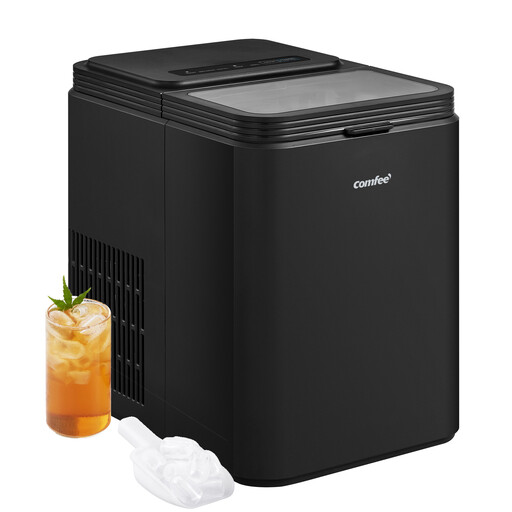
The products below are compact bullet ice makers for iced coffee on the spur of the moment. Compare the first batch, the tank and ice basket, cleaning and the space each machine takes up.
 No image available
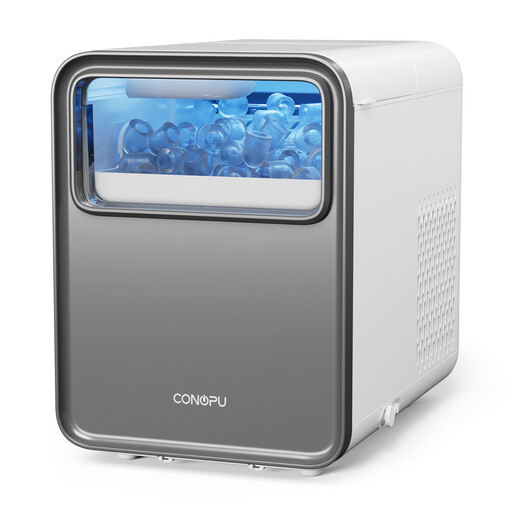
A good choice if you want bullet ice and a cleaning function for drinks made on the spur of the moment.
The title specifies 9 ice cubes in 6 minutes and a daily output of 12,02 kg. The product description states that the water tank holds 1,5 l; it also lists two sizes and a basket.
 No image available
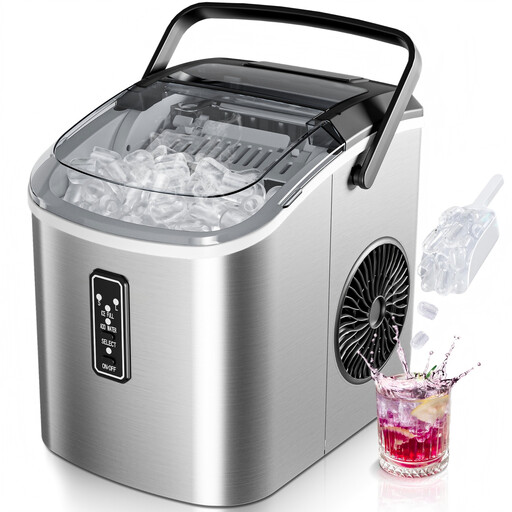
An option for drinks made on the spur of the moment, if you’re looking for a portable machine with a basket and self-cleaning function.
The title specifies 9 ice cubes in 6 minutes and 12 kg per day. The product description states that the water tank holds 1,5 l; it also lists two ice sizes and dimensions of 22,2 × 36,6 × 29,39 cm.
 No image available
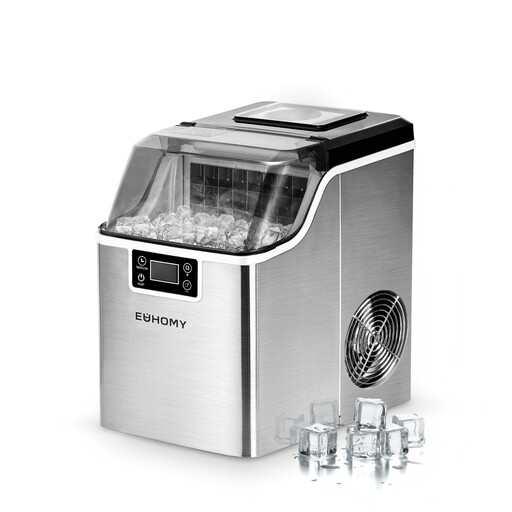
Worth considering if you want to make several ice cubes per cycle and can allow time to separate them by hand before use.
The title specifies 24 ice cubes in 13 minutes and a 3,2-l water tank. According to the product description, the cubes from each cycle are joined together and need to be separated by hand. The description says you can add water manually or using a bottle.
 No image available
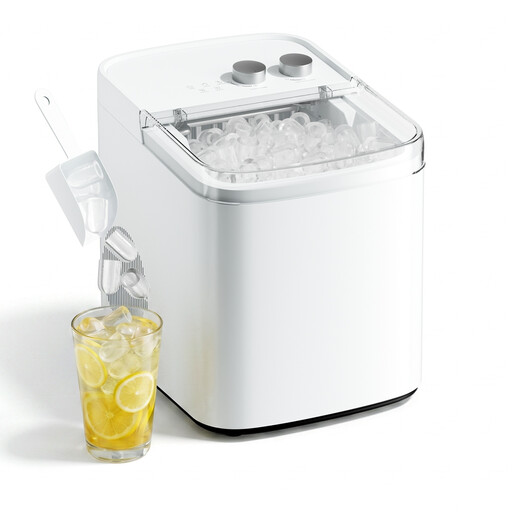
A compact option if a quick first batch and an automatic cleaning function are important to you.
The title specifies 9 ice cubes in 6–10 minutes and two selectable sizes. The water tank and ice basket are listed as 1,2 l and 0,5 kg respectively.
 No image available
A good choice if you’re looking for a compact bullet ice maker with a self-cleaning function for everyday use in the kitchen.
The title specifies 8 ice cubes in 6 minutes. According to the product description, the water tank holds 1,3 l and the removable ice basket holds 0,4 kg; the dimensions are 295,7 × 213 × 295 mm.
Compare the time to the first batch, the size of the ice basket and the water tank separately. Daily output assumes continuous production and removal; it isn’t the amount that can fit in the basket at once.
Don’t rely on this function alone. Check the instructions for the specific model and whether you can clean the basket, scoop and accessible parts that come into contact with water. The German Federal Institute for Risk Assessment recommends following the manufacturer’s care instructions for water dispensers; this isn’t a cleaning guide for a specific ice maker.
To compare electricity costs, you need a consumption figure in kWh that reflects how often you’ll use the machine, as well as your electricity price in €/kWh; the wattage alone won’t tell you what it costs to run. Also check the repair and warranty information for the specific model. SEVERIN’s product page explicitly states that no repair service is available for the EZ 7415.
No. According to information from Germany’s Federal Ministry for the Environment, old electrical equipment must be handed in separately, for example at local collection points or authorised retailers. A retailer’s take-back obligation depends, among other things, on the size of the retailer, the dimensions of the appliance and, in some cases, whether you’re buying a new one. The amendment to the German Electrical and Electronic Equipment Act, which came into force on 1 January 2026, also changed the labelling of take-back points.
No. For products that must carry a CE mark under the relevant EU rules, the manufacturer uses it to declare that the product complies with those requirements. According to the EU’s Your Europe information page, there is no central body that issues a general CE certificate. Read the product and manufacturer information rather than treating the CE mark as an independent quality test.