
Lieferung heute & morgen

Qualitätsgarantie

Willkommens-Angebote freischalten: KOSTENLOSE Lieferung | Bis zu 80 % RABATT | Kostenlose 30-Tage-JoyPlus-Testphase
App herunterladen
A constant supply of fresh ice cubes can be the difference between a lukewarm drink and a perfectly chilled refreshment. Whether for a spontaneous garden party, your daily iced coffee, or as an indispensable companion in your RV, a home ice maker promises convenience at the push of a button. However, the market is filled with devices whose promotional claims often suggest more than the technology can deliver. Before you make a decision, it's crucial to understand the common pitfalls that can lead to an unsatisfying purchase.
As your Joybuy Product Recommendation Officer, I'm here to help you apply objective criteria and find a machine that precisely fits your needs.
Many buyers are guided by marketing headlines that often disappoint in practice. Pay close attention to these three points to avoid a bad purchase:
To make an informed decision, you should focus on measurable performance data rather than advertising slogans. The following three criteria are of key importance for most users.
Two figures are crucial here: the cycle time (e.g., 6–9 minutes per 9 ice cubes) and the total capacity per 24 hours (e.g., 12 kg). The cycle time indicates how quickly you can get the first small batch of ice—ideal for one or two drinks. The 24-hour capacity, on the other hand, is the indicator of the machine's performance during continuous operation, such as at a party. For a family or occasional guests, a capacity of around 12 kg per day is usually more than enough.
If you're looking for a portable ice maker for use when camping, in the garden, or in an RV, weight and dimensions are critical. A small ice maker should not only be compact but ideally also feature a sturdy carrying handle. Models weighing under 8 kg are easy to transport. Check the dimensions carefully to ensure the unit will fit on your countertop or in your camper's storage space.
A self-cleaning ice maker is not a luxury, but a necessity for hygienic, low-maintenance use. At the push of a button, a rinse cycle is activated that flushes the interior of the machine with fresh water, cleaning hard-to-reach lines. This not only saves time but also ensures your ice cubes always come from a clean environment. An additional drain at the bottom of the unit makes it easy to completely empty any residual water.
Based on objective product features, we have identified a few models that are particularly well-suited for specific use cases.
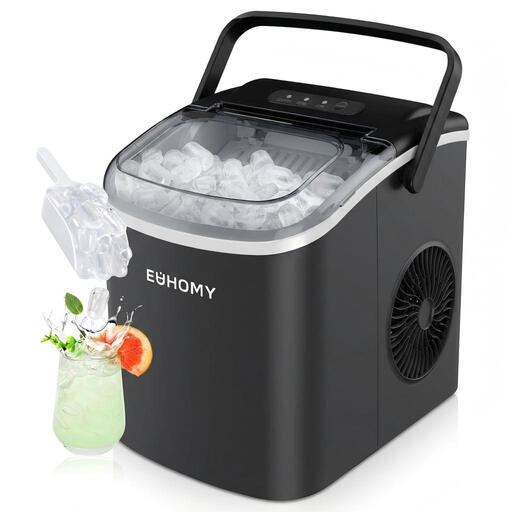
Why it's a match: Ideal for users who frequently entertain guests and need high, reliable ice production. The machine is designed for continuous operation to ensure a constant supply even when demand is high.
It avoids the "misleading production time" trap by offering a solid daily capacity of up to 12 kg (26 lbs according to the manufacturer) in addition to a fast initial cycle, ensuring a steady supply.
The combination of high production capacity and a self-cleaning function makes it a powerful and low-maintenance appliance for demanding home use.
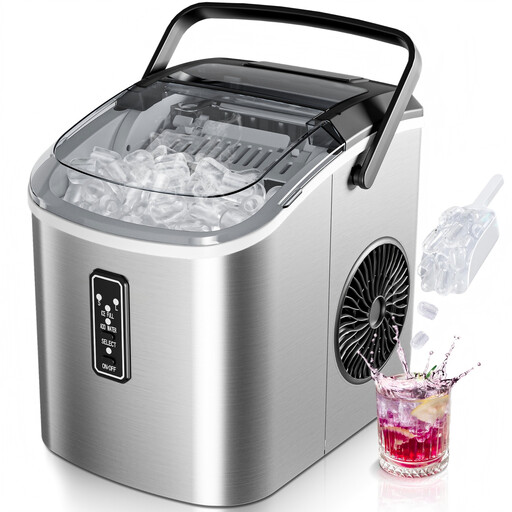
Why it's a match: Weighing just 6.3 kg and featuring an integrated carrying handle, this device is designed for maximum portability. Its compact dimensions make it the ideal ice maker for camping and use in RVs.
Directly addresses the "disruptive operating noise" pitfall. According to the manufacturer, the machine operates at under 45 dB, making it a relatively quiet ice maker that won't disturb the peace in your RV or tent.
Maximum portability thanks to its low weight and carrying handle, combined with quiet operation and the ability to produce two different ice cube sizes.

Why it's a match: Perfect for daily use in the kitchen. Its simple control panel, viewing window, and straightforward cleaning function make ice production a breeze, without having to deal with complex settings.
Solves the "neglected hygiene" problem with an easy-to-activate, 30-minute self-cleaning function. Indicators for low water and a full ice basket also minimize the need for monitoring.
Focus on user-friendliness: A clear control panel with just three modes and a transparent window for observing the ice-making process make operation exceptionally intuitive.
If the models featured here don't perfectly match what you're looking for, you can find more appliances in our main category. We've compiled an up-to-date list of products that meet objective selection criteria.
1. How long does it really take for an ice maker to produce usable ice? The stated time of 6 to 12 minutes refers to the first production cycle. These initial ice cubes are often smaller and softer. For solid, clear ice cubes that will cool drinks longer without melting quickly, you should allow the machine to run for two to three cycles. By then, the cooling system will have stabilized and will be operating at its most efficient.
2. How often does an ice maker with a self-cleaning function need to be cleaned? Even with a self-cleaning function, regular maintenance is important. It is recommended to change the water daily when the machine is in use. The self-cleaning function should be run every few days to once a week, depending on frequency of use and water hardness. Additionally, the ice basket and scoop should be cleaned manually on a regular basis.
3. What does the production capacity rating in "kg per 24 hours" mean? This figure is a theoretical maximum value determined under ideal lab conditions (constant operation, optimal water and ambient temperatures). In real-world home use, where the machine does not run continuously, the actual production amount will be lower. However, the value serves as a reliable benchmark for objectively comparing the basic performance and cooling power of different models.