Who is a countertop ice maker for?

Hosts short on worktop space

You’ll need a spot where the machine can be used during the party with its lid open and the required clearance around it. CASO Design’s instructions say that the IceChef Compact must not be built into a wall or fitted cabinet, and warn against placing it near strong heat sources.

Hosts who need plenty of ice

If you want to keep drinks supplied throughout the party, consider the production rate, water tank and ice basket separately. CASO Design states that the IceMaster Pro 3301 produces 500 g of ice per hour; Gastroback lists a 1.5 kg ice basket for the Bartender Pro 41143.

Those planning an ice reserve

If you want to have ice ready before your guests arrive, check how much finished ice the basket holds and, if needed, set aside separate freezer space. Daily output is not the same as the amount the machine can store at any one time.

What should you look for when buying?

Buying consideration What to check Who is this important to?
Footprint and location Check the width, depth and height, the space needed to open the lid, and the setup instructions for the specific model. CASO Design warns against fitting the IceChef Compact inside a cabinet. If I have limited worktop space, the machine needs to fit with its lid open and enough clearance around it; around 26% of consumers consider space requirements their top priority.
Keeping the ice coming during the party Look at the production rate or cycle time, as well as how often you’ll need to refill the tank and remove ice. CASO Design states that the IceMaster Pro 3301 produces 500 g per hour; Gastroback says the Bartender Pro makes nine ice cubes every 7–15 minutes. If I want to keep serving drinks with ice throughout the party, the rate of supply over the relevant period matters; around 26% of consumers prioritise a steady supply.
Having finished ice ready Check the basket capacity and, if you plan to make ice in advance, set aside separate freezer space. Klarstein lists a 0.6 kg capacity for On-The-Rocks, while Gastroback gives the Bartender Pro an ice basket capacity of 1.5 kg. If I want ice ready before my guests arrive, I need a plan for storing the finished ice; around 21% of consumers prioritise having an ice reserve ready.
Cleaning and water hygiene Check how easy it is to access the water tank and basket, and follow the cleaning instructions for the specific model. A self-cleaning programme does not automatically replace every other care step. If easy cleaning matters to me, I want to look after the water and accessible parts in line with the instructions; around 16% of consumers give this priority.
Operating noise Compare sound levels only when they are specific to the model and the measurement conditions are given; without comparable conditions, you can’t make a reliable comparison. If the machine will be running in a small kitchen close to guests, I want to take its operating noise into account when choosing; around 11% of consumers put this first.

Common planning mistakes

  • Assuming “12 kg per day” means that much ice is always available

    Klarstein states that On-The-Rocks can produce up to 12 kg per day, but its basket holds just 0.6 kg of finished ice. A daily output figure doesn’t tell you how much ice the machine can store.

    Plan production and serving around the basket capacity. If you want to make ice in advance, remember to set aside separate freezer space.

    Ice made in advance needs extra space for separate storage.

  • Confusing the water tank with the ice basket

    The Gastroback Bartender Pro has a 2.8 l water tank and a 1.5 kg ice basket. These figures describe different things and use different units.

    Consider how often you’ll need to refill the water separately from the amount of finished ice available in the machine.

  • Measuring only the footprint

    The lid, machine height and model-specific setup instructions may make a spot underneath a wall cabinet unsuitable.

    Measure the entire usable space and follow the instructions for the specific model.

Brands to consider

CASO Design

The IceChef Compact and IceMaster Pro models differ in areas such as tank capacity and the space they need.

  • CASO Design gives both models a rated production rate of 500 g per hour; their stated tank capacities are 1 l and 2.2 l respectively.
  • The IceChef Compact’s dimensions differ between listings on the product page. Check the measurements of the specific model before deciding where to put it.

Klarstein

On-The-Rocks is described as a countertop machine with a 2.1 l water tank and an ice basket for serving ice as it’s made.

  • Klarstein states that the first ice cubes are ready in 6–12 minutes and that daily production can reach up to 12 kg.
  • The basket holds 0.6 kg of finished ice, so daily production is not the same as the amount available in the machine at any one time.

Gastroback

The Bartender Pro 41143 is an option for households with room for a larger ice basket and a taller machine.

  • Gastroback lists an ice basket capacity of 1.5 kg and a water tank capacity of 2.8 l.
  • The manufacturer gives the machine’s height as approximately 430 mm; a larger ice basket doesn’t reduce the clearance needed above it.

Arendo

The 2 l ice maker is described as producing bullet-shaped ice continuously in two sizes.

  • Arendo states that it makes around nine large ice cubes in nine minutes.
  • A cycle time alone doesn’t tell you how much finished ice the basket can hold at once; also check the basket capacity and the space available for the machine.

Joybuy product options

Here you’ll find Joybuy product options for countertop ice makers, including machines for keeping the ice coming at parties. Before buying, check that the specific model meets the applicable requirements for electrical safety and food-contact materials. EUR-Lex describes these EU requirements, but this does not confirm that any individual listing complies with them.
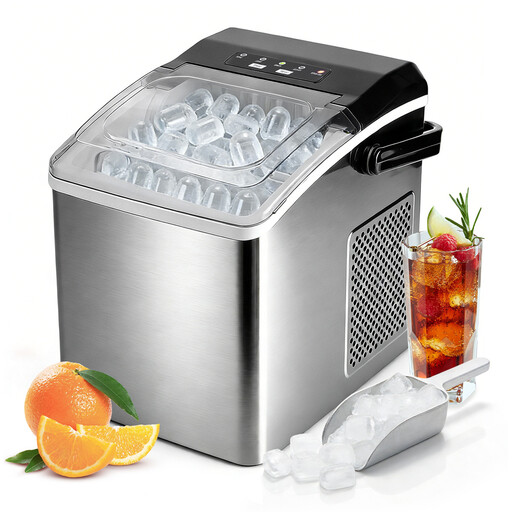
Countertop ice maker with handle and two ice cube sizes

Countertop ice maker with handle, 2 ice cube sizes

A good fit if you’d like to choose between two ice cube sizes during a party.

The title states that it makes 9 ice cubes in 6 minutes, produces up to 12 kg per 24 hours and has a 1.3 l water tank.

A self-cleaning mode is also listed; follow the care instructions for the specific model too.

View at Joybuy
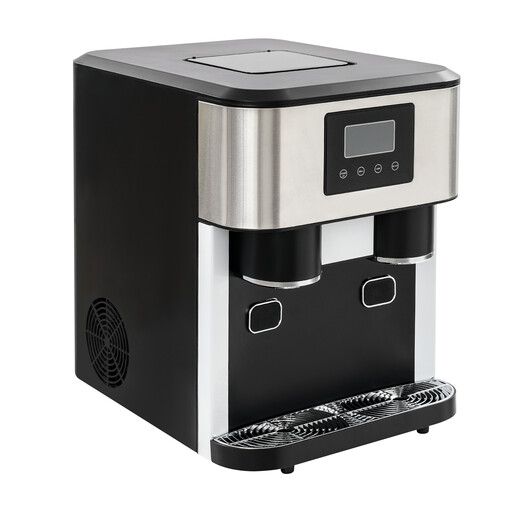
3-in-1 countertop ice maker

3-in-1 countertop ice maker

This combination may suit you if you’d like crushed ice and chilled water as well as bullet-shaped ice.

The product description states that it makes 16 bullet-shaped ice cubes per batch in 7–9 minutes, and also offers crushed ice and chilled water.

View at Joybuy
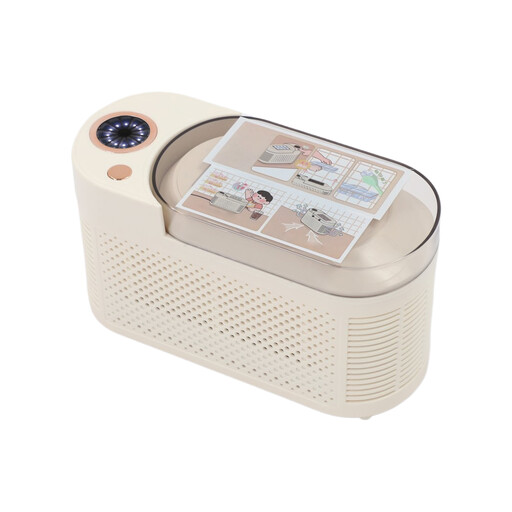
Portable ice maker, 120 W

Portable ice maker, 120 W

Worth considering if you’re looking for a machine with the power options described for use in different locations.

The description lists 8 square ice cubes per cycle, 100–230 V AC and 12 V for connecting it in a car. The title states 120 W.

View at Joybuy
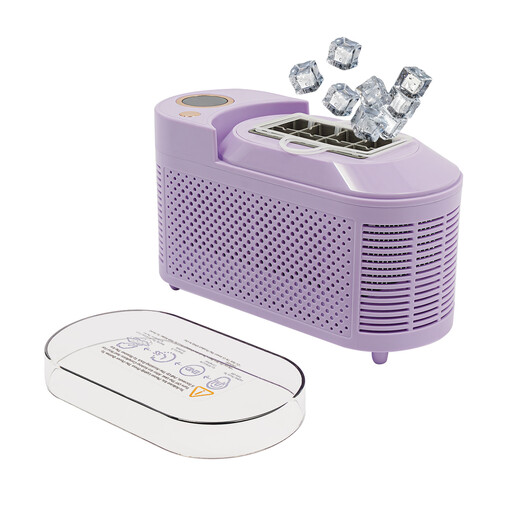
Portable ice maker producing 8 square ice cubes per cycle

Portable ice maker for 8 cubes

A good fit if you’re looking for an ice maker for the kitchen that, according to the description, can also be used in other locations.

The description lists 8 square ice cubes per cycle, 100–230 V AC and a 12 V car connection.

View at Joybuy
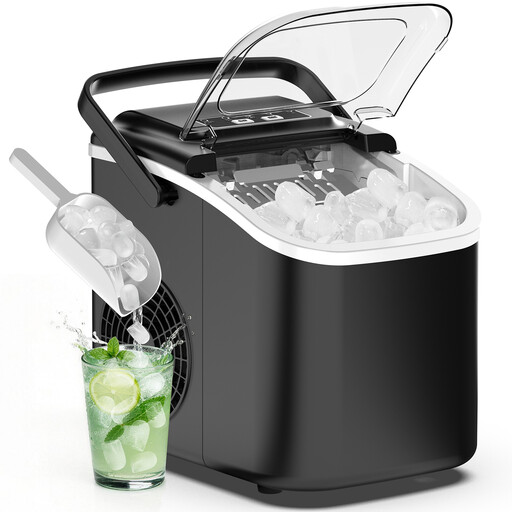
Ice maker with self-cleaning function and two ice sizes

Ice maker with self-cleaning function, 2 ice sizes

A good fit if you want to choose between two ice sizes and use the self-cleaning function described.

The title and description state that it makes 8 ice cubes in 6 minutes and produces up to 12 kg per 24 hours.

A food-safe inner basket and an ice scoop are also listed; follow the instructions for the specific model when using and caring for it.

View at Joybuy

Frequently asked questions

For a party, which tells me more: kilograms per day or ice per hour?

For a party lasting a few hours, the hourly production rate, together with the size of the ice basket, is a better guide to what you’ll actually need. CASO Design lists both 500 g per hour and 12 kg per 24 hours as manufacturer-rated figures for the IceMaster Pro 3301; the daily output doesn’t tell you how much finished ice is in the basket at any one time.

Can I put a compact ice maker inside a kitchen cabinet?

Not without checking the instructions for the specific model. CASO Design notes that the IceChef Compact is not designed to be built into a wall or fitted cabinet, and recommends keeping it away from strong heat sources.

Does a self-cleaning function mean I don’t need to do any other cleaning?

No. A self-cleaning function doesn’t mean you can skip all other care steps. Follow the cleaning instructions for your model and handle water hygienically; the German Federal Institute for Risk Assessment points out that visible cleanliness does not prove microbiological purity.

Which EU requirements apply to an electric ice maker?

Electrical equipment within the scope of the Low Voltage Directive must meet its safety requirements; the Directive covers rated voltages from 50 to 1,000 V AC. Materials and components intended to come into contact with water or ice for consumption must also comply with EU rules on food-contact materials. EUR-Lex describes these requirements, but this does not establish that any individual listing complies with them, so check the specific model.

What happens if a product bought from a business seller develops a fault?

As a rule, goods you buy from a business seller in the EU come with a legal guarantee of at least two years from the date you receive them. Your Europe explains that you should contact the seller first; a voluntary manufacturer’s guarantee is separate.