
Lieferung heute & morgen

Qualitätsgarantie

Willkommens-Angebote freischalten: KOSTENLOSE Lieferung | Bis zu 80 % RABATT | Kostenlose 30-Tage-JoyPlus-Testphase
App herunterladen
An immersion blender set is an indispensable tool for many home cooks and health-conscious households. It combines the functions of multiple kitchen appliances, saves space, and simplifies the preparation of soups, sauces, smoothies, or baby food. However, the selection of models is vast, and the differences are often in the details. This guide is designed to help you understand the key features and find a device that meets your needs. We will present objective criteria and a selection of models to support your purchasing decision.
Before you decide on a model, several technical and functional aspects should be considered. These criteria will help you better assess a device's performance and durability.
The motor power, measured in watts (W), is an indicator of the device's ability to process hard or tough ingredients. A powerful immersion blender with 800 watts or more can typically handle nuts, frozen fruits, or fibrous vegetables with ease. Variable speed control is just as important. Stepless or multi-speed settings allow for precise control over the texture—from coarsely chopped to finely puréed. An additional turbo function provides a short burst of power when needed.
The blending wand is the component that comes into direct contact with food. A stainless steel immersion blender is often the preferred choice here. Stainless steel is durable, rust-proof, does not absorb odours or stains, and is suitable for processing hot liquids like soups directly in the pot. Plastic versions are lighter but should always be declared BPA-free. Also, look for an ergonomic handle design and a sufficiently long power cord for flexible use in the kitchen.
An immersion blender with a chopper and whisk significantly expands its range of applications. Such sets, often referred to as a 4-in-1 hand blender, offer great versatility:
Check if the accessories are dishwasher-safe to simplify cleaning.
Here is a selection of models that cover different needs and applications. The descriptions are based on information provided by the respective manufacturers.
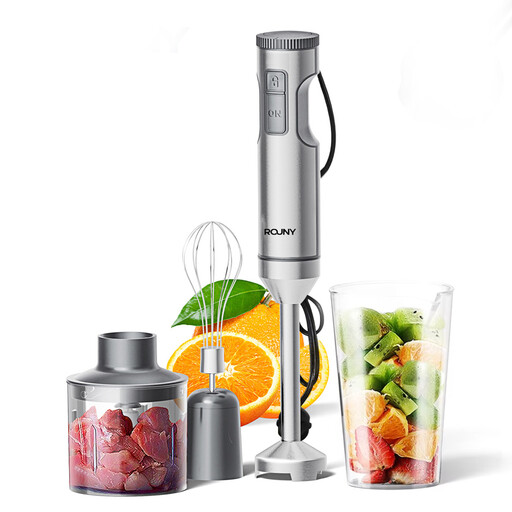
Why it stands out: This model from ROUNY is positioned as a versatile everyday appliance. With a maximum motor power of 1200 watts and a speed of up to 15,000 RPM, it is designed for a wide range of tasks. The set includes the four essential accessories, covering the basic needs of any kitchen.
Pros:
Best for: This set is a great choice for home cooks looking for a functional and powerful hand blender for soups and smoothies who also value a comprehensive accessory package for daily use.

Why it stands out: The Haier Series 5 immersion blender stands out with its high rated power and special blade system. It is designed for more demanding tasks and offers exceptional blending performance with its three blades.
Pros:
Best for: This model is aimed at users who regularly process demanding ingredients and are looking for a particularly powerful immersion blender with extended accessories like a potato masher.
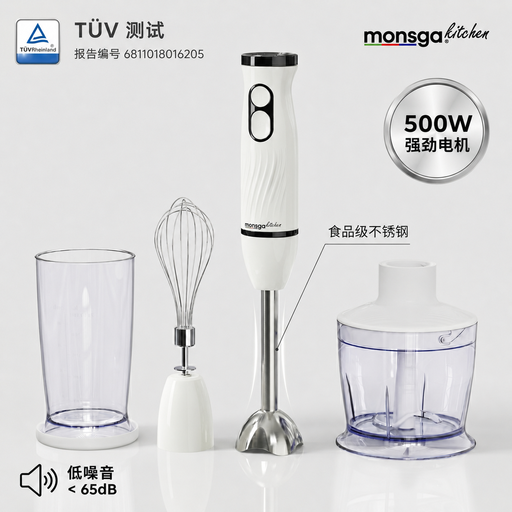
Why it stands out: The Monsga S100 places a special focus on clean operation and protecting your cookware. The design of the blending wand is engineered to minimise splashing and prevent scratches in coated pots.
Pros:
Best for: This device is ideal for users who place a high value on a clean kitchen and the protection of their pots and pans. It is well-suited for processing food directly in non-stick cookware.
The models presented here are just a small sample of the available range. If you are looking for other alternatives or specialised devices, you will find a larger selection in our broader category.
Discover more Food Blenders with Whisk Attachment here.
1. How many watts should a good immersion blender set have? For most everyday tasks like puréeing soups or making smoothies, a power output between 600 and 800 watts is sufficient. If you regularly plan to process hard ingredients like nuts, ice, or frozen fruit, a powerful immersion blender with 1000 watts or more is recommended.
2. Can you use an immersion blender to puree hot soup? Yes, as long as the blending wand is made of stainless steel. A stainless steel immersion blender is heat-resistant and can be safely used directly in hot pots. For plastic blending wands, you should check the manufacturer's specifications for maximum temperature resistance and, if necessary, let the soup cool down a bit.
3. What's the best way to clean an immersion blender set? Cleaning is usually straightforward. You can rinse the detachable blending wand under running water immediately after use. Many accessories, such as the beaker, chopper, and whisk, are dishwasher-safe. The motor unit must never be submerged in water; it should only be wiped with a damp cloth.