
Lieferung heute & morgen

Qualitätsgarantie

Willkommens-Angebote freischalten: KOSTENLOSE Lieferung | Bis zu 80 % RABATT | Kostenlose 30-Tage-JoyPlus-Testphase
App herunterladen
High-end ambient lighting can significantly enhance the driving experience and aesthetics of a vehicle's interior. What was once a pricey extra in luxury-class vehicles is now accessible to many through retrofit kits. However, the market is crowded, and not every product delivers on its promise. Before you make a decision, it's crucial to understand the common pitfalls that often only become apparent after installation.
Common Problems with Car Interior Lighting Retrofit Kits:
app-controlled ambient lighting, but the reality is often different. Connection drops, a confusing user interface, or limited features can quickly spoil the experience.To avoid these pitfalls, it's important to understand the technical fundamentals and apply the right selection criteria.
The quality of a retrofitted ambient lighting system depends on a few, but crucial, technical features. Focus on these three points to make an informed decision.
The method of light distribution is essential for a seamless, uniform appearance. There are two common technologies:
interior car light strips provide consistently uniform and often brighter illumination without any visible "hotspots." A particularly advanced feature here is RGBIC technology.An RGBIC LED strip for your car allows individual segments of the strip to be controlled independently, displaying different colors at the same time. This enables dynamic effects like color gradients or "chasing" lights, which are not possible with a standard RGB strip (which can only display one color at a time).
Operation should be intuitive and stable. Most high-quality kits offer Bluetooth control via a smartphone app. Key features to look for include:
The designations "5-in-1," "14-in-1," or "22-in-1" indicate how many separate light elements and control units are included in the set. A comprehensive kit can include not only strips for the dashboard and doors but also modules to retrofit footwell lighting, as well as lights for door handles, storage compartments, or even speaker covers.
Look for kits with one main controller and several sub-controllers. This modular system simplifies wiring, as the lights in the doors connect directly to a local controller instead of requiring all cables to be routed to the main control unit on the dashboard.
Based on the criteria above, we have identified several products that offer a suitable solution for different user profiles and requirements.
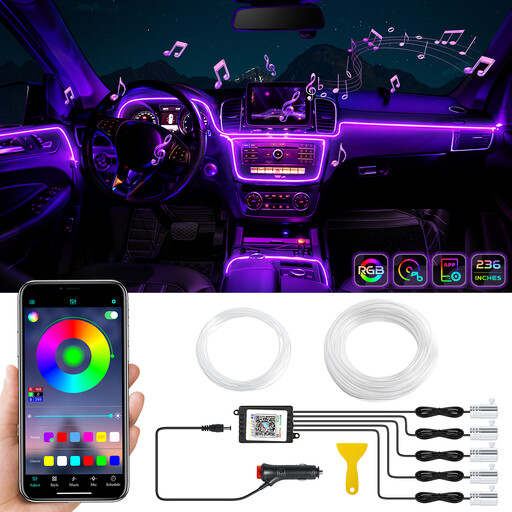
Why This Fits Their Persona: Ideal for users who want to get their first experience with ambient lighting on a small budget. The kit focuses on essential areas like the dashboard and center console and is easy to install by plugging it into the cigarette lighter.
The kit proactively addresses the typical weakness of fiber optic systems: the instructions recommend connecting an LED to both ends of a long strip to even out the brightness if the light appears dim.
Very accessible price point and a straightforward plug-and-play installation via the 12V socket. It is controlled by the widely used "Lotus Lantern" app.

Why This Fits Their Persona: Perfect for users aiming for a factory-installed look. The acrylic light pipes ensure absolutely even light distribution, while the RGBIC (Dreamcolor) technology enables dynamic color gradients for a modern, high-end atmosphere.
The acrylic technology with integrated LEDs completely eliminates the problem of uneven brightness. The dual-zone control via the app also allows for separate configuration of the dashboard and footwell, offering more control than simpler systems.
Uniform, bright illumination and dynamic RGBIC color effects. The 14-in-1 kit covers the dashboard, doors, door handles, and the footwell.

Why This Fits Their Persona: For the ambitious car enthusiast who wants a complete and seamless interior lighting setup. This kit leaves nothing to be desired, integrating lights for door storage bins and even speaker grilles in addition to the standard areas.
The modular system, with one main and four sub-controllers, prevents a complicated mess of wires. Each section of the vehicle is wired locally and syncs wirelessly, which keeps the installation manageable despite its extensive scope.
Maximum lighting coverage for a complete interior transformation. All components come from a single, perfectly coordinated system.
We have compiled a complete, up-to-date list of products that fully meet these strict selection criteria and comply with safety regulations.
Most entry-level kits are simply powered via the 12V cigarette lighter socket. More comprehensive kits, especially those with many components, are typically wired directly to the vehicle's fuse box. This allows for hidden wiring and often enables the lights to turn on automatically with the ignition. It is recommended to have the fuse box connection performed by a qualified professional.
Yes, most acrylic and fiber optic strips can be cut to size. However, with acrylic strips that have integrated LEDs, you must be careful not to cut through electronic components (like resistors). The product descriptions usually provide precise instructions on where cuts can be made without affecting functionality.
Regulations regarding vehicle lighting vary by region. In Germany, for example, the Road Traffic Licensing Regulations (StVZO) govern this. Interior lighting is generally permissible as long as it does not distract or dazzle the driver (§30 StVZO). Furthermore, the light must not shine outwards or confuse other road users. A subtly adjusted, non-flashing ambient lighting system is usually not a problem. However, it is advisable to check your specific local regulations before installation and to keep the lighting dimmed while driving.