
Lieferung heute & morgen

Qualitätsgarantie

Willkommens-Angebote freischalten: KOSTENLOSE Lieferung | Bis zu 80 % RABATT | Kostenlose 30-Tage-JoyPlus-Testphase
App herunterladen
An indoor climbing frame is an excellent way to support a child's natural urge to move and develop their motor skills. However, navigating the market can be overwhelming, and not every product delivers on its promises. Before you make a decision, it's important to understand the common pitfalls that can lead to a purchase you'll regret. This guide will help you separate the good from the bad.
Many well-intentioned purchases turn out to be unusable or even unsafe after a short time. Watch out for these three typical problems:
To create a durable and safe indoor playground for kids, you should check three core parameters. These form the basis for a worthwhile investment in a motor skills toy for ages 2 and up.
Your child's safety is the top priority. Robust playroom gym equipment must be stable and securely constructed.
Children grow quickly, and their abilities are constantly evolving. A good climbing frame grows with them.
An indoor climbing frame is more than just a toy. It is a tool for promoting physical and cognitive development.
Here are some product suggestions tailored to different requirements and age groups that meet the quality criteria mentioned above.
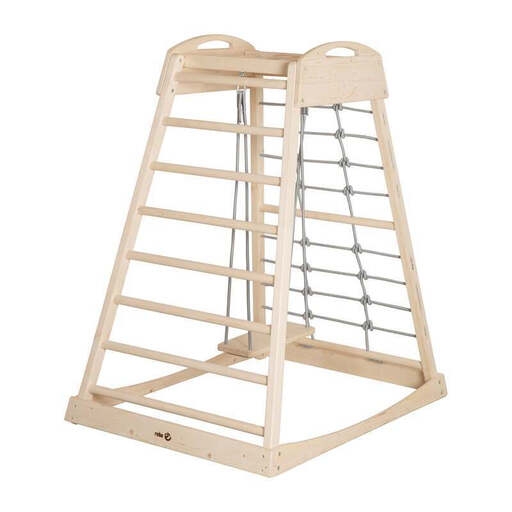
Why this model is a good fit: Ideal for toddlers from 24 months who are ready for a comprehensive play landscape. It combines climbing, swinging, and gymnastics in one unit, creating a versatile indoor playground in your own child's room.
The solid natural wood construction with rounded edges directly addresses safety concerns associated with low-quality materials. The versatile elements (swing, rings) provide long-lasting play value and prevent the equipment from becoming uninteresting too quickly.
Multifunctionality thanks to climbing ropes, gymnastic rings, and an interchangeable wooden swing. The high weight capacity of up to 70 kg ensures a long service life.
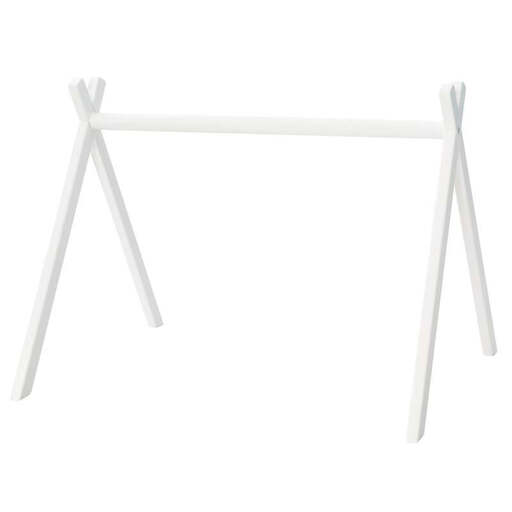
Why this model is a good fit: Perfect for infants from birth to encourage grasping, touching, and hand-eye coordination. It is an ideal precursor to more complex climbing equipment.
The simple, focused design made of wood avoids any sensory overload from unnecessary extras. It concentrates on fundamental motor skill development and is crafted from easy-care, safe materials.
Promotes early motor skills according to Montessori principles. The play arch can be individually equipped with different grasping toys and thus adapted to the child's development.
We have compiled a complete, up-to-date list of products that fully meet these strict selection criteria and German safety regulations.
As a rule, indoor climbing frames are suitable from around 24 months of age, when children can walk confidently and are making their first climbing movements. Simpler structures like a wooden climbing triangle can often be used a bit earlier under supervision. Always consider the manufacturer's specific age recommendation and your child's individual abilities.
The space requirement varies by model. Compact climbing triangles need a footprint of about 1.2 x 1.2 metres, while larger play towers require more space. Plan not only for the footprint of the equipment itself but also for an adequate safety zone of at least 1.5 metres around it, which should be free of furniture, walls, or hard objects.
Most freestanding climbing frames for home use, like the featured roba play tower, are designed to stand stably on a level surface without additional anchoring. Their construction is engineered for stability. However, for particularly intensive use, an additional wall anchor, if recommended by the manufacturer, can increase safety. In any case, carefully read and follow the manufacturer's assembly and safety instructions.