
Lieferung heute & morgen

Qualitätsgarantie

Willkommens-Angebote freischalten: KOSTENLOSE Lieferung | Bis zu 80 % RABATT | Kostenlose 30-Tage-JoyPlus-Testphase
App herunterladen
An indoor climbing frame can be a valuable addition to any playroom. It not only promotes motor skills, coordination, and self-confidence but also provides an engaging outlet when the weather outside isn't cooperating. However, the market is crowded, and not every model lives up to its promises. Before you make a decision, it's crucial to understand the common pitfalls that can lead to disappointment and unnecessary expense.
As your Joybuy Product Recommendation Officer, I'm here to help you identify the essential features and make an informed choice.
Many products are advertised with appealing images, but the reality is often quite different. Watch out for these three common issues to avoid a purchase you'll regret:
To ensure you get a durable and safe product, you should carefully examine three core areas. These parameters will help you objectively assess a model's quality.
An indoor wooden play tower is the first choice for many parents, but not all wood is created equal.
Your child's safety is the top priority. A play tower in the playroom must be completely stable.
A good climbing frame is more than just a toy. A Montessori climbing frame is based on the principle of offering the child diverse and self-directed movement opportunities. Look for versatile elements that target different motor skills:
Instead of presenting an overwhelming list, we're highlighting one product that thoughtfully meets the above criteria and is suited for a specific user profile.
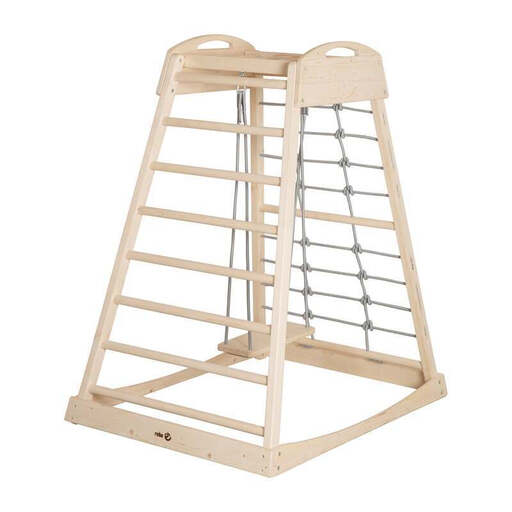
Why this model is a great fit: This model is designed for families who want maximum play variety in a limited space. It combines climbing, swinging, and gymnastics in a single unit, supporting the Montessori approach by allowing children to freely choose their activities and test their skills independently.
The construction of solid natural wood addresses the problem of low-quality materials. By combining a climbing rope, gymnastic rings, and an interchangeable swing, it overcomes the pitfall of limited play value and creates lasting appeal.
The maximum weight capacity of 70 kg indicates a robust build and a long lifespan. The versatility of its elements promotes various motor skills within a small footprint.
We have compiled a complete, up-to-date list of products that meet these strict selection criteria and relevant safety standards.
1. From what age is an indoor climbing frame suitable? Most manufacturers recommend their models for children aged 24 months and older. This is a good guideline, as children at this age typically have the basic motor skills to interact safely with the equipment. However, your child's individual development is more important than their age. Always start with direct supervision and slowly introduce your child to the new movement possibilities.
2. How much space does a play tower need in a playroom? Plan not only for the footprint of the frame itself but also for a safety zone of at least 1.5 metres (approx. 5 feet) around the entire unit. This area should be clear of furniture, walls, or other hard objects and ideally be covered with a play mat to cushion falls. Carefully measure the available space in your playroom before purchasing.
3. Does an indoor climbing frame need to be anchored to the wall? That depends on the model. Many climbing frames are designed as freestanding structures and are tip-resistant thanks to a wide base and a low centre of gravity. However, for extra stability, especially with very active children or on uneven floors, some manufacturers recommend wall anchoring. Check the product description to see if an anchor is recommended and whether the necessary mounting hardware is included.