
Lieferung heute & morgen

Qualitätsgarantie

Willkommens-Angebote freischalten: KOSTENLOSE Lieferung | Bis zu 80 % RABATT | Kostenlose 30-Tage-JoyPlus-Testphase
App herunterladen
Indoor play equipment for children should encourage movement without permanently turning the playroom into a building site. In practice, however, poor purchases are often caused not by missing features, but by unclear age recommendations, underestimating the space required or failing to observe safety requirements properly.
This selection guide from the Joybuy Product Recommendation Officer explains what families, nurseries and childminders should look out for before buying. The focus is on clear information about age, weight capacity, materials, floor space, assembly and intended use.
A recommendation such as “from 24 months” does not automatically describe every possible use. Climbing ropes, swings and raised platforms place different demands on children than simple motor skills toys for children aged 2 and over. The safety instructions, the child’s height, their motor skills and direct adult supervision are also crucial.
For some products, the product title and safety instructions differ. For the roba play tower and the roba climbing triangle, use from 24 months is stated in one place; however, the safety instructions warn against use by children under 36 months because of the risk of falling. The stricter requirement should therefore be decisive when making your purchase.
The maximum load is not a general value for several children. Swinging, jumping and climbing create additional dynamic forces. Many pieces of play equipment also specify: one child at a time only. If a children’s trampoline has a maximum user weight of 25 kg, this limit must not be exceeded by jumping together or using additional accessories.
Product dimensions usually show only the footprint. A climbing tower, swing or indoor climbing frame also requires safety distances from walls, windows, radiators, furniture and stairs. Ceiling height is relevant too. With a trampoline, there should be sufficient clear space above the jumping surface.
Before buying, check:
A Pikler climbing triangle supports open-ended movement, but requires a safe environment. For younger children, low and clearly visible elements are often easier to assess than a tall, multi-functional climbing tower for children.
For wooden climbing toys, look for clear material information, rounded edges, and firmly secured screws and joints. Untreated solid wood can blend harmoniously into a child’s bedroom, but regular checks are still essential.
With a trampoline, on the other hand, the frame material, jumping mat, springs or elastic bands and padding cover are key considerations. A spring-free system with elastic bands may operate more quietly, while a model with steel springs has different jumping characteristics. These are technical differences, not a general statement about quality.
Before placing your order, measure the available floor space and assess the surface. Climbing equipment should be placed on a level, stable floor, ideally on a suitable play mat or carpet. With freestanding structures, anchoring them to a wall may be advisable or recommended in the safety instructions.
For many wooden products, care involves no more than a dry or slightly damp cloth and regular visual checks. With trampolines, the jumping mat, frame, springs or bands and padding should be inspected before every use. Inflatable equipment also requires a suitable surface, a continuous air supply during use and proper drying afterwards.
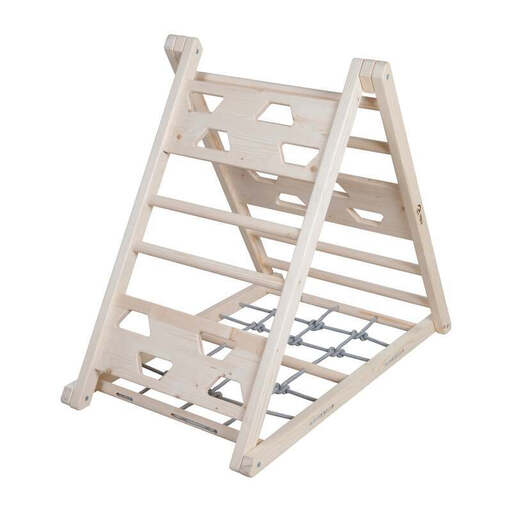
Why this product suits this profile: The compact climbing triangle offers three play sides and can be used for a range of movement activities in the child’s bedroom.
The dimensions of 85 × 63.5 × 97.5 cm and the maximum load of 50 kg are clearly stated. A separate play mat and the need for supervision should nevertheless be taken into account.
Solid wood, three functions with rungs, a climbing rope and grip surfaces, plus compatibility with separately available accessories.
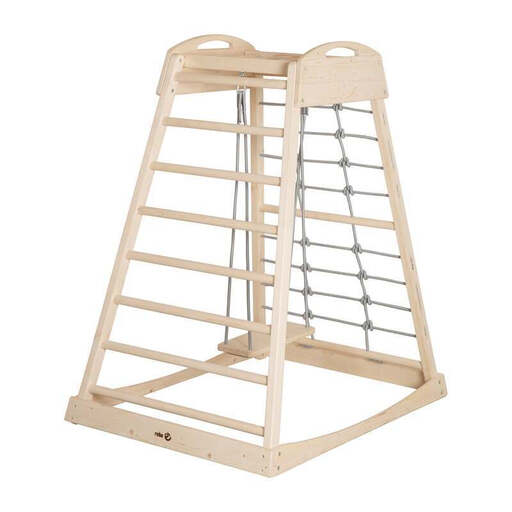
Why this product suits this profile: The play tower combines a ladder, climbing ropes, gymnastic rings and a removable wooden swing in one sturdy structure.
The overall dimensions of 127.5 × 83 × 110.5 cm and the load capacity of 70 kg are specified. The manufacturer recommends a level, soft surface, direct supervision and regular checks.
Untreated solid wood, several movement stations and a replaceable or removable swing.
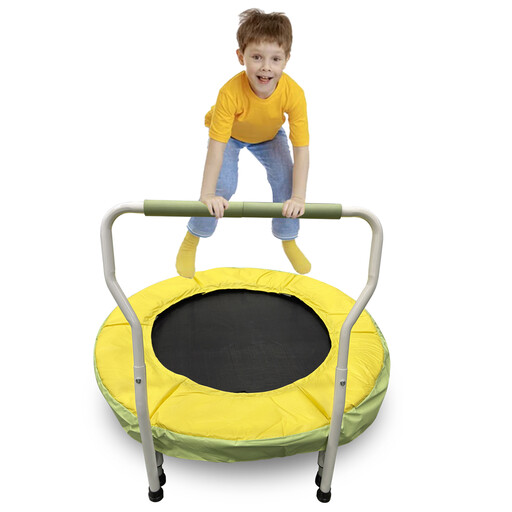
Why this product suits this profile: For families with limited space, a compact children’s trampoline with a support handle can provide a dedicated area for physical activity.
The maximum user weight of 25 kg, adjustable handle and full spring cover are clearly specified. It is still intended for one user with direct supervision.
Steel frame, polypropylene jumping mat, 24 steel springs and an adjustable support handle.

Why this product suits this profile: The agility ladder is suitable for short coordination exercises indoors or outdoors and can be stored away compactly after training.
The ladder is secured with four ground pegs. The distance between the rungs can be adjusted, allowing the exercise course to be adapted to children with different ability levels.
Four-metre length, connecting clips for additional ladders and a carry bag for storage and transport.
We have put together a complete, regularly updated list of products that fully meet these strict selection criteria and the safety regulations applicable in the EU.
For a child’s bedroom, compact wooden equipment, a climbing triangle or a small trampoline are usually easier to accommodate. A climbing tower requires more clearance and should not be placed near windows, stairs or radiators.
Children’s play equipment for indoor and outdoor use must be suitable for the relevant surface. A children’s bouncy castle requires a large clear area, anchoring, a blower that runs continuously and, if water is used, thorough drying afterwards. For larger groups, such as in nurseries, the manufacturer’s information on user numbers, load capacity and supervision must be checked particularly carefully.
In addition to the stated external dimensions, you need movement and safety clearances around the equipment. For a play tower measuring 127.5 × 83 × 110.5 cm, the available area should therefore not be limited exactly to the product’s footprint. Walls, furniture, windows and radiators must be outside the potential fall zone.
Its service life depends on the materials, level of use, assembly and care. Wooden joints, screws, ropes, rings, jumping mats and padding should be checked regularly. Damaged or loose parts must not be used any further. It is not possible to give a reliable general lifespan without specific conditions of use and maintenance.
A mechanical mini trampoline does not require electricity during use. A bouncy castle, on the other hand, needs a blower which, according to the product information, must remain switched on while children are playing. Running costs therefore depend on the blower’s power rating, how long it is used and the electricity tariff.