
Lieferung heute & morgen

Qualitätsgarantie
App herunterladen
Kategorien
An indoor Wi-Fi security camera offers a flexible way to keep an eye on living rooms, children's rooms, or areas with pets. Its connection to your home network enables access via a smartphone app from virtually anywhere. Choosing the right model depends on specific technical requirements and the intended use case. This article analyses the key technical parameters and presents a selection of models with different feature sets.
The functionality of modern indoor cameras is determined by a combination of hardware and software features. An informed decision is based on an analysis of the following technical criteria.
Resolution is a measure of the level of detail in the video image.
The field of view (FoV) indicates the area the camera can cover without moving. For monitoring an entire room, cameras with pan-and-tilt functionality (Pan-Tilt-Zoom, PTZ) are a practical solution. A 360-degree camera can eliminate blind spots through motorised rotation. Static cameras, on the other hand, are suitable for the targeted monitoring of a fixed area, such as an entryway or a baby's crib.
For monitoring in low-light or no-light conditions, a night vision camera with infrared (IR) LEDs is required. The range of the IR illumination, typically between 5 and 10 metres, determines how far the camera can see in the dark. Note that placing the camera behind a pane of glass can impair IR performance due to reflections.
Modern cameras use algorithms for object analysis. A basic camera with a motion detector and app sends a notification for any detected movement. Advanced models can distinguish between people, pets, and irrelevant movements (e.g., curtains moving in a breeze), which significantly reduces the number of false alarms. Sound detection can also react to unusual noises like a baby crying or glass breaking.
Recorded video data can be stored in two ways:
Some models offer a dedicated privacy mode where the lens is physically turned away or covered.
Based on the criteria above, we have compiled a selection of indoor Wi-Fi cameras that cater to different user profiles.
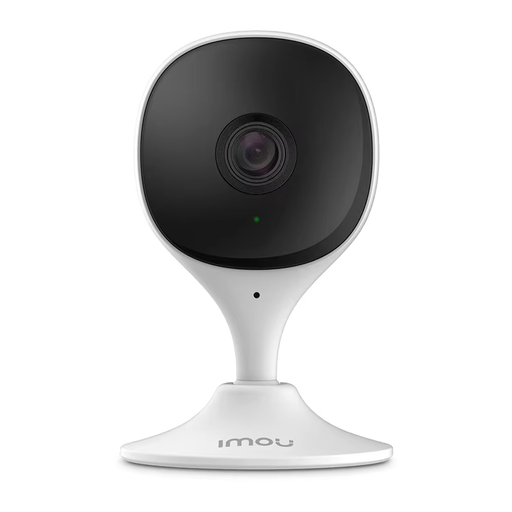
Why We Recommend This Product The IMOU Cue 2E focuses on high image quality within a static body. With its 3MP resolution (2304 x 1296 pixels), it surpasses the common 1080p standard and delivers sharper details. A standout feature is its abnormal sound detection, which qualifies it for use as a baby monitor with a camera. The AI-based human detection helps to minimise false alarms. Installation is simplified by a magnetic mount.
Pros
Who It's For This model is designed for users who want to monitor a specific area—such as a baby's crib, an entryway, or a pet's feeding station—with high image clarity and reliable audio surveillance.
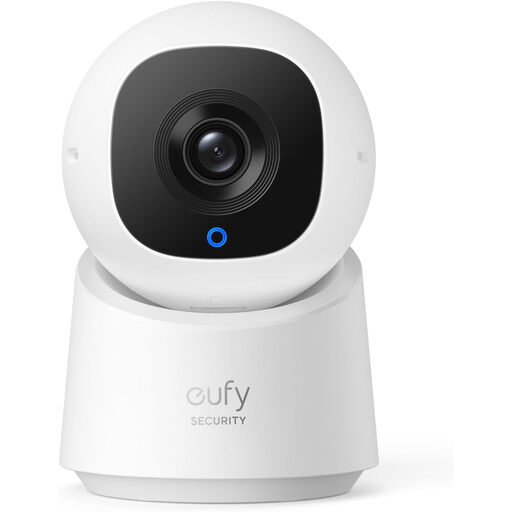
Why We Recommend This Product The eufy Indoor Cam C220 is a 360-degree camera that can monitor an entire room without blind spots thanks to its motorised pan-and-tilt function. The 2K resolution ensures clear images. A key advantage is the on-device AI processing for human and motion detection. Recordings can be stored on a microSD card, meaning no monthly fees are required. The privacy mode pivots the lens to a non-viewable position at the touch of a button.
Pros
Who It's For Ideal for users who want to monitor a complete living space, a playroom, or an area with free-roaming pets using just one device. Especially suitable as a pet camera or for general indoor security.
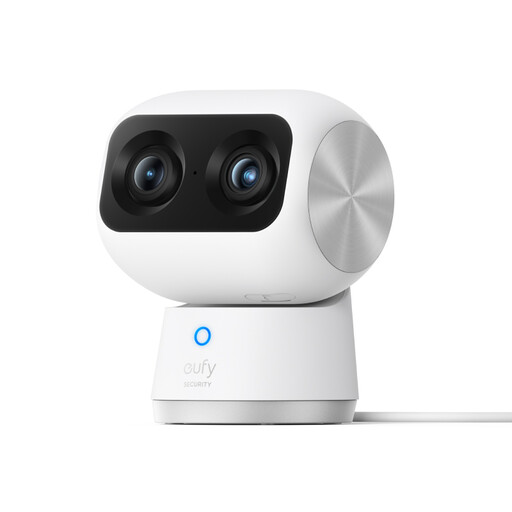
Why We Recommend This Product The eufy Security Indoor Cam S350 sets a high technical standard with its dual-lens system and 4K resolution. It combines a wide-angle lens for a broad overview with a telephoto lens that enables up to 8x hybrid zoom. This allows you to zoom in on distant details with precision. Like other eufy models, it features 360° PTZ functionality, AI-powered human detection, and the option for local storage. Dual-band Wi-Fi ensures a stable network connection.
Pros
Who It's For This model is aimed at tech-savvy users and those with high demands for image quality and zoom capability, for instance, for monitoring large indoor areas or when the smallest details matter.
If the featured models don't exactly meet your requirements, or if you're looking for cameras with other specific features, you can find a wider selection in our Smart Security Monitors category.
1. Do I need a subscription for an indoor Wi-Fi security camera? Not necessarily. Many models, like the eufy ones featured here, offer the option to save recordings locally on a microSD card. This means no monthly fees are required for basic recording and notification functions. Cloud subscriptions are often optional and provide advanced features or off-site storage.
2. How secure is the data on a Wi-Fi camera? Data security depends on several factors. With reputable manufacturers, data transmission between the camera, app, and servers is typically secured with encryption standards like WPA2/WPA3 and AES. Using models with local storage can increase your control over the data. Furthermore, users should always use a strong, unique password for their account and secure their Wi-Fi network.