
Lieferung heute & morgen

Qualitätsgarantie

Willkommens-Angebote freischalten: KOSTENLOSE Lieferung | Bis zu 80 % RABATT | Kostenlose 30-Tage-JoyPlus-Testphase
App herunterladen
A quality casserole pot is a staple in any kitchen. However, the search for the right model, especially a 28 cm induction casserole pot, can quickly become overwhelming. Marketing claims often sound too good to be true, and what seems like an all-in-one workhorse can turn out to be an expensive mistake. As your Joybuy Product Recommendation Officer, I'm here to help you identify the crucial features and sidestep common marketing traps.
Before you make a decision, it's important to understand the typical issues that only become apparent after a few weeks of use.
To avoid these pitfalls, focus on three verifiable criteria. These factors determine the performance, durability, and safety of your new cookware.
For optimal performance on induction hobs, it’s not just about whether the base is magnetic, but how it's constructed. Look for a fully ferromagnetic base of sufficient thickness. A thick, flat base retains heat better and distributes it evenly across the entire cooking surface. This prevents "hot spots" where food burns while it's still raw in other areas. A universal pot suitable for all hob types like this will also perform flawlessly on ceramic, gas, or electric hobs.
Modern non-stick coatings should be free from harmful substances. The PFOA-free label is a key indicator for health-conscious cooking. However, durability also varies significantly.
A 28 cm pot with a lid is an extremely versatile size for households of two to four people. It offers enough surface area for searing meat and sufficient volume for stews, curries, or pasta sauces. Pay attention to the following details:
Here are some recommendations that are aligned with the criteria above and suit various user profiles.
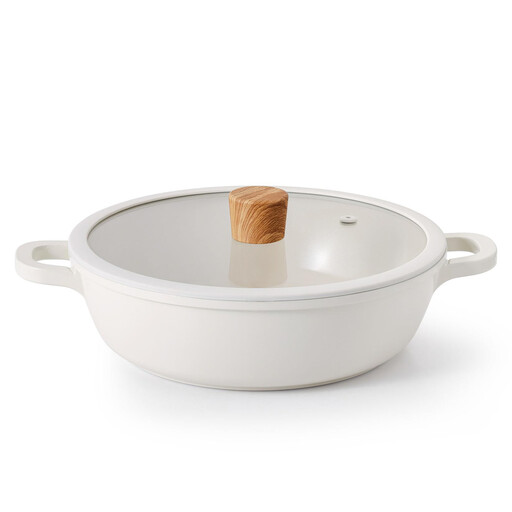
Why This Fits Their Persona: Ideal for users who prefer a ceramic-based coating and value a bright, appealing aesthetic. Perfect for gentle cooking and preparing everyday meals.
The ceramic coating is free from the substances found in some PTFE coatings and offers solid non-stick performance that won't fail after just a few uses.
Made with a die-cast aluminium process for robustness; compatible with all hob types including induction; tempered glass lid.
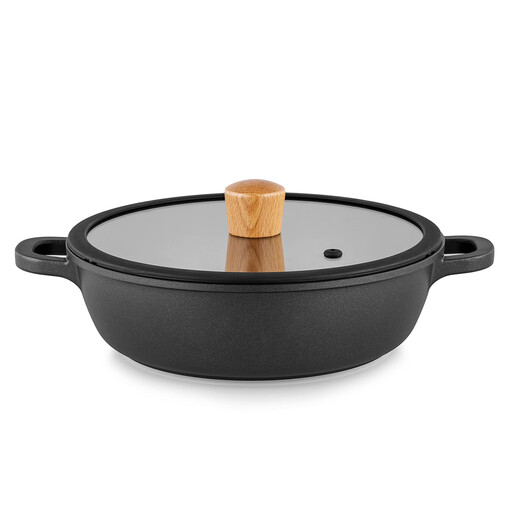
Why This Fits Their Persona: For cooks who use their pot daily and intensively. The robust coating and high functionality are designed for durability and performance, from high-heat searing to slow braising.
It bypasses the short-lived coating trap with a PFOA-free Swiss ILAG coating, which, according to the manufacturer, offers 3 to 4 times higher non-stick performance than marble coatings.
Excellent non-stick properties for low-fat cooking; thick base for even heat distribution on induction; dishwasher-safe for easy cleaning.
Why This Fits Their Persona: The flat, wide shape makes this pot ideal for dishes like Sukiyaki, Shabu-Shabu, or fondue that are prepared and shared right at the table. A true all-in-one pot for social dining.
It avoids the trap of unsuitable design. While tall casserole pots are impractical at the table, this model is designed as a Sukiyaki pot, combining the function of a cooking pot with that of a serving dish.
Versatile for cooking, searing, frying, and serving; removable silicone grips for safe transport from hob to table; elegant, minimalist design.
We have compiled a complete, real-time list of products that fully satisfy these strict selection criteria and UK safety regulations.
The easiest test is to hold a magnet to the base of the pot. If it attracts strongly, the material is generally suitable for induction. Additionally, check that the base is completely flat, as a warped base will heat unevenly.
Even if many pots are labelled as dishwasher-safe, washing by hand is often gentler. Use soft sponges, warm water, and mild washing-up liquid. Be sure to avoid metal utensils and abrasive scourers. Also, allow the pot to cool down before rinsing it with cold water to prevent thermal shock.
Yes, for most dishes, a 28 cm pot with a lid is an excellent size for a family of four. It provides enough space for stews, goulash, chilli con carne, or a large batch of pasta sauce. However, for very large roasts or cooking for more than four guests, a larger model might be necessary.