
Lieferung heute & morgen

Qualitätsgarantie

Willkommens-Angebote freischalten: KOSTENLOSE Lieferung | Bis zu 80 % RABATT | Kostenlose 30-Tage-JoyPlus-Testphase
App herunterladen
By a Joybuy Product Recommendation Officer
Finding the right frying pan for an induction hob can be a challenge. You need a model that is not only technically compatible but also meets your standards for durability, easy cleaning, and health-conscious cooking. Ceramic pans, in particular, are increasingly becoming a popular choice.
This article serves as your practical guide. I will outline the objective criteria to consider when choosing an induction ceramic pan and present a selection of models that excel in specific areas. My goal is to provide you with the information you need to make an informed decision.
To make the right choice, a few technical and functional aspects are crucial. Here are two key points you should consider.
A pan's performance largely depends on the combination of its base material and coating. A stainless steel pan with a ceramic coating provides a solid foundation. Stainless steel ensures a robust structure and efficient heat conduction, which is especially important on induction hobs.
The ceramic coating itself is known for its non-stick properties. Look for products explicitly declared as a pan free of PFOA and PTFE. This indicates that certain chemical compounds were avoided during the coating's manufacturing process, a key criterion for many health-conscious households. Modern coatings are often reinforced with particles like diamond or titanium to increase abrasion resistance and durability.
Consider how you will primarily use the pan. A coated and oven-safe frying pan significantly expands your cooking options. You can sear dishes on the hob and then finish them in the oven or gratinate them without having to switch cookware. Always check the maximum temperature resistance of both the pan and the handle.
For households with limited storage, for use in RVs, or for anyone who loves a tidy kitchen, space-saving cookware is a solution worth considering. A cookware set with a detachable handle allows pots and pans to be nested, making optimal use of cupboard space. For special preparations like braised dishes or sauces, a high-sided sauté pan with a lid is ideal, as it prevents splatters and facilitates even cooking.
Based on the criteria above, we have compiled a selection of products that stand out for their specific features.
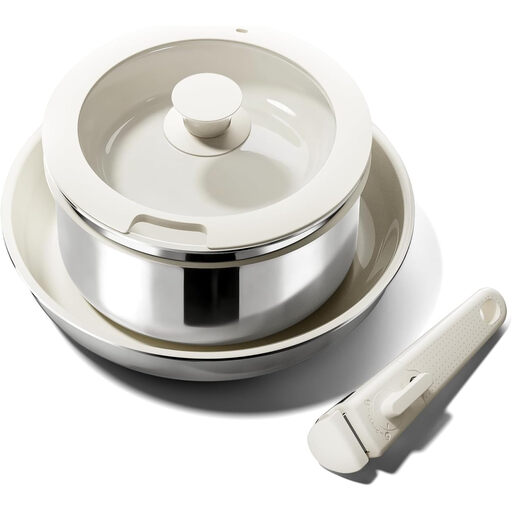
Why It Stands Out: This set solves the problem of cluttered kitchen cabinets. The detachable handle allows the pots and pans to be nested in an extremely space-saving manner, which the manufacturer claims can save up to 70% more space.
Advantages:
Who It's For: Ideal for those with small kitchens, for use in RVs and campers, or for anyone who values highly organised and space-saving cookware.
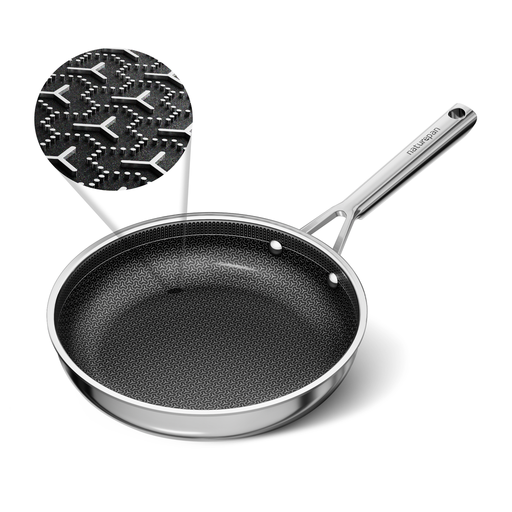
Why It Stands Out: This honeycomb pan combines the benefits of stainless steel and ceramic. A laser-etched hexagonal pattern of stainless steel ridges allows for perfect searing, while the recessed ceramic areas provide reliable non-stick performance.
Advantages:
Who It's For: For home cooks who appreciate the searing power of a stainless steel pan but don't want to sacrifice the convenience of a non-stick coating.
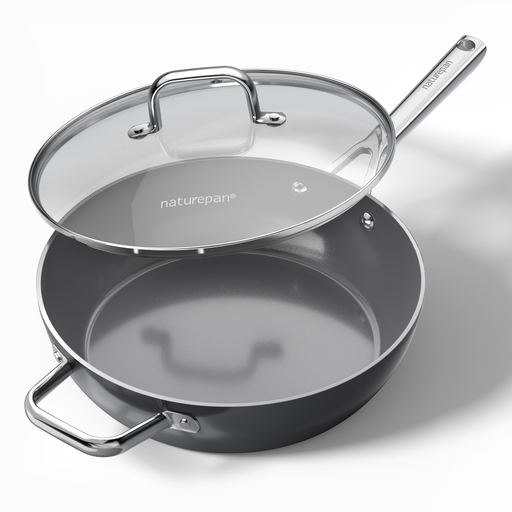
Why It Stands Out: With its high sides and included lid, this pan is more than just for frying. It serves as a versatile sauté pan with a lid, making it excellent for stews, sauce-based dishes, and one-pan meals.
Advantages:
Who It's For: Perfect for families and anyone who enjoys preparing versatile dishes in a single pan, from seared meat to slow-simmered vegetables.
If these selections don't include the perfect model for your specific needs, there are other alternatives to discover. Different sizes, designs, and set configurations might be better suited for your household.
Browse our entire selection of ceramic cookware to find the perfect addition to your kitchen.
1. Are ceramic pans safe for your health? High-quality ceramic coatings are typically manufactured without the use of perfluorooctanoic acid (PFOA) and polytetrafluoroethylene (PTFE). If these features are important to you, look for the manufacturer's corresponding labels. The coating is based on natural minerals and does not release any harmful substances into food when used correctly.
2. How do I care for a ceramic pan to ensure its longevity? To maintain the non-stick properties, you should follow a few basic rules. Use utensils made of wood, silicone, or plastic to avoid scratches. Heat the pan slowly over low to medium heat and avoid heating it empty on the highest setting. Allow the pan to cool down after use before cleaning it with water to prevent thermal shock. While many models are dishwasher-safe, gentle hand washing is often recommended for maximum durability.
3. Does every ceramic pan work on an induction hob? No, not automatically. Induction compatibility depends on the base of the pan. It must be made of a ferromagnetic material, such as stainless steel or cast iron, for the hob's magnetic field to generate heat. When purchasing, always look for the induction symbol (a stylized coil) or an explicit statement from the manufacturer in the product description confirming that the pan is suitable for induction hobs.