
Lieferung heute & morgen

Qualitätsgarantie

Willkommens-Angebote freischalten: KOSTENLOSE Lieferung | Bis zu 80 % RABATT | Kostenlose 30-Tage-JoyPlus-Testphase
App herunterladen
Purchasing new cookware, especially for an induction hob, can quickly become overwhelming. The market is filled with promises of versatile materials and innovative coatings. However, not every product advertised as "induction-compatible" delivers the desired performance in practice. As your Joybuy Product Recommendation Officer, I'll help you identify the crucial features and make an informed choice that suits your cooking habits.
Before we dive into the important quality features, let's highlight the typical traps that often lead to disappointment and unnecessary expense.
To avoid these pitfalls, focus on three core aspects before you buy new pots and pans.
For induction cookware, the base is the most critical component. A high-quality pot or pan has what is known as an encapsulated sandwich base. This consists of several layers:
Such a thick, full-surface base ensures optimal heat distribution without "hot spots" and high energy efficiency. Make sure the diameter of the base matches the size of your cooking zones.
The choice of material depends directly on your cooking habits.
Consider what you truly need. A good starter cookware set should include at least the following:
Speciality items like a wok, a deep fryer, or a roaster can be added later as the need arises.
Here are some product recommendations tailored to different user profiles and the criteria mentioned above.

Why this set is a great fit: Ideal for a first kitchen or for students. With four different pot sizes (1.5L, 2L, 2.5L, 5L), it covers the basic daily cooking needs without being cluttered with unnecessary items.
This set avoids the "oversized set" trap by offering a practical selection of sizes for daily use, rather than focusing on a high piece count.
Made from durable 304 stainless steel and suitable for all stovetops, including induction. The glass lids allow for easy monitoring of the cooking process.
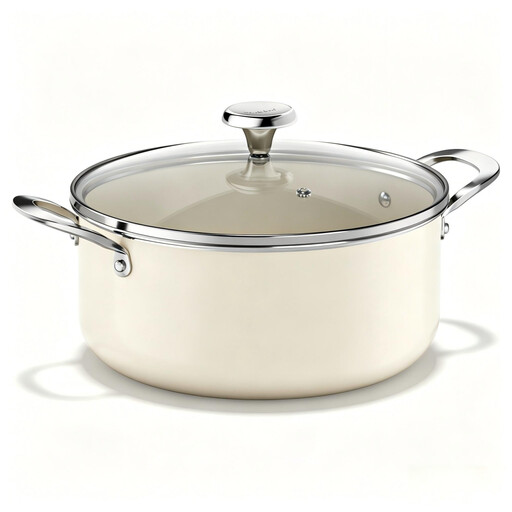
Why this pot is a great fit: Perfect for anyone who values low-fat cooking and non-toxic materials. Ideal for soups, stews, or steaming vegetables.
This pot addresses the "misleading coating" trap, as it is explicitly free of Teflon, PFAS, PTFE, PFOA, lead, and cadmium, according to the manufacturer.
The advanced ceramic non-stick coating allows for cooking with minimal oil. The thickened base ensures fast, even heating on induction and is oven-safe up to 450°C.
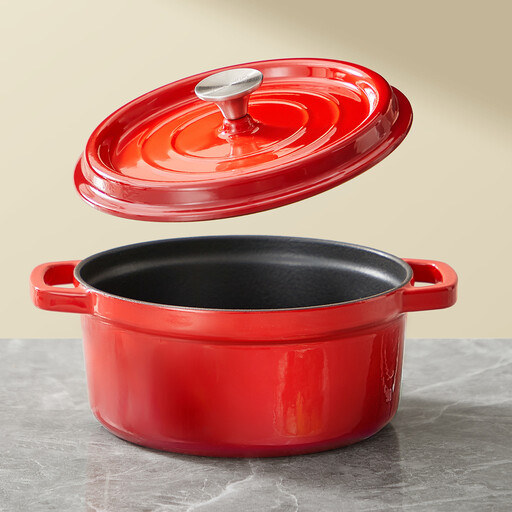
Why this pot is a great fit: For anyone who loves preparing goulash, roasts, or sourdough bread. This cast iron Dutch oven is a specialist for dishes that require long, even heat.
It avoids the "poor performance" trap by being a specialised tool designed for a specific purpose. Its material properties are optimised for braising, something no all-purpose pot can achieve.
Excellent heat retention and distribution thanks to solid cast iron. The enamel coating makes it easy to clean and ready to use immediately, without seasoning.
We have compiled a complete, up-to-date list of products that fully meet these strict selection criteria and German safety regulations.
1. How can I tell if my old cookware is suitable for induction? The easiest way is the magnet test. Hold a standard magnet to the bottom of the pot or pan. If the magnet sticks firmly, the cookware is ferromagnetic and therefore suitable for induction hobs. If it doesn't stick, or only very weakly, it won't work.
2. How do I properly care for a coated pan to extend its lifespan? To preserve the non-stick properties, especially of a ceramic pan, you should follow a few rules:
3. Is a complete starter cookware set worth it, or should I buy pots individually? That depends on your needs and budget. A pot set for all stovetops can offer a price advantage and ensures you have a basic setup. However, if you already have specific preferences or only need to replace a single item (e.g., a wok with a lid), buying individually makes more sense. This allows you to invest specifically in the pieces you use most often.