
Lieferung heute & morgen

Qualitätsgarantie

Willkommens-Angebote freischalten: KOSTENLOSE Lieferung | Bis zu 80 % RABATT | Kostenlose 30-Tage-JoyPlus-Testphase
App herunterladen
By Joybuy Product Recommendation OfficerPublished August 28, 2026
Induction hobs are known for their efficiency and precise temperature control. However, you can only unlock their full potential with the right cookware. The market is flooded with pots and pans that promise induction compatibility but often disappoint in practice. Before you invest, it's crucial to understand the common pitfalls that can lead to unevenly cooked food, damaged hobs, or a short lifespan for your cookware.
This guide will help you identify the key features of high-quality induction cookware and distinguish marketing hype from genuine quality.
Many products advertise features that don't live up to their claims in reality. Pay close attention to these two points to avoid a bad investment:
To avoid the problems mentioned above, you should carefully examine two technical aspects before making a purchase. These largely determine the performance and longevity of your new pots and pans.
The base is the most critical component of induction cookware. Its quality determines efficiency and cooking results.
Besides the base, the main material determines the cookware's cooking properties and ease of care.
Instead of making a one-size-fits-all recommendation, we have selected products tailored to specific user profiles and requirements.
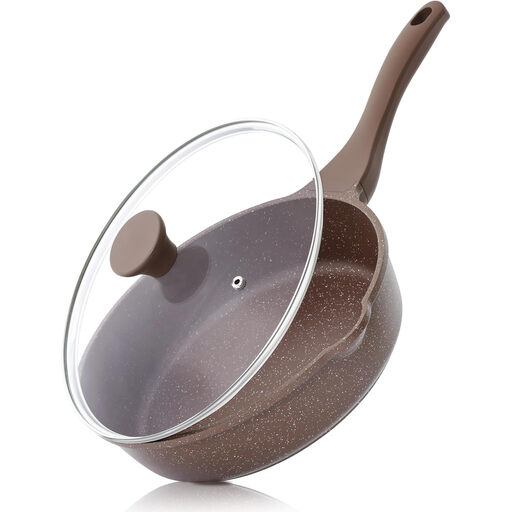
Why This Fits Their Persona: Ideal for families looking for a large, versatile frying pan with a lid for daily use. The high sides are perfect for stews, sauces, and larger portions without boiling over.
According to the manufacturer, the granite non-stick coating is free of PFOA and PFOS and offers higher abrasion resistance than simple PTFE coatings. The solid base ensures stable, warp-free performance on induction.
Large capacity and high sides for versatile dishes. The heat-resistant ("stay-cool") handle enhances safety during cooking.
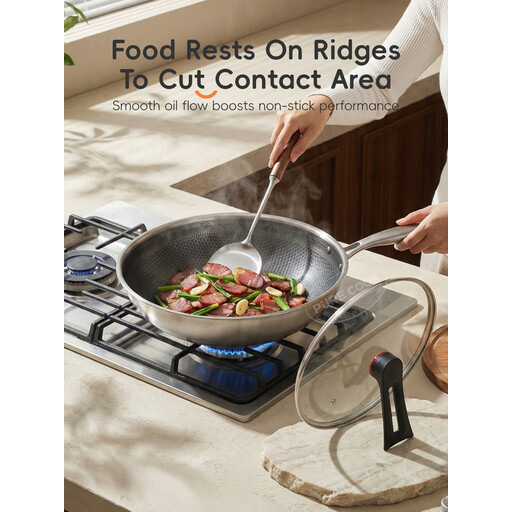
Why This Fits Their Persona: This induction wok is designed for home cooks who want to prepare authentic stir-fry dishes at high heat and are looking for a durable alternative to coated pans.
Instead of a delicate chemical coating, this wok uses a physical non-stick surface created by an engraved honeycomb pattern. This makes it extremely scratch-resistant and durable. The three-layer stainless steel construction ensures fast, even heat distribution.
Suitable for use with metal utensils. The absence of a chemical coating prevents wear and tear and the potential release of particles.

Why This Fits Their Persona: This saucepan is a versatile tool for smaller tasks like heating milk, cooking sauces, or steaming vegetables. The use of 316 stainless steel offers even higher corrosion resistance.
Instead of relying on a thin base, this model features a three-layer ("Tri-ply") construction that ensures optimal heat performance on induction. The silicone-wrapped handle prevents overheating and provides a secure grip.
The included steamer insert significantly expands its functionality. The combination of 316 stainless steel and a ceramic outer coating is both durable and easy to clean.
A complete cookware set for all hob types or specialty pots can be found in our carefully curated selection. Discover practical accessories for your kitchen, too.
1. How can I tell if my old cookware is suitable for induction? The easiest way is the magnet test: hold a standard magnet to the bottom of the pot or pan. If the magnet sticks firmly, the base is ferromagnetic and therefore fundamentally suitable for induction. However, this doesn't tell you anything about the efficiency of the heat transfer.
2. Why is my induction cookware making noise? A quiet hum or buzz, especially on high power settings, is normal. It's caused by the vibrations of the magnetic field. Louder noises or a clicking sound can indicate an uneven or poorly constructed pot base that isn't lying flat on the hob.
3. How do I care for a PFOA-free non-stick pan to extend its life? Avoid using metal utensils; opt for wood, silicone, or plastic instead. Clean the pan by hand with a soft sponge and mild detergent rather than putting it in the dishwasher. Do not expose the pan to extreme temperature shocks (e.g., holding a hot pan under cold water) and do not heat it empty on the highest setting.