
Lieferung heute & morgen

Qualitätsgarantie

Willkommens-Angebote freischalten: KOSTENLOSE Lieferung | Bis zu 80 % RABATT | Kostenlose 30-Tage-JoyPlus-Testphase
App herunterladen
Buying a new cookware set for your induction hob should be exciting, but it often ends in disappointment. A set that looked promising in the store heats unevenly at home, its coating fails after just a few months, or the handles start to wobble. As a Joybuy Product Recommendation Officer, I see every day which features truly matter and which marketing promises often lead to disappointment.
This guide will help you navigate the common pitfalls and make an informed decision that suits your cooking habits and budget.
Before we dive into the key features, let's highlight the three most common issues that can lead to a bad purchase.
To avoid these traps, focus on three objective criteria that determine the quality and longevity of an induction cookware set.
Efficiency on an induction hob depends entirely on the quality of the base. A simple magnetic bottom is not enough.
Look for a multi-layer composite base (often called a 'sandwich base'). This typically consists of an outer layer of ferromagnetic stainless steel, an aluminium core for fast and even heat conduction, and an inner layer of food-grade stainless steel or a non-stick coating. Such a construction ensures:
The choice of material affects the cooking experience, durability, and maintenance.
Consider which features will make your daily cooking routine easier:
Here are some recommendations based on the objective criteria above, catering to different needs.

Why this set fits: Ideal for a first apartment or for families looking for a comprehensive starter kit without breaking the bank. With pots, pans, and a steamer insert, this set covers all basic cooking tasks.
The aluminium alloy body ensures fast, even heat distribution, countering the "uneven heating" trap. The non-stick coating is specified for food contact.
A complete 12-piece set that covers frying, boiling, and steaming. The wood-effect handles stay cool during cooking.

Why this set fits: For those who cook daily and prioritise health-safe materials. The ceramic coating is a deliberate choice for preparing family meals.
This set directly addresses the "unclear materials" trap, as it is free of PTFE, PFOA, and PFAS according to the manufacturer. The multi-layer base is designed for efficient use on induction hobs.
Health-safe ceramic coating. The removable handle and universal lid save valuable kitchen cabinet space.
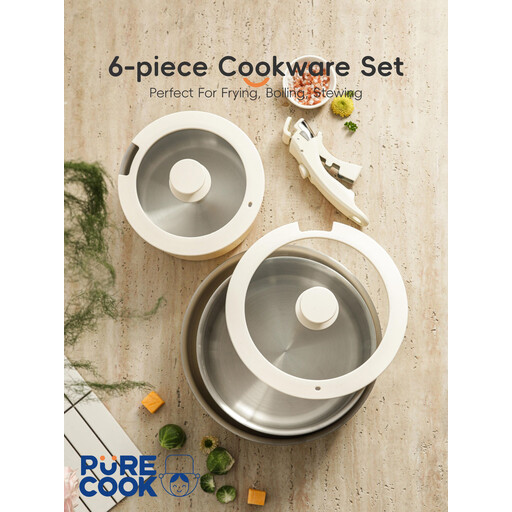
Why this set fits: Perfect for kitchens with limited storage, for use in an RV, or for anyone who values a tidy, modular solution. The combination of stainless steel and ceramic offers versatility.
This set counters the "structural flaws" trap with a robust 304 stainless steel interior and a secure locking mechanism for the removable handle, which is designed for durability.
The removable handle allows for extremely space-efficient stacking. The pots can also be used in the oven, air fryer, or even for serving.
If you're looking for a specific type of pan, we've compiled a complete, up-to-date list of products that meet our strict selection criteria.
1. How can I tell if my old cookware is induction-compatible? The easiest way is the magnet test. Hold a regular refrigerator magnet to the bottom of the pot or pan. If the magnet sticks firmly, the base is ferromagnetic and therefore suitable for induction. If it doesn't stick, or only very weakly, the cookware will not work on an induction hob.
2. How do I properly care for a non-stick pan to extend its lifespan? Avoid using metal utensils that could scratch the coating; use wood, silicone, or plastic instead. Clean the pan by hand with a soft sponge and mild dish soap rather than putting it in the dishwasher. Also, avoid extreme temperature shocks by not placing a hot pan directly under cold water.
3. Does stainless steel cookware warp on an induction hob? High-quality stainless steel cookware with a thick, multi-layer composite base is engineered to resist warping. The different metal layers expand in a controlled manner when heated, ensuring stability. In contrast, cheap, thin-walled cookware is more prone to deforming under the rapid and intense heat of an induction field.