
Lieferung heute & morgen

Qualitätsgarantie

Willkommens-Angebote freischalten: KOSTENLOSE Lieferung | Bis zu 80 % RABATT | Kostenlose 30-Tage-JoyPlus-Testphase
App herunterladen
An induction cookware set can simplify your kitchen equipment, provided the sizes, materials and hob compatibility suit your everyday needs. At the same time, large sets, unclear coating information and sweeping promises often lead to disappointing purchases. A small household has different requirements from a family or a kitchen with limited storage space.
This buying guide explains which details really matter before purchasing a pot set for induction, a pan set for induction or a combined set.
A set with lots of individual pieces may seem comprehensive at first glance. What matters, however, is how many genuinely usable cooking vessels it contains. Lids, handles, pan protectors and kitchen utensils may increase the piece count, but they do not replace a suitable cooking pot.
So check the following:
For a small kitchen, a stackable pot set with coordinated diameters may be more useful than a larger assortment containing many individual pieces.
With induction, it is not the cooking surface itself that gets hot, but a magnetic pan base. Cookware is therefore only suitable if its base is sufficiently magnetic and sits properly on the cooking zone. The manufacturer’s statement “suitable for induction” should be clearly included in the product details.
The base diameter is also important: if it is significantly smaller than the cooking zone, usable heat distribution may be limited. With stainless steel cookware featuring a multi-layer or specialised base, you should also look for information about heat distribution and heat retention.
Coated cookware can make it easier to release food from the surface. However, this does not automatically mean that it will remain resistant to damage over time. High temperatures, metal utensils, thermal shock and harsh cleaning can put greater strain on the coating.
With ceramic pans, information such as “for low to medium heat” and recommendations to use wooden, nylon or silicone turners are particularly important. For searing at high heat, an uncoated stainless steel pan may be more suitable, while coated pans are often chosen for delicate foods and controlled cooking.
18/10 stainless steel is commonly used for pots. The material is rust-resistant, does not affect flavour and, for the products mentioned, is suitable for dishwasher cleaning. However, an uncoated surface requires the right temperature control and sufficient fat when searing to prevent food from sticking.
Coated cookware with a ceramic non-stick surface can be practical for vegetables, fish or pancakes. Always follow the manufacturer’s instructions on temperature and suitable kitchen utensils. “Dishwasher-safe” also does not always mean that every component can go in the dishwasher: with sets featuring removable handles, the handles, lids and accessories may only be suitable for hand washing.
For everyday use, graduated sizes are generally more practical than several almost identical pots. Typical combinations include:
Capacity should also be checked. Depending on its shape, a 20 cm pot may hold around 2 to more than 4 litres. The actual figure in the specification sheet is therefore more informative than the diameter alone.
With dishwasher-safe cookware, the claim should apply to every individual piece. Glass lids, silicone rings and removable handles in particular often have different care instructions.
“Oven-safe” is not a uniform property either. The following points are decisive:
For example, according to the product specifications, the pots in the WMF Compact Cuisine Set are oven-safe up to 250 °C, while the glass lids are safe up to 180 °C. With the Naturepan set, the cookware bodies can be placed in the oven at up to 230 °C, but without the removable handles, lids, protectors and utensils.
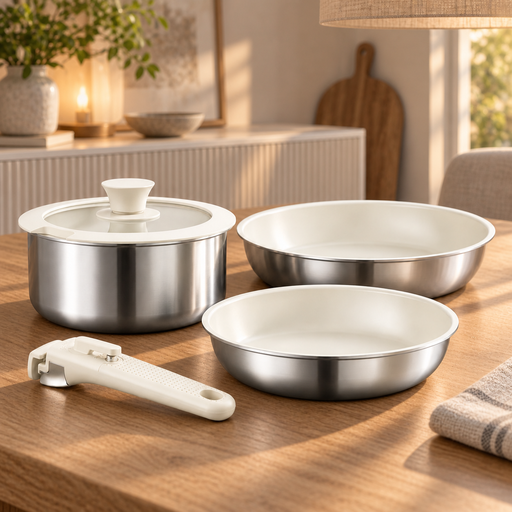
Why this product suits this profile: The set combines a 20 cm pot with two pans and a removable handle. The cookware bodies can be nested to save space and are suitable for several hob types, including induction.
The included cookware bodies are clearly described. For oven use, removable parts must be taken off, making the temperature specification unambiguous.
Ceramic interior coating, 3-litre pot, removable handle and nestable cookware bodies.
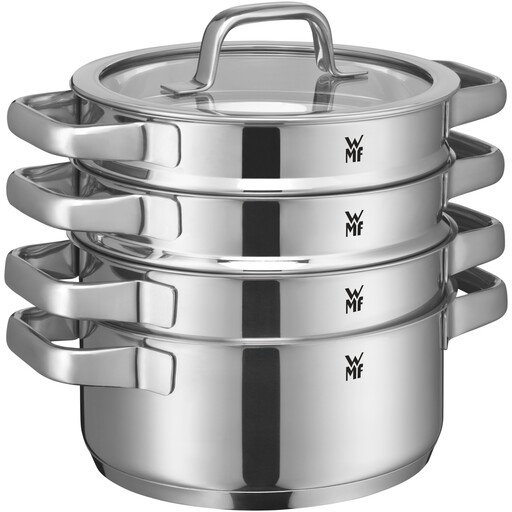
Why this product suits this profile: The uncoated stainless steel set offers graduated pot sizes from 16 to 24 cm, glass lids and a design that allows vessels with the same diameter to be stacked compactly.
The set size is made clear through specific pots and capacities. The oven temperature for the pots and glass lids is specified separately.
Cromargan 18/10 stainless steel, TransTherm base, dishwasher-safe components and stackable design.
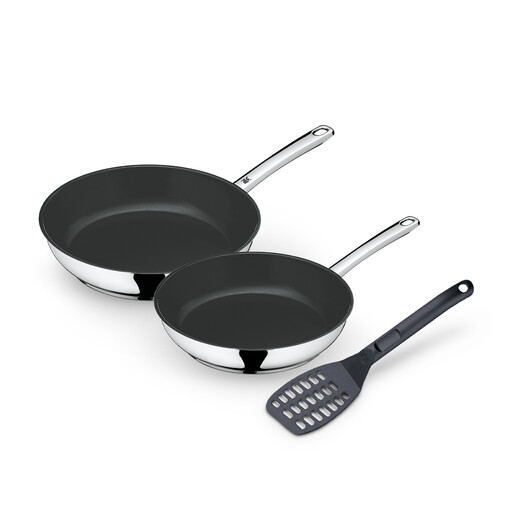
Why this product suits this profile: Two coated induction pans cover the most common frying sizes. The included turner is designed for use with the ceramic surface.
The product details specify the coating, induction base and temperature limits. Cooking over medium heat is recommended for the coating.
24 and 28 cm pans, ceramic coating, induction compatibility and oven suitability up to the stated limit.
We have put together a complete, regularly updated list of products that fully meet these strict selection criteria and the safety regulations applicable in the EU.
The product description must expressly state that the item is suitable for induction hobs. A magnet test on the base of the pot may provide an additional indication, but it does not replace the manufacturer’s information about the base construction and compatible hob types.
Its service life depends on the material, workmanship, temperature control and care. With proper use, uncoated stainless steel is less dependent on a wear-prone interior coating. With coated pans, heat, kitchen utensils and cleaning have a significant effect on the condition of the surface.
A suitable, flat pot base that sits properly on the induction hob can support efficient heat transfer. As well as the cookware, the pot size, cooking zone and selected power setting are also important. The manufacturer’s information about the base design and diameter should therefore be taken into account before buying.