
Lieferung heute & morgen

Qualitätsgarantie

Willkommens-Angebote freischalten: KOSTENLOSE Lieferung | Bis zu 80 % RABATT | Kostenlose 30-Tage-JoyPlus-Testphase
App herunterladen
An induction cookware set can replace several individual pots and pans while saving storage space. At first glance, choosing one seems straightforward: the number of pieces, material, coating and lowest possible price usually take centre stage. In practice, however, several common marketing claims can lead to disappointing purchases.
Three typical pitfalls are particularly important:
An induction cookware set should be explicitly suitable for induction hobs. Compatibility with gas, electric and ceramic hobs is also useful if you want to continue using the cookware after moving house or in a holiday home.
With stainless steel sets, the base is crucial. A multi-layer construction with an aluminium core can distribute heat throughout the base. WMF refers to the corresponding base in several ranges as the TransTherm universal base. According to the product information, it is suitable for induction, gas, electric and ceramic hobs. However, even heat distribution also depends on using a cooking zone of the right size and controlling the temperature carefully.
You should also look for:
A stainless steel saucepan set is generally uncoated and suitable for soups, pasta, vegetables, sauces and slow-cooked dishes. Stainless steel is easy to care for and resistant to metal utensils, unless the manufacturer advises otherwise. A wide pouring rim can make decanting easier.
A coated frying pan set, on the other hand, is designed for frying at low or medium heat. The bodies of the Naturepan sets are made from stainless steel with an aluminium heat core and a ceramic non-stick coating. The coating is applied to a metal body; this is not a frying pan made from solid ceramic. Use wooden, silicone or nylon utensils, and avoid heating the pan empty for extended periods.
The term ceramic coating does not automatically mean that the frying pan can withstand particularly high temperatures or harsh cleaning. Washing by hand with mild washing-up liquid can help protect the coating in everyday use, even if the pan body is labelled dishwasher-safe.
For a small household, pots measuring 12 to 16 cm can be useful. According to the product information, a mini set such as the WMF Cromargan Mini Set includes pots and pans for smaller portions. For families or regular batch cooking, however, pots measuring around 20 to 24 cm and a 26 or 28 cm frying pan are often more practical.
A stackable cookware set is particularly useful in small kitchens. With some Naturepan sets, removable handles allow the bodies to be nested inside one another. Before each use, check that the handle has been attached and locked into place correctly. With stainless steel ranges featuring fixed handles, stackability depends on the specific design; lids generally require additional storage space.
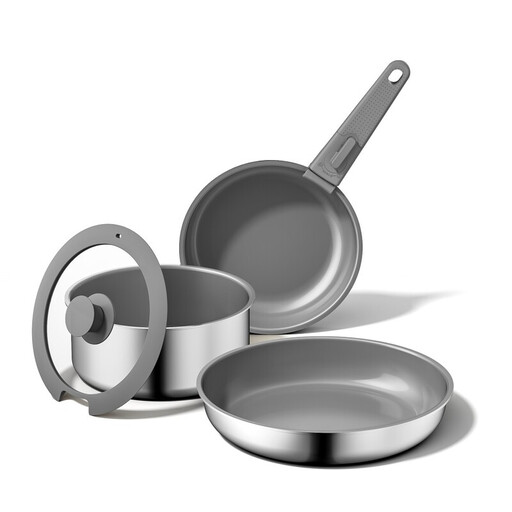
Why this product suits this profile: The set combines a 20 cm pot with 20 and 26 cm frying pans, plus a removable handle and lid. It covers essential cooking tasks and can be stored neatly to save space.
According to the product information, the set focuses on different useful sizes rather than several almost identical pieces. The bodies are dishwasher-safe; the handle and lid must be washed by hand.
Stainless steel body with an aluminium heat core, ceramic interior coating, and compatibility with induction, gas, electric and ceramic hobs.
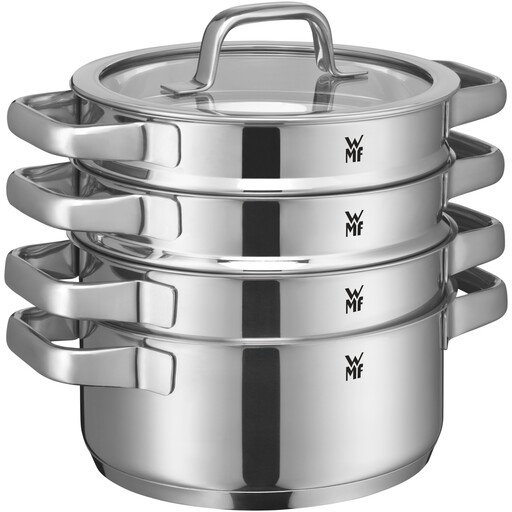
Why this product suits this profile: The uncoated Cromargan stainless steel pots are designed for regular use. The set includes three saucepans and a roasting pot with glass lids.
The product information describes a stackable design for pots with the same diameter. The pots and glass lids are also listed as dishwasher-safe.
TransTherm base, glass lids, measurement scales on the pots and oven suitability up to 250 °C for the cookware, according to the manufacturer’s information.

Why this product suits this profile: Three sizes – 20, 24 and 28 cm – cover small portions, side dishes and larger frying tasks. The textured surface combines coated areas with visible stainless steel ridges.
The sizes are clearly graduated. According to the product information, the pan bodies are oven-safe up to 230 °C; lids must be removed before placing them in the oven.
Suitable for induction, gas, electric and ceramic hobs; dishwasher-safe according to the product information. Careful use at low to medium heat and with suitable kitchen utensils remains important.
An induction hob responds quickly to changes in power. For this reason, do not use the highest setting continuously; reduce the temperature once the cookware has heated up. The base of the pot should sit as fully as possible on the cooking zone. This makes better use of the energy supplied and prevents unnecessarily long heating times.
Coated frying pans require a few additional precautions:
If you mainly cook soups, pasta and slow-cooked dishes, you do not necessarily need a frying pan set with a ceramic coating. For frequent frying, a separate induction frying pan set may be more practical than a very large pots-and-pans set containing unused pieces.
We have put together a complete, regularly updated list of products that fully meet these strict selection criteria and the safety regulations applicable in the EU.
Stainless steel with a magnetic base is suitable for induction and easy to care for. Coated frying pans can reduce sticking, but require more careful choices when it comes to temperature and utensils. The specific manufacturer’s information on hob compatibility is always decisive.
No. Oven suitability may vary from one component to another. With sets featuring a removable handle, the handle, lid and accessories must be removed before placing the cookware in the oven. Check the maximum temperature in the product description and instruction manual.
Its lifespan depends on the material, temperature, cleaning and storage. With proper care, uncoated stainless steel pots are less dependent on the condition of a non-stick coating. With ceramic coatings, gentle cleaning, medium heat and suitable kitchen utensils can help preserve their performance for longer.