
Lieferung heute & morgen

Qualitätsgarantie

Willkommens-Angebote freischalten: KOSTENLOSE Lieferung | Bis zu 80 % RABATT | Kostenlose 30-Tage-JoyPlus-Testphase
App herunterladen
As your Joybuy Product Recommendation Officer, I analyse the market to provide you with objective, practical advice. This guide will help you find the right frying pan for your induction hob and steer clear of common purchasing traps.
Buying a new induction frying pan might seem straightforward, but the market is flooded with marketing claims that often fail to deliver. Many consumers invest in products that quickly lose their functionality or are unsuitable for their needs. Before you make a decision, you should be aware of the three most common pitfalls:
To avoid a bad purchase, focus on three technical features that determine the performance and longevity of an induction pan.
The efficiency on an induction hob depends directly on the base. There are two fundamental designs:
For ambitious home cooks, a pan with full multi-ply construction is almost always the more solid choice.
The choice between a coated and an uncoated pan depends on your cooking habits and willingness to perform maintenance.
The size of the pan should match the diameter of your cooking zones and the amount of food you're preparing.
Here are some product recommendations tailored to specific user profiles that meet the quality criteria mentioned.
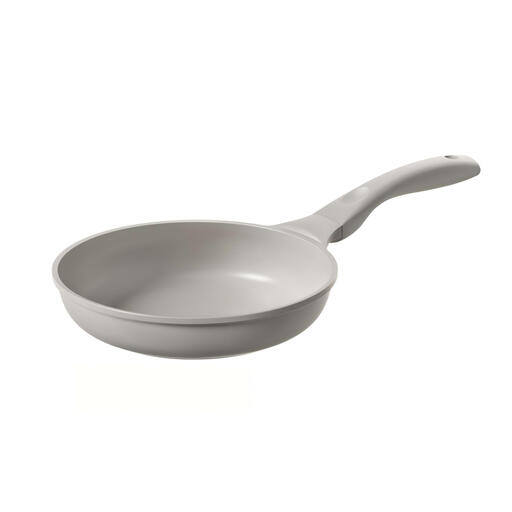
Why This Fits Their Persona: Ideal for novice cooks or small households looking for a straightforward, easy-to-clean pan for daily use. Perfect for eggs and vegetables without requiring extensive maintenance.
The pan uses a ceramic coating explicitly declared as PTFE/PFOA/PFAS-free, thus sidestepping the trap of short-lived, low-quality coatings. The aluminium core ensures rapid and even heating.
Very easy to clean with excellent non-stick properties for low-fat cooking. The heat-resistant Bakelite handle stays cool during cooking.

Why This Fits Their Persona: For cooks who value durability, precise heat control, and versatility. This pan is a long-term investment for searing, braising, and oven use.
The three-ply construction (stainless steel-aluminium-stainless steel) prevents the "induction deception" and warping. It provides superior, even heat conduction across the entire pan surface.
Extremely robust, scratch-resistant (even with metal utensils), and oven-safe. The glass lid allows for visual monitoring while cooking.
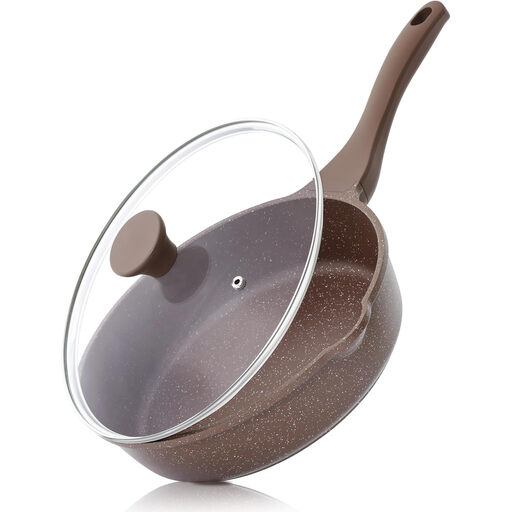
Why This Fits Their Persona: Perfect for preparing larger meals. The high sides and lid make the pan versatile for frying, braising, and making sauce-based dishes for the whole family.
This pan avoids the short-lived coating trap by using a granite non-stick coating that is free of PFOA, lead, and cadmium. The solid aluminium body prevents warping.
Large capacity (approx. 3.3 litres) and high versatility. The non-stick surface allows for very easy hand washing.
We have compiled a complete, up-to-date list of products that fully meet these strict selection criteria and German safety regulations.
1. How can I tell if my old pan is suitable for induction? The easiest way is the magnet test. Hold a standard magnet to the bottom of the pan. If the magnet sticks firmly, the base is ferromagnetic and therefore suitable for induction hobs. If it doesn't stick, or only very weakly, the pan will not work on an induction stove.
2. How do I properly care for a coated pan to extend its lifespan? Avoid overheating the empty pan. Use only wooden, silicone, or plastic utensils to prevent scratches. Although many pans are listed as dishwasher-safe, cleaning by hand with a soft sponge and mild detergent is recommended, as harsh cleaning agents can damage the coating.
3. Is a complete induction pan set worth it? An induction pan set can be a cost-effective initial purchase, as it's often cheaper than buying individual pans. It typically offers various sizes for different purposes. However, check if the pans included in the set match your actual cooking needs. Sometimes it makes more sense to selectively invest in two or three high-quality individual pans that are perfectly tailored to your habits (e.g., a small ceramic pan for eggs and a large stainless steel pan for searing).