
Lieferung heute & morgen

Qualitätsgarantie

Willkommens-Angebote freischalten: KOSTENLOSE Lieferung | Bis zu 80 % RABATT | Kostenlose 30-Tage-JoyPlus-Testphase
App herunterladen
A quality induction frying pan is the cornerstone of countless dishes. Yet, the market is flooded with models whose marketing promises often fall flat in practice. Many buyers quickly discover that heat is distributed unevenly, the coating fails, or the pan is simply unsuitable for their cooking style. Before you make a decision, it's crucial to understand the common pitfalls that can lead to a costly mistake.
As your Joybuy Product Recommendation Officer, I'm here to help you separate the wheat from the chaff. We'll explore which technical features truly matter and how to identify a durable, high-performance induction pan.
To avoid these issues, you should check three key aspects before buying. These determine whether an induction frying pan truly masters the technology and delivers in daily use.
For optimal performance on an induction hob, the pan's base must meet two criteria: it must be fully ferromagnetic and sufficiently thick.
The choice of the right coated frying pan depends on your priorities. The most common types are PTFE and ceramic coatings.
Regardless of the material, durability heavily depends on care. Use wooden or silicone utensils and, if possible, clean the pan by hand.
The right size depends on your household size and typical dishes.
The handle should be ergonomically shaped and securely riveted or screwed on. For maximum flexibility, an oven-safe pan with a stainless steel handle or a detachable handle system is an excellent choice. A lightweight frying pan with a well-insulated handle also makes it easier to manage in daily use.
Here are some models that represent a considered choice for different user profiles based on objective features.
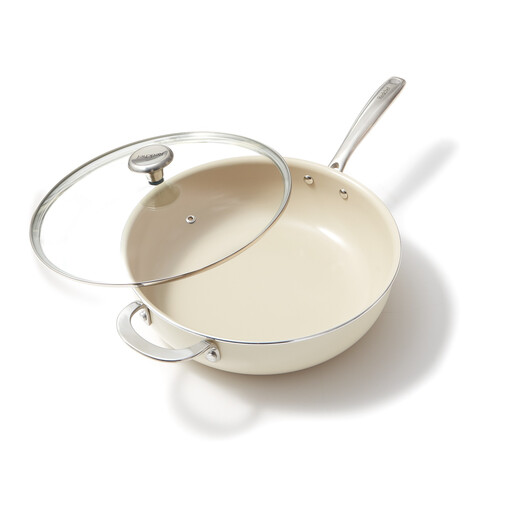
Why This Fits Their Persona: Ideal for cooks who love to sear at high heat and finish dishes in the oven. The solid cast aluminium body and stainless steel handle allow for use at very high temperatures. The ceramic coating is robust and designed for health-conscious cooking without harmful substances.
Its extreme oven-safe temperature (up to 450°C, according to the manufacturer) bypasses the pitfall of limited versatility. The robust cast aluminium construction ensures durability and even heat distribution.
High heat resistance for both hob and oven; non-toxic ceramic coating (free of PFAS, PFOA, lead, cadmium); includes a glass lid.

Why This Fits Their Persona: A straightforward and lightweight frying pan for quick, daily cooking. The aluminium body heats up fast, the non-stick coating facilitates low-fat frying and easy cleaning. The wooden handle is comfortable to hold and stays cool.
The light weight and ergonomic handle address everyday comfort. The easy-care coating counteracts the problem of short-lived surfaces, as long as it is handled properly.
Lightweight aluminium body for easy handling; fast and even heat conduction; easy-to-clean non-stick coating.
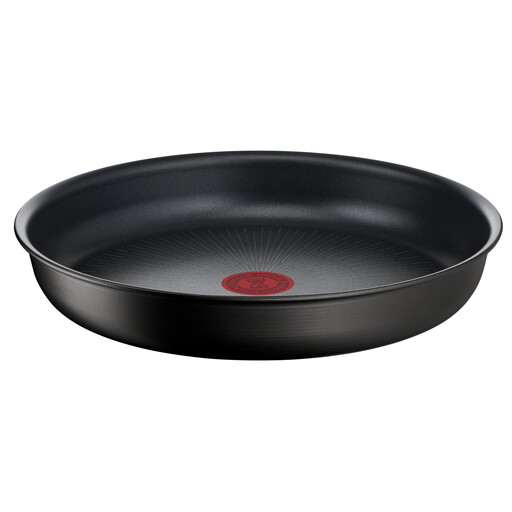
Why This Fits Their Persona: Perfect for anyone with limited storage space. The Ingenio system allows the pans to be stacked without bulky handles. The detachable handle (sold separately) makes the pan extremely versatile—from the hob to the oven and then into the fridge.
This concept directly solves the problem of limited versatility and high space requirements. Thanks to the detachable handle, the pan is automatically oven-safe and space-saving.
Extremely space-saving, stackable design; high versatility (hob, oven, fridge); durable non-stick coating, according to the manufacturer.

Why This Fits Their Persona: This induction pan set covers all bases with three different sizes (20, 24, and 28 cm)—from a small fried egg to a large family meal. The uniform quality and design ensure a cohesive cooking experience.
Instead of buying several individual pans of varying quality, this set offers consistent performance. The ceramic coating is PFOA-free and the pans are oven-safe, ensuring versatility.
Three essential sizes in one set; consistently oven-safe and induction-compatible; robust and non-toxic ceramic coating.
We have compiled a complete, up-to-date list of products that fully meet these strict selection criteria and safety standards.
The lifespan of a coating heavily depends on the material and care. A high-quality ceramic pan or PTFE pan can last for several years with proper handling. Avoid metal utensils, excessive heat on an empty pan, and aggressive cleaning agents. Cleaning by hand with a soft sponge is generally recommended to maximise its lifespan.
No, not every induction pan is automatically an oven-safe pan. The crucial factor is the handle material. Pans with stainless steel or cast iron handles are typically highly heat-resistant. Models with plastic or Bakelite handles are often only suitable for low temperatures (e.g., 70°C for keeping food warm) or not suitable for the oven at all. Always check the manufacturer's specifications for the maximum heat resistance.
This is a classic sign of an unsuitable pan base. If the base is too thin or the ferromagnetic material is not integrated across the entire surface, the induction field cannot transfer energy efficiently. This leads to "hot spots" and cold zones. A high-quality induction frying pan has a thick, warp-resistant base with a continuous ferromagnetic plate.