
Lieferung heute & morgen

Qualitätsgarantie

Willkommens-Angebote freischalten: KOSTENLOSE Lieferung | Bis zu 80 % RABATT | Kostenlose 30-Tage-JoyPlus-Testphase
App herunterladen
A good induction frying pan is the foundation of many successful dishes. Yet, the market is flooded with promises that often go unkept. Many home cooks invest in a new pan, only to find that after a few months, food sticks, the base warps, or heat is distributed unevenly. As your Joybuy Product Recommendation Officer, I'm here to help you identify the common pitfalls and make an informed decision.
Before we dive into the important features, let's shed light on the problems that lead to frustration in the kitchen. Recognising these marketing traps will protect you from a bad purchase.
To avoid the problems mentioned above, you should check three key technical parameters before buying. These determine the performance, longevity, and safety of your new pan.
For optimal performance on an induction stovetop, a solid, ferromagnetic base is essential. The stovetop's magnetic coils generate an alternating magnetic field that only produces heat in a magnetisable material.
A high-quality non-stick pan enables low-fat cooking and easy cleanup. But the differences are significant.
The material of the pan's body affects heat conduction and stability. Cast aluminium is a common and excellent choice here. Compared to cheaper, pressed aluminium, it is more warp-resistant, durable, and retains heat better, leading to more even cooking results.
Instead of making a one-size-fits-all recommendation, we have selected products that match specific user profiles and meet the quality criteria mentioned above.
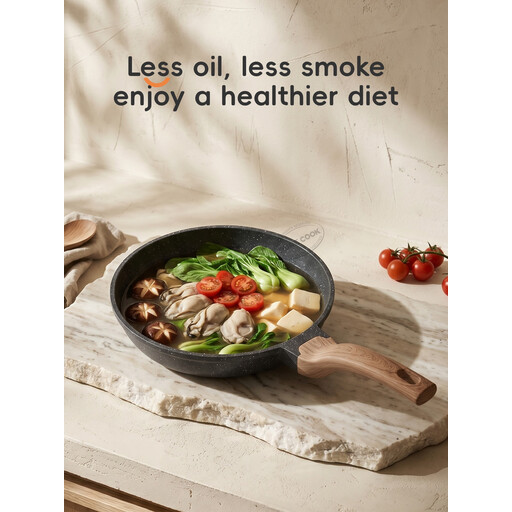
Why This Fits Their Persona: Ideal for daily use. The 24cm size is versatile for quick meals, from fried eggs to sautéed vegetables. The lightweight aluminium body makes handling effortless.
Avoids the short-lived coating trap with a food-grade, stone-look non-stick coating designed for heavy daily use and easy cleaning.
Fast and even heat conduction thanks to the aluminium alloy body. The universal base is suitable for all common stovetops, including induction.
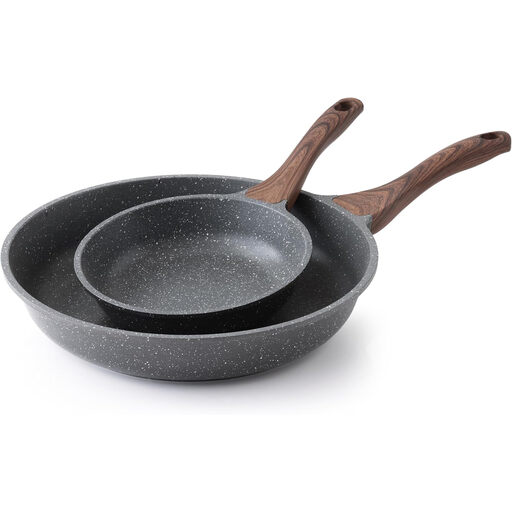
Why This Fits Their Persona: Perfect for chefs who need flexibility. The small 20cm pan is an excellent omelette pan, while the large 32cm pan has room for steaks or larger portions.
Addresses the "induction deception" with a high-grade magnetic stainless steel base that ensures fast, even heating. The coating is manufactured without intentionally added PFOA, according to the manufacturer.
The sturdy cast aluminium body is warp-resistant. The Swiss granite coating allows for cooking with little to no oil and is very easy to maintain.

Why This Fits Their Persona: This comprehensive induction cookware set covers all of a family's cooking needs—from pots for boiling and steaming to frying pans in various sizes.
Solves the problem of having to buy mismatched individual pieces. All parts of the set are made from the same material and optimised for induction, ensuring consistent cooking performance.
Excellent value for a complete starter kit. The uniform non-stick coating and induction compatibility make it a practical all-in-one solution.
We've compiled a complete, up-to-date list of products that fully meet these strict selection criteria.
1. How can I tell if my old pan is induction-compatible? The easiest way is the magnet test. Hold a standard refrigerator magnet to the bottom of the pan's base. If the magnet adheres strongly, the base is ferromagnetic and therefore suitable for induction stovetops.
2. Why is my frying pan warping on the induction stovetop? Warping is usually caused by thermal shock or a base that is too thin and unstable. This can happen when a hot pan is quenched with cold water or if the pan has a low material thickness to begin with. The extremely rapid and concentrated heating of induction can worsen this problem in low-quality pans. Look for a thick, solid base to prevent this.
3. Are pans with a granite coating really better? The term "granite coating" or "stone look" is primarily a marketing term for a multi-layer PTFE non-stick coating reinforced with mineral particles. Objectively, these coatings often offer greater scratch resistance and durability compared to basic, unreinforced PTFE coatings. However, they are not made of real stone. The advantage lies in their improved durability and appealing aesthetics.