
Lieferung heute & morgen

Qualitätsgarantie

Willkommens-Angebote freischalten: KOSTENLOSE Lieferung | Bis zu 80 % RABATT | Kostenlose 30-Tage-JoyPlus-Testphase
App herunterladen
Buying a new induction frying pan seems straightforward, but the market is flooded with products whose marketing promises don't hold up in practice. Many buyers find that after just a few months, heat is distributed unevenly, the coating deteriorates, or the pan warps. To help you make an informed decision based on facts instead of hype, we'll highlight the crucial criteria and most common pitfalls.
Before we dive into the technical details, it's important to understand the most common issues that lead to disappointment and unnecessary expense.
To avoid the pitfalls mentioned above, you should check three technical features before buying. These determine the durability, performance, and versatility of your new frying pan.
The base is the heart of any induction frying pan. Its quality determines the efficiency of heat transfer and distribution.
The choice of coating depends on your cooking habits and personal preferences.
A versatile pan should do more than just fry on the stovetop.
Based on the criteria above, we have compiled a selection of products suitable for different user profiles and their specific needs.
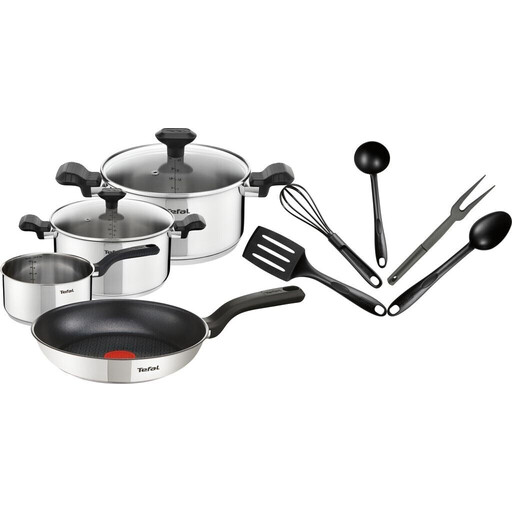
Why This Fits Their Persona: Ideal for a first kitchen or as a complete replacement for old cookware. This set covers all the basic needs with pots, a frying pan, and kitchen utensils, eliminating the need for individual purchases.
The thick, warp-resistant stainless steel base ensures solid heat distribution on induction cooktops, bypassing the trap of inefficient bases. The robust material choice promises greater durability than budget products.
Comprehensive 11-piece set made of high-quality 18/10 stainless steel. The pan features Tefal's Thermo-Spot technology, which indicates the optimal frying temperature.

Why This Fits Their Persona: Perfect for cooks who prioritize non-toxic materials and want a versatile, space-saving solution. Ideal for compact kitchens, RVs, or households that value organization.
The ceramic coating is free of PTFE, PFAS, and PFOA, directly addressing concerns about conventional non-stick coatings. The detachable handle system makes the pans fully oven-safe and highly versatile.
Extremely space-saving, stackable design. Without the handle, the pans are oven-safe up to 450°C (840°F) and suitable for all cooktops, including induction.

Why This Fits Their Persona: For home cooks who cook daily and need a durable, high-performance pan for a wide variety of dishes. The combination of stainless steel and a high-quality coating provides the right tool for demanding tasks.
The SiliTherm universal base is specifically designed for optimal heat distribution on induction. The robust stainless steel construction and durable Silitan non-stick coating counteract the trap of short-lived products.
Combines the robustness of 18/10 stainless steel with a 3-layer non-stick coating. The pans are oven-safe up to 260°C (500°F) and feature a wide pouring rim for drip-free pouring.
We have compiled a complete, real-time updated list of products that fully meet these strict selection criteria and German safety regulations.
1. How can I identify a good induction frying pan? You can identify a good induction pan by its thick, perfectly flat base that is strongly magnetic (test this with a magnet). A multi-layered construction, often called a "sandwich base," is an indicator of good heat conduction and retention. The weight of the pan can also be a clue; very light pans are more prone to warping.
2. How long does a non-stick pan last? The lifespan heavily depends on the quality of the coating and its care. A high-quality non-stick pan can last for several years with proper handling (no metal utensils, hand washing recommended, no overheating). Cheaper models can lose their non-stick properties in less than a year.
3. Is a ceramic pan better than a PTFE pan? Neither is universally "better"; they are suited for different purposes. A ceramic pan is free of plastics like PTFE and is often very heat-resistant, making it great for searing. However, it can be more sensitive to impacts. A PTFE pan typically offers superior non-stick properties, which are particularly beneficial for delicate foods like eggs. The choice should be based on your personal cooking habits and priorities.