
Lieferung heute & morgen

Qualitätsgarantie

Willkommens-Angebote freischalten: KOSTENLOSE Lieferung | Bis zu 80 % RABATT | Kostenlose 30-Tage-JoyPlus-Testphase
App herunterladen
An induction frying pan needs to do more than simply be recognised by an induction hob. In everyday use, the right size, even heat distribution, heat resistance and care requirements determine whether the pan becomes a regular favourite or is left in the cupboard after only a short time.
Many product descriptions rely on terms such as “non-stick”, “ceramic” or “suitable for all hob types”. However, these details are not always enough to assess how practical a pan will be in everyday use. Three common buying misconceptions deserve particular attention.
Induction hobs require a magnetic base. When choosing a frying pan for induction, it is therefore not enough for the general hob compatibility to be stated. A sufficiently large, flat base that sits evenly on the hob is also important, as is clear information from the manufacturer.
With a small 20 cm frying pan, the usable base may be considerably smaller than the top diameter. Conversely, a large frying pan may heat unevenly on a hob zone that is too small. For this reason, check the recommended hob-zone size whenever it is provided.
A non-stick frying pan generally reduces food sticking and makes cleaning easier. However, it is not automatically designed for high temperatures, sharp-edged metal turners or abrasive cleaning products.
For coated models, you should look out for the following information:
“Ceramic-coated” does not necessarily mean that the pan is made from solid ceramic. Many products consist of an aluminium or stainless-steel body with a ceramic coating.
A 28 cm frying pan offers space for several portions, but requires more storage room and can be considerably heavier, depending on the material. For a single omelette or a small portion of vegetables, a 20–24 cm pan is often easier to handle.
A wok pan or deep sauté pan makes sense if you often prepare vegetables, noodle dishes or casseroles. For shallow frying, pancakes or crêpes, however, low sides are more practical.
An aluminium frying pan is usually lightweight and heats up quickly. To work on induction, it needs a magnetic base or a suitable base construction. Aluminium with a multi-layer construction can distribute heat more evenly than very thin models.
An uncoated stainless-steel frying pan is robust and highly temperature-resistant, but requires a controlled approach when frying. Preheating, using the right amount of fat and cooking over medium heat can help reduce sticking. An aluminium core in a multi-layer base can improve heat distribution.
Cast iron retains heat for a long time but is heavier. This can be helpful when searing food, although it makes everyday handling and cooling more demanding.
With a coated induction frying pan, the specific manufacturer’s instructions should be more important than general marketing claims. PTFE and ceramic coatings have different care requirements. Information such as “PFOA-free” relates to the declaration for that particular product and should not be treated as a blanket statement about every other type of coating.
Where possible, use:
Even a pan labelled as dishwasher-safe may retain its surface finish for longer if washed by hand. If you are unsure, follow the manufacturer’s care instructions.
For a two-person household, 20–24 cm is often sufficient for smaller portions. 28 cm is more suitable for family-sized portions, several schnitzels or vegetable dishes. A frying pan with a lid is useful when you want to retain liquid, steam vegetables or finish cooking a dish slowly.
Also pay attention to:
The recommendations below categorise specific models according to different usage situations. The product information comes from the respective manufacturers’ and sellers’ details.

Why this product suits this profile: This compact aluminium pan is suitable for smaller portions and, according to the product information, is compatible with gas, electric, ceramic and induction hobs.
The manufacturer specifies a recommended hob-zone size of 14.5 cm and a maximum heat resistance of 260 °C, and advises against heating the pan while empty.
Coated aluminium, 20 cm diameter, plastic handle and, according to the seller, a five-year guarantee covering materials, workmanship and the non-stick function.
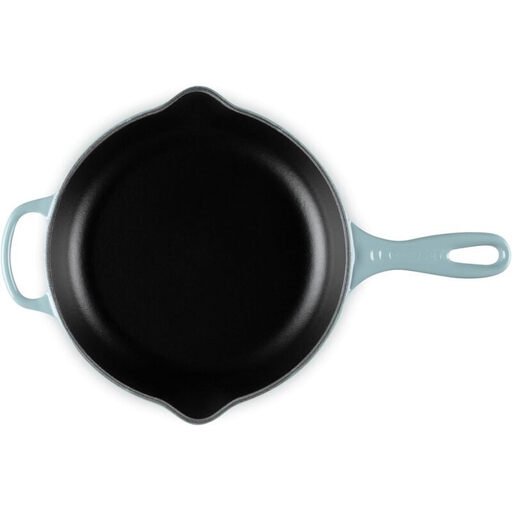
Why this product suits this profile: This enamelled cast-iron pan is suitable for induction, other hob types, the oven and the grill. It is ideal for anyone who prefers heavy cookware with excellent heat retention.
The specifications state the material, a weight of 1.93 kg and a maximum temperature of 350 °C. This helps put its greater weight compared with lightweight aluminium models into perspective.
Enamelled surface, two pouring spouts and an additional helper handle; according to the product description, it is suitable for searing and serving.
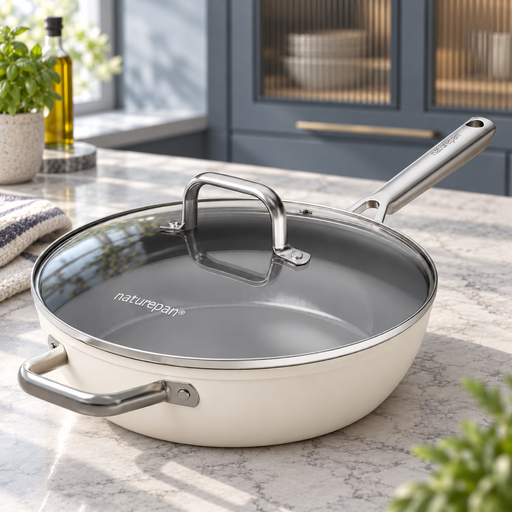
Why this product suits this profile: This deep 28 cm aluminium pan with matching lid is designed for larger portions, sautéing and covered cooking.
The product details specify compatibility with induction, gas, electric and ceramic hobs, as well as clear limits: up to 230 °C in the oven, with the lid removed beforehand.
Ceramic-coated aluminium body, 7.5 cm-high pan, matching lid and stated dishwasher suitability; hand washing is recommended to protect the surface.
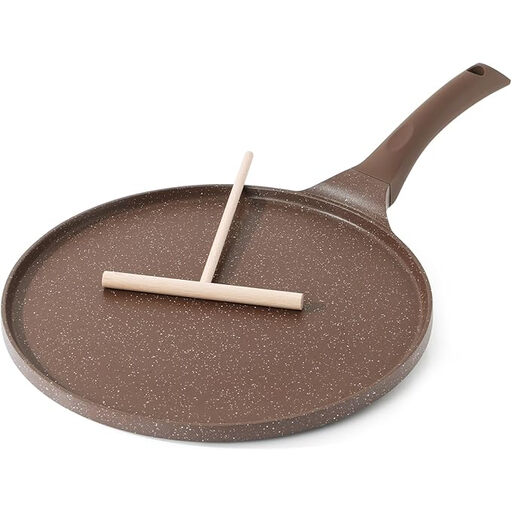
Why this product suits this profile: This shallow pan with low sides is suitable for crêpes, pancakes, tortillas, omelettes and similar dishes.
The specifications state that it has a magnetic stainless-steel base for induction, a maximum oven temperature of 302 °F, and that it should be washed by hand and used without metal utensils.
Aluminium core, shallow design, Bakelite handle and, according to the product information, a coating without intentionally added PFOA, lead or cadmium.
Even a solid induction frying pan can lose performance if handled incorrectly. After use, allow the cookware to cool down before cleaning it with cold water. With coated pans, avoid scratches and do not heat the pan empty on the highest setting.
Stainless steel requires a different approach: preheat the pan, add fat and choose the temperature carefully. Burnt-on residues can often be removed by soaking. Scouring products and steel wool can alter the surface.
For everyday cooking, size, weight, handle, cleaning and hob compatibility are all important. A 20–24 cm pan is suitable for smaller portions. If you regularly cook for several people, you can choose a 28 cm pan or a deep pan with a lid.
There is no single service life that applies in every case. It depends on how often the pan is used, the temperature, the utensils and the cleaning method. A coating should be replaced when it is visibly damaged or starts to peel. The manufacturer’s guarantee and care instructions provide additional guidance.
The pan itself does not use electricity. Energy consumption depends on the induction hob, the power setting, the cooking time and the hob zone used. A flat base that sits evenly on the hob and the correct hob-zone size can help transfer heat more efficiently.
We have put together a complete, regularly updated list of products that fully meet these strict selection criteria and the safety regulations applicable in the EU.