
Lieferung heute & morgen

Qualitätsgarantie

Willkommens-Angebote freischalten: KOSTENLOSE Lieferung | Bis zu 80 % RABATT | Kostenlose 30-Tage-JoyPlus-Testphase
App herunterladen
Buying a new induction frying pan seems straightforward, but the market is full of pitfalls. Many users only realise after their purchase that their pan heats unevenly, the coating wears off quickly, or it's simply unsuitable for their cooking habits. As your Joybuy Product Recommendation Officer, I'm here to help you navigate these common errors and make an informed decision.
Marketing promises can be misleading. Pay close attention to these three critical points to avoid a bad investment:
To make the right choice, focus on these three fundamental properties that separate a good induction pan from an inadequate one.
The base is the most critical factor for performance on an induction cooktop. Look for the following features:
The choice of coating depends on your cooking habits and priorities.
The right size and features make all the difference in your daily kitchen routine.
Here are a few models that represent a smart choice for different user profiles based on their objective features.

Why it's a good fit: Ideal for daily use like frying eggs or vegetables. The lightweight aluminium body and easy cleaning make it a practical tool for quick meals without breaking the bank.
The model is explicitly suitable for induction, gas, and ceramic hobs and features a food-grade non-stick coating. This meets the basic performance requirements for a reliable everyday induction pan.
The aluminium alloy ensures a low weight and fast, even heat conduction, which makes the cooking process more efficient.
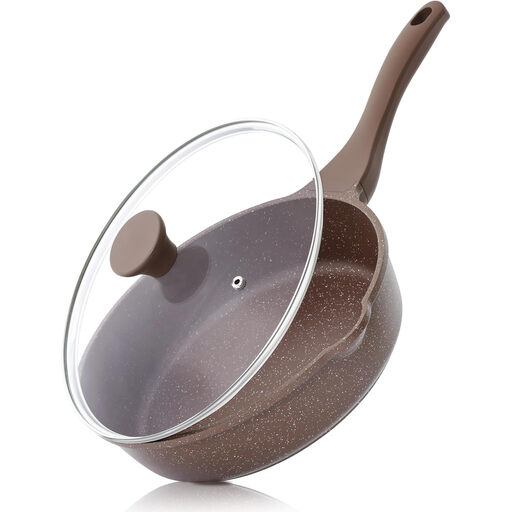
Why it's a good fit: The high sides and included lid make this pan extremely versatile—from searing and braising to steaming. Its size is perfect for family-sized portions or preparing complete one-pan meals.
According to the manufacturer, the granite non-stick coating is made without PFOA, PFOS, lead, and cadmium. This addresses concerns about material safety and coating durability.
The combination of a deep pan body and a matching lid enables a wide range of cooking methods that go beyond simple frying.
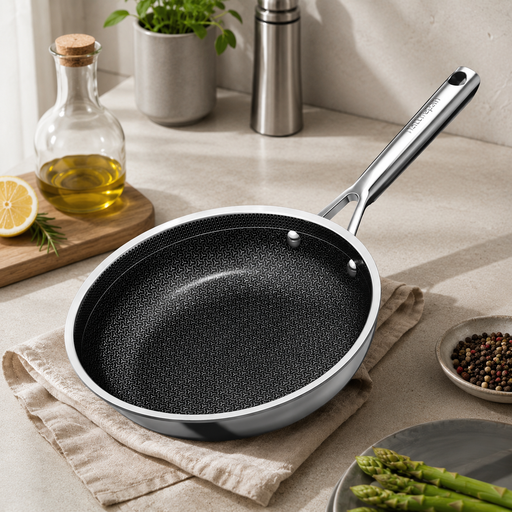
Why it's a good fit: For users who value durability and high performance. The hybrid construction is designed for intensive use, allowing for both high-heat searing on the stainless steel ridges and effortless food release from the ceramic valleys.
The laser-etched hexagonal surface protects the non-stick coating from direct contact with metal utensils, thereby increasing its lifespan. The coating is also explicitly declared to be PFAS, PFOA, and PTFE-free.
The 5-layer hybrid construction and high oven-safe temperature (up to 260°C / 500°F) offer performance and versatility suitable for demanding cooking applications.
We have compiled a complete, up-to-date list of products that fully meet these strict selection criteria and safety regulations.
The easiest way is the magnet test: hold a standard magnet to the bottom of the pan. If the magnet sticks firmly, the pan is ferromagnetic and therefore suitable for induction cooktops. If it doesn't stick, the pan will not work on an induction stove.
To protect the coating, you should follow a few basic rules: Clean the pan by hand with a soft sponge and mild dish soap, even if it's labeled dishwasher-safe. Avoid using metal utensils and never cut food directly in the pan. Do not preheat the empty pan on the highest setting; use medium heat instead.
Both types of coatings are considered safe for food contact when used correctly. Modern PTFE coatings are made without intentionally added PFOA. Ceramic coatings are naturally free of PTFE and PFAS. The decision often depends on personal cooking habits. Ceramic is often more heat-resistant for searing, while PTFE generally offers excellent non-stick properties for a longer period.