
Lieferung heute & morgen

Qualitätsgarantie

Willkommens-Angebote freischalten: KOSTENLOSE Lieferung | Bis zu 80 % RABATT | Kostenlose 30-Tage-JoyPlus-Testphase
App herunterladen
By the Joybuy Product Recommendation Officer, Published July 28, 2026
Buying a new induction frying pan seems simple. But disappointment often sets in after just a few months: the base warps, the coating peels, and food starts to stick. Many advertising claims turn out to be marketing hype, leading to costly mistakes. As your Product Recommendation Officer at Joybuy, I'm here to separate fact from fiction so your next induction frying pan becomes a worthwhile long-term investment.
Before we dive into the important features, let's look at the typical pitfalls that often lead to frustration in the kitchen.
To make an informed decision, you should examine three core technical aspects. These largely determine your pan's performance and lifespan.
For induction hobs, a solid, fully ferromagnetic base is essential. Look for the following constructions:
The base should be at least 4-5 mm thick to guarantee good stability and heat retention.
The choice of surface depends on your cooking habits and priorities.
Features like being oven-safe, dishwasher-safe, or with a detachable handle can significantly enhance user convenience.
Here are a few models that represent a considered choice for specific user profiles, based on objective features.
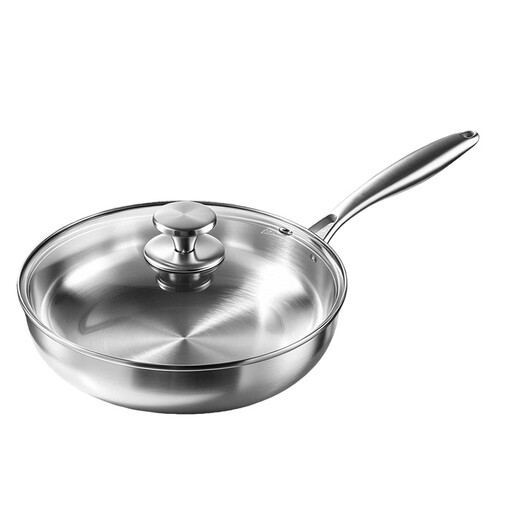
Why It's a Match: Ideal for cooks who value durability and pure, unadulterated flavour. The uncoated, food-grade stainless steel surface is perfect for searing steaks and vegetables at high temperatures.
This pan bypasses the coating debate entirely. Its solid 3-layer (Tri-Ply) construction ensures high stability and prevents warping on induction cooktops.
Maximum heat resistance and robustness; no chemical coating that can wear off. Excellent heat conduction for even cooking results.
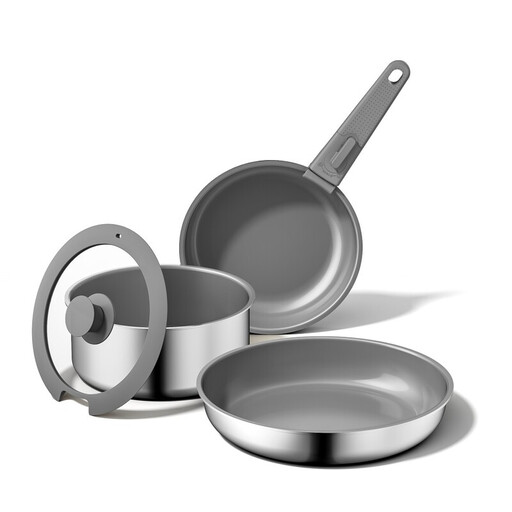
Why It's a Match: Perfect for households with limited storage space, like small city apartments or camper vans. The detachable handle allows the entire set to be stacked compactly.
This set solves the problem of cluttered cabinets. Instead of multiple bulky pans, it offers a compact all-in-one solution. The solid 3-layer stainless steel body ensures it won't warp.
Extremely space-saving thanks to the detachable handle. The PFAS- and PFOA-free ceramic coating is ideal for health-conscious cooking. The set is also oven-safe.

Why It's a Match: This induction pan set is a pragmatic all-rounder. With the popular 24 cm and 28 cm sizes, it covers most of a family's daily cooking needs, from fried eggs to stir-fries.
The set combines a durable Silitan non-stick coating with a robust stainless steel body and the SiliTherm base. This combination offers a great balance of non-stick convenience and structural stability.
Two versatile pan sizes in one set. The base ensures optimal heat distribution and retention on all hob types, including induction. The pans are also oven-safe.
We've compiled a complete, continuously updated list of products that fully meet these strict selection criteria and UK safety regulations.
1. How can I identify a good induction frying pan in a store? Bring a small magnet with you (the magnetic clasp on a handbag often works). Check if the entire base is strongly magnetic, not just a small spot in the centre. Also, look for a substantial weight and a base thickness of at least 4 mm. These are indicators of a solid, warp-resistant construction.
2. How long does a non-stick pan really last? The lifespan heavily depends on the quality of the coating and how you care for it. With daily use and proper care (hand washing, avoiding metal utensils and overheating), a high-quality non-stick pan can last 2 to 5 years. Cheaper models often lose their properties after just one year.
3. Is a ceramic pan better than a PTFE pan? Neither is universally "better"; they have different strengths. A ceramic pan is often the choice for users who want to avoid all types of fluoropolymers (PFAS). It offers good non-stick properties but can be more sensitive to overheating and thermal shock. A high-quality PTFE pan often provides slightly longer-lasting and more robust non-stick performance but requires equally careful handling. The decision is a personal trade-off between material preference and durability expectations.