
Lieferung heute & morgen

Qualitätsgarantie

Willkommens-Angebote freischalten: KOSTENLOSE Lieferung | Bis zu 80 % RABATT | Kostenlose 30-Tage-JoyPlus-Testphase
App herunterladen
An induction frying pan needs to do more than simply work on an induction hob. The key factors are a suitable base, an appropriate coating or stainless steel construction, and features that match the way you cook every day. Home cooks, families and demanding households should therefore check carefully before buying whether the pan is suitable for low-fat frying, sautéing, braising or wok dishes.
The term non-stick frying pan alone says little about the coating. Some models use PTFE, while others have a ceramic coating. For a PFAS-free frying pan, this information should be stated explicitly in the product details. Terms such as “healthy” or “Teflon-free” do not replace an exact description of the material.
A ceramic pan is not necessarily made entirely from ceramic either. It is often a metal body with a ceramic coating on the inside. This is explicitly how the Naturepan range is described.
A frying pan with a diameter of 28 or 32 cm does not always require an induction zone of the same size. If the base of the pan is significantly smaller than the cooking zone, heat distribution may be uneven when frying. For the 20 cm Silit Belluna, for example, a hob with a diameter of around 14.5 cm is stated as suitable.
Before buying, you should therefore compare the base diameter, not just the upper rim.
“Ovenproof” may mean that only the pan body, without the lid and handle, can go in the oven. With removable handles, these often need to be taken off. Similarly, with a dishwasher-safe pan set, only the metal bodies may be approved for dishwasher use, while handles, lids and accessories should be washed by hand.
Always check the maximum temperature and the specific conditions for the lid, handles and coating.
A coated frying pan is particularly suitable for eggs, fish, pancakes and vegetables. Wooden, silicone or nylon utensils are recommended for coated surfaces. Metal turners can damage the surface.
Ceramic coatings are often intended for low to medium temperatures. Avoid heating the pan empty for long periods and exposing it to sudden changes in temperature. With an uncoated stainless steel frying pan, by contrast, using the right preheating and oil technique is more important. The surface is fundamentally constructed differently, however.
Aluminium bodies heat up quickly and are comparatively lightweight. Multi-layer constructions made from stainless steel and aluminium combine a robust outer body with a heat-conducting core. This can support more even heat distribution in a stainless steel frying pan or wok.
Induction also requires a magnetic or induction-compatible base. Claims such as “suitable for all hob types” should explicitly include induction in the technical specifications.

Why this product suits the profile: The compact pan is designed for smaller portions and hobs with a diameter of around 14.5 cm. The aluminium body is lightweight, and according to the product information, the Silitan PTFE coating is intended for low-fat frying.
The stated pan diameter and matching hob size make choosing easier. However, according to the specifications, oven use is limited to up to 70 °C.
20 cm diameter, induction compatibility, low weight and a stated five-year manufacturer's warranty.

Why this product suits the profile: The uncoated three-layer construction of stainless steel, an aluminium core and stainless steel is designed for high temperatures and various wok techniques. A metal lid with a steam vent completes the features.
The product description explicitly states the material construction, induction compatibility, lid and oven suitability. As there is no non-stick coating, coating wear is not a selection criterion.
32 cm diameter, steam valve in the lid, suitable for all common hob types and, according to the product information, dishwasher-safe.
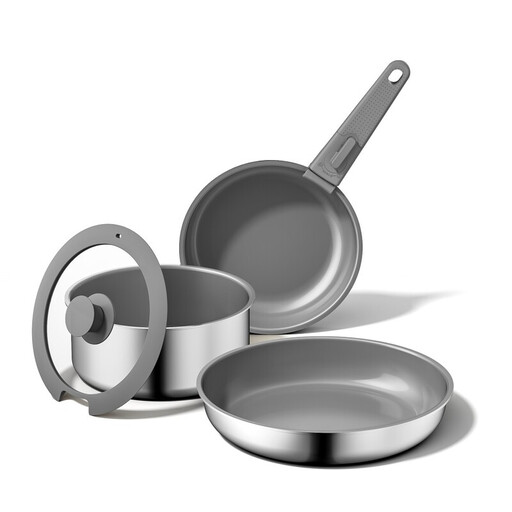
Why this product suits the profile: The set combines two saucepans, two frying pans, a sauté pan, lids, removable handles and pan protectors. This covers a range of cooking situations in one household.
The individual components and temperature limits are clearly stated. For oven use, handles, lids and accessories must be removed; this restriction should be taken into account before buying.
20 and 26 cm frying pans, 3-litre saucepan, stackable bodies and oven suitability up to 230 °C without removable components.
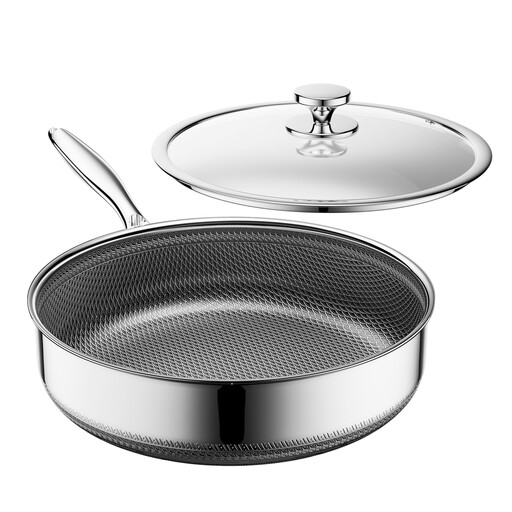
Why this product suits the profile: The deep pan with glass lid combines stainless steel and a ceramic coating. According to the product information, it is PFAS-, PTFE- and PFOA-free and suitable for induction, various hob types and oven use.
The information distinguishes between the temperature limits for the pan and the lid: up to 260 °C for the pan body and up to 148 °C for the glass lid.
Deep shape, lid, induction compatibility, dishwasher suitability and an explicitly stated PFAS-, PTFE- and PFOA-free coating.
We have put together a complete, regularly updated list of products that fully meet these strict selection criteria and the safety regulations applicable in the EU.
A non-stick frying pan or ceramic pan makes it easier to release delicate foods. For low-fat frying, an intact coating, low to medium heat and suitable cooking utensils are more important than marketing terms. The manufacturer's information on materials and care should be clear.
There is no standard service life. It depends on the temperature, cleaning method, utensils used and frequency of use. Overheating, metal utensils and significant temperature shocks can damage the coating sooner.
An uncoated stainless steel frying pan usually requires a little more practice when it comes to preheating and the amount of oil used. However, there is no traditional non-stick coating that can be worn away by scratches. For wok dishes and high-heat searing, an induction wok pan made from multi-layer stainless steel can be a suitable option, provided its size and heat zone match the hob.