
Lieferung heute & morgen

Qualitätsgarantie

Willkommens-Angebote freischalten: KOSTENLOSE Lieferung | Bis zu 80 % RABATT | Kostenlose 30-Tage-JoyPlus-Testphase
App herunterladen
An induction frying pan needs to do more than simply be magnetic. It should heat evenly, suit your hob, be comfortable to handle and, depending on its design, also allow you to sauté or braise. However, many disappointing purchases are not caused by the price, but by unclear information about the coating, base, cleaning requirements and temperature limits.
Aluminium is a good heat conductor, but it is not automatically suitable for induction. Only a magnetic base plate or a suitably designed multi-layer base makes it compatible with an induction hob. Therefore, look for the specific wording “induction suitable” or “suitable for all hob types”. It is also important that the base of the pan sits as flat as possible on the hob.
A non-stick frying pan makes it easier to cook with little oil and simplifies cleaning. However, a non-stick surface can be damaged by overheating, metal utensils, abrasive cleaners or sudden temperature changes. Coated aluminium frying pans in particular should not be heated empty on a high setting.
A 28 cm frying pan can offer different amounts of cooking space depending on the shape of its rim and base. A rim that slopes sharply outwards makes turning food easier, while a deeper shape provides more room for sauces, vegetables or braised dishes. As well as the diameter, check the height, capacity and suitable hob-zone size.
A non-stick frying pan is particularly suitable for eggs, pancakes, fish and vegetables. The models considered here use, among other options, PTFE or ceramic coatings. Claims such as “PFOA-free” refer to the material properties stated by the supplier and should not be interpreted as a general statement about health benefits.
For a long service life, we recommend:
A dishwasher-safe frying pan can be convenient for everyday use. Nevertheless, check the manufacturer’s instructions carefully, as hand washing is often recommended to protect the coating and handle.
An aluminium frying pan usually heats up quickly and is comparatively easy to lift. Models with a magnetic stainless-steel base are suitable for induction. Cast properties or a thicker base can increase the weight, but may also affect heat retention.
An uncoated stainless-steel frying pan is robust and suitable for high temperatures. However, it requires more attention when cooking: preheating, the right temperature and enough fat can help reduce sticking. Multi-layer stainless-steel frying pans with an aluminium core combine a stainless-steel interior with a heat-conducting core.
A deep frying pan with a lid or sauté pan is a sensible choice if you want to do more than fry, such as braising, steaming or reducing sauces. A glass lid lets you keep an eye on the food without constantly removing it.
You should also check:
For products with plastic or Bakelite handles, the stated oven suitability is particularly important. A model may be suitable for induction without automatically being approved for high oven temperatures.

Why this product suits this profile: The compact size is ideal for smaller households and everyday portions. According to the product information, this coated aluminium frying pan is suitable for gas, electric, ceramic and induction hobs.
The information explicitly states that it is suitable for induction, specifies the type of coating and gives temperature limits of 260 °C and 70 °C in the oven.
24 cm diameter, PTFE-based Silitan coating according to the manufacturer and a five-year manufacturer’s warranty covering materials, workmanship and non-stick performance.
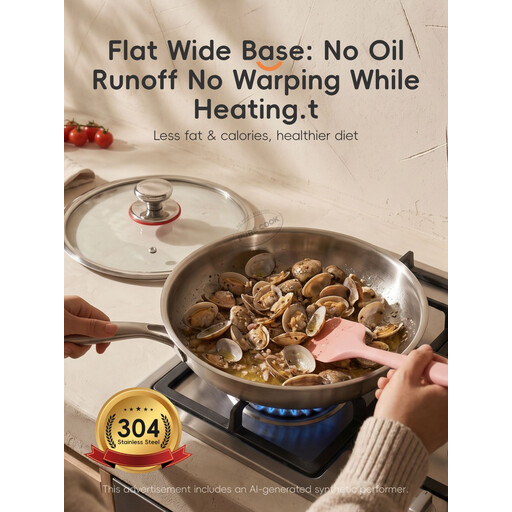
Why this product suits this profile: The combination of 304 stainless steel, an aluminium core and a stainless-steel outer layer is ideal for households looking for an uncoated, versatile frying pan.
The multi-layer construction and suitability for induction, gas and ceramic hobs are clearly specified. According to the product description, the pan is dishwasher-safe.
28 cm diameter, 304 stainless steel with an aluminium core, glass lid and stated oven suitability up to 220 °F.
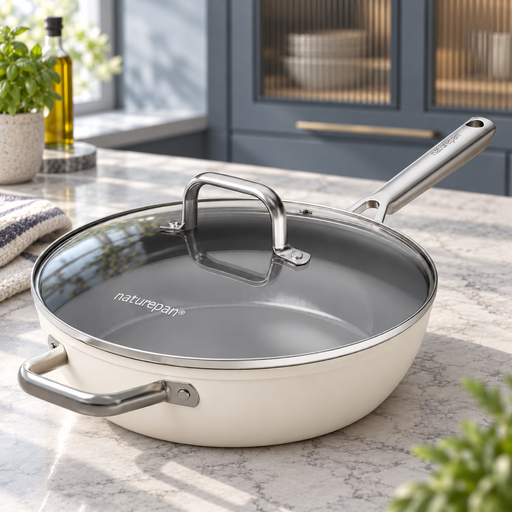
Why this product suits this profile: The deep shape and included lid are suitable for sautéing, braising, vegetable dishes and sauces for several portions.
The information specifies the base and body dimensions, hob compatibility and the requirement to remove the lid before using the pan in the oven.
28 cm diameter, 7.5 cm body height, ceramic coating and dishwasher suitability according to the product information.
We have put together a complete, regularly updated list of products that fully meet these strict selection criteria and the safety regulations applicable in the EU.
With an induction-compatible frying pan, the cooking zone should match the base. A significantly smaller or larger diameter can affect heat distribution. Coated models are best used on a low to medium setting. Depending on the manufacturer’s instructions, stainless-steel frying pans can be heated more intensely, but they require careful temperature control.
Do not use abrasive cleaning products and avoid sudden temperature changes. Even if a pan is labelled dishwasher-safe, hand washing may be gentler on the surface and handles. Glass lids should not be moved directly from high heat into cold water.
A magnetic or induction-compatible base is essential. The product description should explicitly state “induction” or “all hob types including induction”. If you are unsure, holding a magnet against the outside of the pan base can provide an initial indication; however, the manufacturer’s information remains the decisive source.
20 to 24 cm is often suitable for individual portions, egg dishes or smaller households. A 28 cm frying pan provides more space for several portions and is ideal for family meals. Also check whether the corresponding hob zone covers the base evenly.
It is not possible to give a reliable fixed lifespan for every model. It depends on heat, utensils, cleaning and how often the pan is used. Avoiding high temperatures, metal utensils and heating the pan empty reduces the typical stresses placed on the coating. With a stainless-steel frying pan, the coating is not a wear component, but you will need to adapt your frying technique.