
Lieferung heute & morgen

Qualitätsgarantie

Willkommens-Angebote freischalten: KOSTENLOSE Lieferung | Bis zu 80 % RABATT | Kostenlose 30-Tage-JoyPlus-Testphase
App herunterladen
An induction frying pan needs to do more than simply stick magnetically to the hob. For everyday use, you’ll want a base that fits your cooking zone, controllable heat, a suitable coating and care instructions that match the material. There’s plenty of choice for UK households, from coated frying pans and stainless steel or ceramic models to deep frying pans and pans with lids.
If you focus only on terms such as “scratch-resistant”, “premium” or “non-stick”, you could miss important details. The points below will help you separate marketing claims from features that matter in practice.
An induction-compatible pan needs a magnetic base. But it’s also important to consider how evenly it distributes heat and whether it sits flat on the hob. In multi-layer designs, an aluminium core between layers of stainless steel can improve heat conduction. Look for specific details about the base construction in the product description.
A dishwasher-safe frying pan can go in the dishwasher, but high temperatures, alkaline detergents and mechanical wear can put extra strain on its surface. For coated models, hand-washing with a soft sponge is often a better option. This applies even when the manufacturer explicitly says the pan is dishwasher-safe.
A non-stick frying pan isn’t automatically suitable for every temperature or cooking utensil. Metal turners, knives, scouring pads and prolonged heating while empty can damage the coating. For ceramic and hybrid surfaces, you should also follow the manufacturer’s care instructions. Claims such as “PFAS-free”, “PFOA-free” or “PTFE-free” should relate specifically to the product in question, rather than being applied broadly to all coated pans.
A stainless steel pan is usually uncoated and can be highly practical for everyday cooking when used at the right temperature. However, food can stick more easily if the pan is too cold or used without enough fat. A three-ply stainless steel model with an aluminium core will typically distribute heat differently from a simple, thin-walled pan.
Aluminium heats up quickly and is often used in coated models. Cast iron retains heat for longer, but is considerably heavier. For example, according to its product specifications, an enamelled cast-iron pan with a 23 cm diameter may weigh around 1.93 kg. Bear this in mind when handling and washing it.
For a ceramic pan or hybrid pan, the precise nature of the surface matters. The ZEROPAN and Naturepan models in this selection are described as combining stainless steel, an aluminium core and a ceramic coating. According to the product descriptions, these models are free from PFAS, PFOA and PTFE. These claims apply to the respective manufacturers’ product descriptions and shouldn’t be taken as general statements about other products.
For PTFE-coated pans, such as the Silit Belluna models, the product description specifies a Silitan coating that is heat-resistant up to 260 °C. The stated oven temperature may be considerably lower; for Belluna, it’s listed as up to 70 °C. Check suitability for the hob, oven and cleaning separately.
A 28 cm frying pan is suitable for cooking several portions, but needs a cooking zone large enough to match. For eggs or smaller portions, a 20 to 24 cm pan is often easier to handle. A deep frying pan with a rim height of 7 to 8 cm is handy for vegetable dishes, braised meals and larger quantities. A frying pan with a lid is useful when you want to reduce liquids or cook food covered.
Also check:
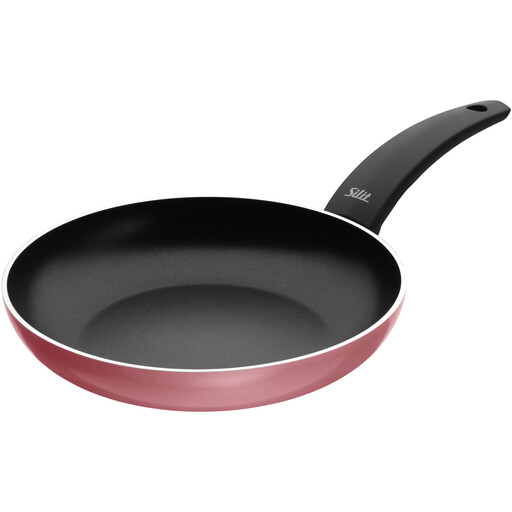
Why this product suits this profile: This 24 cm aluminium pan is designed for smaller households and everyday portions. According to the product details, it’s suitable for induction, gas, electric and ceramic hobs.
The product details give specific information about hob compatibility, coating and temperature, rather than relying on general non-stick claims.
24 cm diameter, coated aluminium, induction-compatible and, according to the product details, backed by a five-year manufacturer’s warranty.
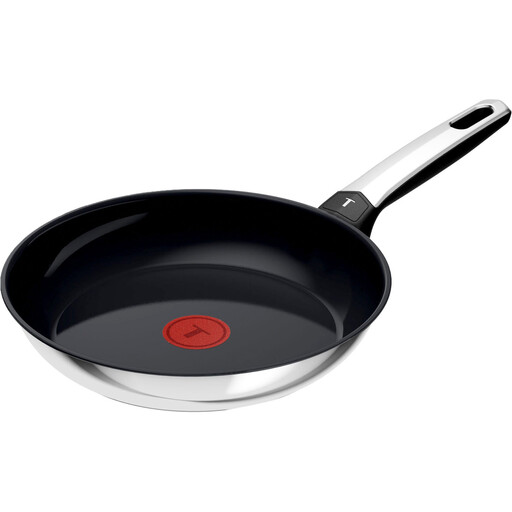
Why this product suits this profile: This 28 cm pan, with an 18/10 stainless steel body and ceramic non-stick coating, is designed for households that cook larger portions.
The product details specify the material combination, 8.2 cm height, induction base and recommendation to avoid metal utensils.
28 cm diameter, deep shape, Thermo-Signal indicator, induction-compatible and dishwasher-safe according to the product description.
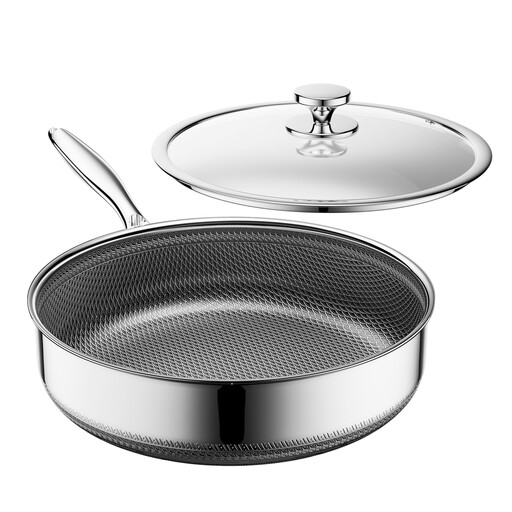
Why this product suits this profile: Its deep shape and glass lid make it suitable for family-sized portions, sauces and dishes that need to continue cooking covered.
According to the product details, the pan and lid have different maximum oven temperatures. This distinction helps prevent assumptions that the same limit applies to both.
Coating described as PFAS-, PTFE- and PFOA-free, induction-compatible, dishwasher-safe and oven-safe up to 260 °C for the pan.
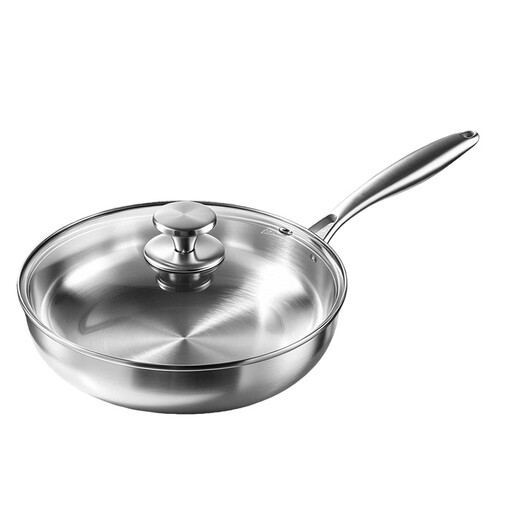
Why this product suits this profile: The uncoated, three-ply construction is designed for people who prefer to cook without a non-stick surface and control the temperature themselves.
The product description explicitly states that the pan is uncoated and that food may stick if it’s used at the wrong temperature.
304 stainless steel, aluminium core, induction-compatible, glass lid and dishwasher-safe according to the product details.
We’ve put together a comprehensive, regularly updated list of products that meet these strict selection criteria and fully comply with the safety regulations in force in the EU.
A 28 cm frying pan is often practical for cooking several portions. If you have a small hob, check that the pan base matches the heated zone. A large rim diameter alone doesn’t guarantee even heating.
“Scratch-resistant” isn’t a standardised technical category. Even ceramic or hybrid coatings marketed as durable shouldn’t be used with metal cutlery, knives or scouring pads. Always follow the manufacturer’s specific care instructions.
Electricity consumption depends mainly on cooking time, temperature, the pan base and how well the pan size matches the cooking zone. An induction-compatible pan that fits well can make more effective use of the hob’s heat. Shorter preheating times, medium heat and avoiding heating the pan while empty can help limit unnecessary energy use.