
Lieferung heute & morgen

Qualitätsgarantie

Willkommens-Angebote freischalten: KOSTENLOSE Lieferung | Bis zu 80 % RABATT | Kostenlose 30-Tage-JoyPlus-Testphase
App herunterladen
An induction frying pan needs to do more than simply respond magnetically to the cooktop. A flat, stable base, the right size, a suitable handle, and care requirements that match the material are all essential. Focusing only on terms such as “non-stick,” “scratch-resistant,” or “suitable for all cookers” often means overlooking important limitations.
As a Joybuy Product Recommendation Officer, I assess the relevant product features objectively and show which induction pan best suits different cooking habits.
The specification pan for all cookers should always be checked against the product’s technical data. For the models considered here, suitability for induction, gas, electric, and ceramic cooktops is explicitly stated in several places. However, differences may still exist in oven compatibility, maximum temperature, or handle material.
A plastic or Bakelite handle, for example, is not automatically suitable for high oven temperatures. The Silit Belluna 20 cm is described as suitable for all cookers, while its stated oven suitability extends only up to 70°C. That makes it suitable for keeping food warm, but it should not be equated with a stainless-steel pan designed for high-temperature oven use.
A coated frying pan can make cleaning easier and is often well suited to delicate foods such as fish, eggs, or pancakes. However, coated surfaces should not be overheated while empty and should generally be used with wooden, silicone, or plastic utensils.
An uncoated frying pan made from stainless steel, cast iron, or carbon steel requires more attention. This may initially result in more sticking, but the issue can be managed through proper temperature control and—particularly with cast iron or carbon steel—seasoning and regular oiling.
A 28 cm frying pan provides plenty of space for vegetables, meat, or several portions. If the induction zone is significantly smaller, however, heat may be distributed unevenly. For smaller households or a cooktop with a 14.5 cm zone, a 20 cm frying pan, 22 cm, or 24 cm model may be more practical.
The usable base is more important than the diameter measured at the upper rim. With wok pans, buyers should also consider the weight: a model with a lid can be considerably more cumbersome to move during everyday use than a flat aluminium pan.
Aluminium heats up relatively quickly and is often lighter. For induction cooking, however, it requires a magnetic base plate. The Silit Belluna is made from coated aluminium and is suitable for induction cooktops.
Multi-layer stainless steel with an aluminium core, also known as a tri-ply construction, combines a stainless-steel cooking surface with a heat-conducting core. The PURECOOK models in 28 cm and the Maxcook pan in 22 cm are described as featuring a stainless steel–aluminium–stainless steel structure. Stainless steel is uncoated, but it can be more prone to sticking if used at the wrong temperature.
Cast iron and carbon steel retain a great deal of heat. The 10 cm Maxcook cast-iron pan is designed for small portions and must be dried and oiled immediately after cleaning. According to its product description, the 24 cm Ballarini carbon-steel pan develops a natural patina through seasoning. Neither material should be treated as equivalent to a conventional non-stick coating.
With a non-stick frying pan, buyers should pay attention to the specific type of coating and the care instructions. According to the manufacturer’s information, the Silit Belluna uses a PTFE-based Silitan coating. The Naturepan 28 cm is described as having a ceramic coating on a multi-layer stainless-steel body. A ceramic pan can be an alternative to conventional coatings, but it also requires gentle cleaning and moderate temperatures.
Those who prefer to avoid coatings can choose from stainless steel, cast iron, or carbon steel. Claims such as “free from harmful substances” or “non-toxic” should not be accepted at face value. The decisive factors are the specific material and conformity details provided by the respective manufacturer.
A pan with a lid is also useful for braising, reducing, and keeping food warm. However, the lid adds weight and requires additional storage space. “Dishwasher-safe” also does not mean that the dishwasher is the gentlest option for every material. With coated models and polished surfaces, hand washing can help extend the product’s service life. Cast iron and carbon steel should generally never be placed in the dishwasher.

Why it suits this profile: This compact aluminium pan is designed for small portions and delicate ingredients in everyday cooking.
The product data explicitly states induction compatibility and a PTFE-based Silitan coating. This makes the type of surface easier to assess than with an unspecified “non-stick” marketing claim.
20 cm diameter, low weight, compatibility with all listed cooker types, and a five-year manufacturer’s warranty according to the product information.
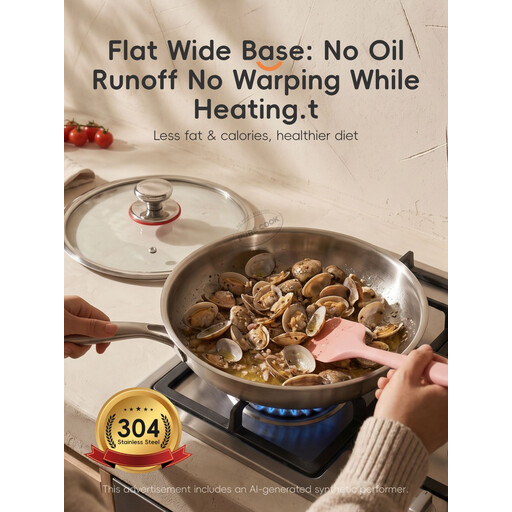
Why it suits this profile: This uncoated 28 cm pan is aimed at households seeking to combine stainless steel, a generous cooking surface, and broad cooker compatibility.
The three-layer construction and 304 stainless-steel specification are clearly stated. Buyers should nevertheless note that uncoated stainless steel requires appropriate temperature and oil control.
Tri-ply construction, 28 cm diameter, induction compatibility, and dishwasher-safe cleaning according to the product description. This version does not include a lid.
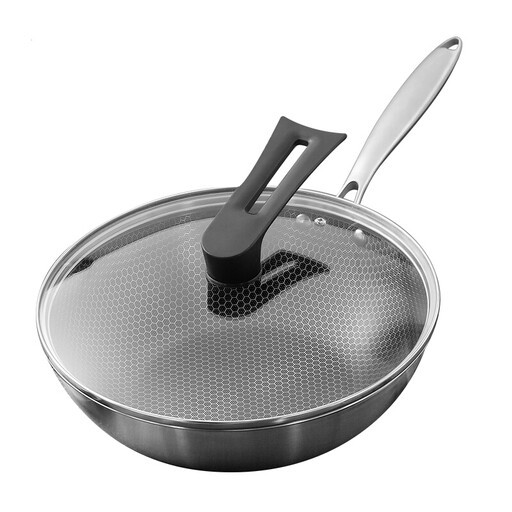
Why it suits this profile: This large wok pan with lid is designed for generous quantities, one-pan dishes, and braising.
The product description explicitly states compatibility with gas, induction, and electric cookers, as well as the inclusion of a lid. Before buying, customers should check the available cooktop area and the total weight.
30 cm diameter, stainless-steel honeycomb surface, and lid. The stated combined weight of the pan and lid is approximately 2.1 kg.
We have put together a current selection of pans that takes key criteria such as material, cooker compatibility, size, and care requirements into account.
A 24 cm frying pan is a practical middle ground for many two-person households. For individual portions or smaller cooktops, 20 to 22 cm is sufficient. Those who regularly prepare vegetables, meat, or several portions may prefer 26 to 28 cm.
Service life depends on the material, temperature, cleaning routine, and frequency of use. Stainless steel, cast iron, and carbon steel can last for many years with proper care. Coated pans should not be overheated while empty; visible damage or noticeably reduced non-stick performance are reasons to replace the pan.
Not necessarily. A dishwasher-safe pan can be cleaned in the dishwasher according to the manufacturer. However, hand washing with a mild detergent is often gentler on coatings, ceramic surfaces, and polished stainless steel. Cast iron and carbon steel require different care and should be stored dry and lightly oiled.