
Lieferung heute & morgen

Qualitätsgarantie

Willkommens-Angebote freischalten: KOSTENLOSE Lieferung | Bis zu 80 % RABATT | Kostenlose 30-Tage-JoyPlus-Testphase
App herunterladen
Choosing a new hob is a crucial decision when planning or renovating a kitchen. Technology has evolved, and the sheer number of features and designs can be overwhelming. This article serves as a guide, providing objective information to help you find an induction hob or a suitable alternative that matches your cooking habits and kitchen layout.
To make an informed decision, it's helpful to understand a few basic criteria. From cooking technology to specific convenience features, there are key differences that will impact your daily kitchen routine.
The most fundamental choice concerns the heating technology. The two most common standalone systems are induction and ceramic glass (often called ceramic).
Installing a standalone ceramic hob means it can be placed anywhere in the worktop, independent of the oven, offering maximum flexibility in kitchen design. The same applies to standalone induction hobs.
The standard width for hobs is 60 cm. These models typically offer 4 burners (cooking zones) and fit into most standard kitchen cabinets. For larger households or ambitious cooks, wider models of 80 or 90 cm are also available.
Pay attention to the arrangement and flexibility of the zones:
Modern hobs offer a range of features that make cooking more convenient and safer.
Here we present a selection of hobs that cater to different requirements and preferences. The descriptions are based on the product data provided by the manufacturer.
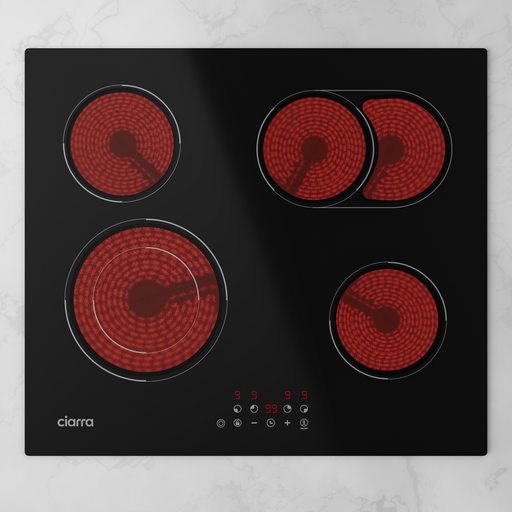
Why it stands out: This model is a ceramic glass hob that offers high versatility thanks to its flexible cooking zones. The combination of an oval roaster zone and a dual-circuit zone allows for the efficient use of cookware of different shapes and sizes.
Advantages:
Who is it for? For users who appreciate the universal compatibility of a ceramic hob but don't want to miss out on flexible cooking zones for special cookware.

Why it stands out: This induction hob in the standard 60 cm size combines a high power output of up to 7200 W with useful features like a boost function for all four zones. It represents a functional and powerful option.
Advantages:
Who is it for? For budget-conscious buyers looking for the benefits of induction technology, including fast heat-up times and high efficiency, in a well-equipped built-in hob.
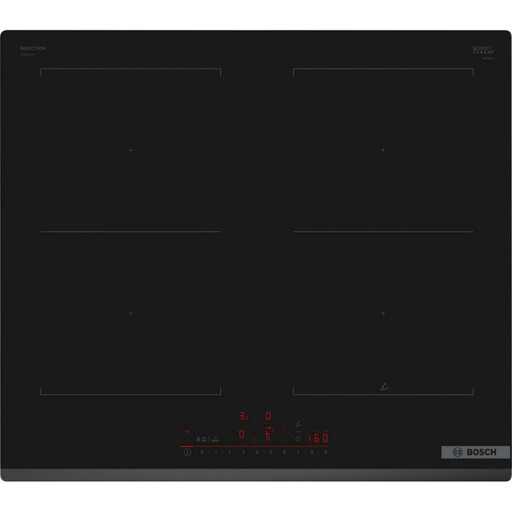
Why it stands out: The Bosch PVQ631HC1E stands out for its CombiZone technology. Two cooking zones can be linked to form a large, rectangular surface, which is ideal for large roasters, grills, or multiple small pots at once.
Advantages:
Who is it for? For tech-savvy home cooks who value brand quality, high flexibility in cooking, and smart features, and are willing to invest in a premium appliance.
For kitchens that require an efficient extraction solution integrated directly into the hob, hobs with integrated extractors are an excellent choice. These appliances combine cooking and ventilation functions and are an elegant solution for open-plan kitchens or kitchen islands.
Discover our selection of extractor hobs to find the right option for your kitchen design.
1. What cookware do I need for an induction hob? An induction hob requires cookware with a ferromagnetic base. You can easily test if a pot or pan is suitable with a magnet: if it sticks to the bottom of the pot, the cookware is induction-compatible. Materials like cast iron, enamelled steel, or special stainless steel alloys are generally suitable.
2. Is an induction hob more energy-efficient than a ceramic hob? Yes, induction technology is generally more energy-efficient. Since the heat is generated directly in the base of the pot and doesn't have to heat the glass plate first, less energy is lost to the surroundings. This results in shorter cooking times and lower electricity consumption compared to a ceramic glass hob.
3. What does 'standalone' mean for a hob? A standalone hob has its own controls and power connection. It can therefore be installed in the worktop independently of an oven. This offers maximum flexibility in kitchen planning, as the hob and oven can be placed in different locations—for example, the hob on a kitchen island and the oven in a tall cabinet at eye level.