
Lieferung heute & morgen

Qualitätsgarantie

Willkommens-Angebote freischalten: KOSTENLOSE Lieferung | Bis zu 80 % RABATT | Kostenlose 30-Tage-JoyPlus-Testphase
App herunterladen
An induction hob can make everyday cooking easier when the design, cookware and power connection match the way you use it. However, many purchasing decisions go wrong not because of the heating technology, but because important details are overlooked: a portable appliance is not automatically suitable for several pans, a high total power rating says little about how it actually operates, and a glossy glass surface is only easy to clean when treated correctly.
Figures such as 5,600 or 7,400 watts usually describe the maximum total power of a built-in hob. They do not automatically show how quickly a single zone will heat a pan or how power is distributed when several zones are active. With a portable induction hob rated at 2,000 watts, a standard household connection is also relevant. A single cooking zone may be sufficient for one- or two-person households, while families will more often need four zones.
An induction hob 60 cm wide is not necessarily exactly 60 cm wide. For example, the Bosch PVS611BB6E is listed with product dimensions of 59.2 × 52.2 × 5.1 cm, while the required cut-out measures 56 × 49 cm. Before buying, you should therefore compare the appliance width, installation depth, cut-out dimensions, ventilation and connected load with your existing worktop and electrical installation.
An induction hob with touch control may look streamlined, but it can be less convenient to operate with wet or dirty fingers. Clear displays, intuitive power-level selection and the option to assign the timer directly to the relevant zone are key. The glass surface also needs clearance from metal objects and must not be used if it is cracked.
If you regularly cook with several pans, an induction hob with 4 zones is practical. Check the diameter of each zone, as a large frying pan needs a suitably sized heating area. A hob with FlexInduction can combine adjacent zones to create a larger cooking area. This is particularly useful for roasting dishes, elongated grill plates or large oval frying pans.
A portable appliance or an induction hot plate, on the other hand, only needs a level, heat-resistant surface. A double induction hot plate provides two zones but is generally more flexible to use than a built-in appliance. Important: induction only works with magnetic cookware. A magnet held against the base of the pan gives you an initial indication, but it does not replace the manufacturer’s specifications.
Several power levels make it easier to switch between searing, boiling and keeping food warm. According to the product specifications, the ochama Induction Hub operates at 2,000 watts and offers ten power levels. The ProfiCook double hot plate specifies 16 function levels per hob, including six power levels and ten temperature levels from 60 to 240 °C.
Built-in appliances often offer Boost or PowerBoost functions. Bosch specifies a maximum total power of 6,600 watts and a PowerBoost function for the PVS611BB6E. The PVQ631HC1E is listed with 7,400 watts and four zones. Actual performance depends on the selected zone, cookware, power supply and power management.
An induction hob with timer can help switch a zone off automatically. However, this function does not replace supervision while cooking, particularly when using oil or fat. Other useful features include a child lock, pan detection, residual-heat indicator and overheating protection. According to its product description, the ochama portable appliance has a safety lock; the ProfiCook hot plate also specifies pan detection, overheating protection and automatic shut-off functions.
When installing a built-in appliance, a qualified electrician should check the technical requirements. The voltage, fuse and connection specifications in the relevant manual are decisive.

Why this product suits this profile: The portable appliance requires no permanent installation and can be stored away neatly after use. Ten power levels and six preset functions cover everyday tasks such as boiling, frying and preparing soup.
The product specifications state the maximum power of 2,000 watts rather than implying that it has several zones or the power output of a non-existent built-in appliance. Its suitability is therefore clearly limited to use as a portable cooking station.
Slim housing, touch controls, glass panel and child lock. Suitable for magnetic cookware.
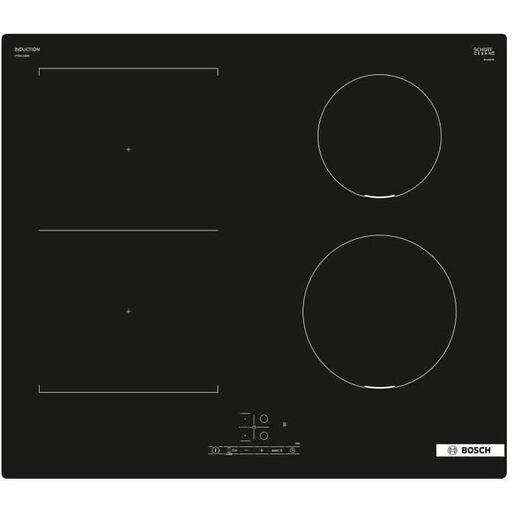
Why this product suits this profile: This built-in hob offers four cooking zones, TouchSelect controls, a timer and PowerBoost. Its dimensions and required cut-out are specified for a typical 60 cm kitchen layout.
The technical data distinguishes between the external dimensions and the cut-out dimensions. This reduces the risk of ordering a hob that looks suitable but is not compatible with the installation space.
Four zones, timer, residual-heat indicator and restart function according to the product description. Installation by qualified electrical professionals is required.
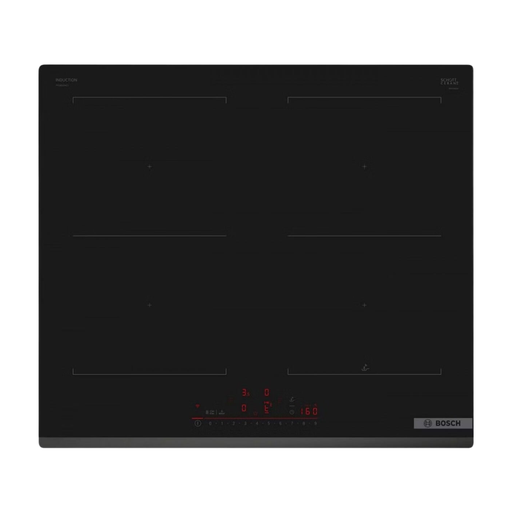
Why this product suits this profile: This four-zone built-in appliance features FlexInduction, individual timers, a child lock and automatic pan detection. It is designed for households that regularly cook with pans and roasting dishes of different sizes.
The FlexInduction function is specifically described as connecting two adjacent zones. This makes its suitability for large cookware clear, rather than relying on a vague claim of flexibility.
7,400 watts total power according to the product data, FlexInduction, Boost function, four individual timers and residual-heat indicator.
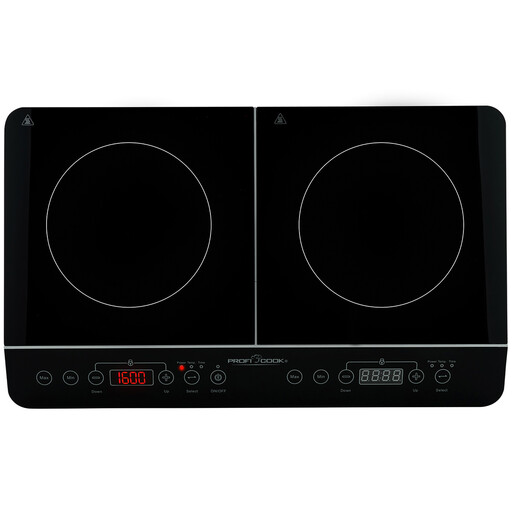
Why this product suits this profile: This double induction hot plate is suitable for small kitchens, temporary cooking areas or as additional cooking space when preparing larger meals. Two hobs and a timer of up to 180 minutes extend its range of uses.
The features include specific temperature levels, timer duration, pan detection and automatic shut-off functions. This makes it easier to match the portable solution to your actual requirements.
Two hobs, sensor-touch controls, 180-minute timer, non-slip feet and overheating protection according to the product specifications.
We have put together a complete, regularly updated list of products that fully meet these strict selection criteria and the safety regulations applicable in the EU.
Suitable cookware includes pots and pans with a magnetic, sufficiently flat base, such as those made from cast iron or magnetic stainless steel. Aluminium, glass and ceramic cookware will only work if the manufacturer has explicitly integrated a magnetic induction base. A magnet test on the base provides a quick preliminary check.
Induction transfers heat directly to the base of the pan. This can reduce heating times, but actual electricity consumption depends on the power rating, cooking time, pan size, whether you use a lid and the selected setting. For a fair comparison, you should consider your actual energy consumption rather than looking at the wattage alone.
Its lifespan depends on how it is used, its installation, ventilation and care. Avoid hard impacts to the glass surface, blocked ventilation openings and abrasive cleaning products. A hob with a crack must not be used. Repairs to permanently installed appliances should only be carried out by authorised professionals.