
Lieferung heute & morgen

Qualitätsgarantie

Willkommens-Angebote freischalten: KOSTENLOSE Lieferung | Bis zu 80 % RABATT | Kostenlose 30-Tage-JoyPlus-Testphase
App herunterladen
Purchasing a new induction hob is a significant decision for any kitchen. The technology promises fast, energy-efficient, and safe cooking. However, the market is saturated with models whose features and marketing promises often create more confusion than clarity. Many buyers invest in expensive extras that go unused in daily life or overlook basic technical requirements, leading to costly installation problems.
This guide serves as an objective resource. We'll show you which pitfalls to avoid and which key features truly matter, enabling you to make an informed decision.
Before you start comparing models, it's crucial to understand the most common mistakes. These often lead to dissatisfaction and unexpected costs.
Focus on the technical fundamentals that determine real-world value in the kitchen. These three parameters are crucial.
A key distinction is whether a hob is standalone or oven-dependent.
Before purchasing, always check the power rating (in watts) and the required voltage. While a portable induction hob plugs into a standard 230V socket, most built-in hobs with four zones require a hardwired (three-phase power) connection.
The standard width for built-in hobs is 60 cm, which fits most kitchen counters. For smaller kitchens or special requirements, narrower models (e.g., 30 cm with two zones) or wider versions (80-90 cm) are also available.
Pay attention to the layout of the cooking zones:
A higher number of power levels (e.g., 17 instead of 9) allows for finer and more precise temperature control, which is particularly advantageous when melting chocolate or preparing delicate sauces.
Practical extra features that offer real added value include:
Instead of making a blanket recommendation, we have selected models tailored to specific user profiles and their requirements.

Why It's a Good Fit: Ideal for first-time buyers or renovators on a clear budget. It offers all the core functions of a modern 60 cm standard induction hob without inflating the price with rarely used extras.
This hob focuses on the essentials: four cooking zones, 9 power levels, a timer, and a boost function. It deliberately omits complex smart-home integrations, delivering solid and reliable cooking performance instead.
With 7200 W, it offers high total power and a boost function on all four zones. The standard cutout dimensions (56.5 × 49.5 cm) ensure a straightforward installation in most countertops.
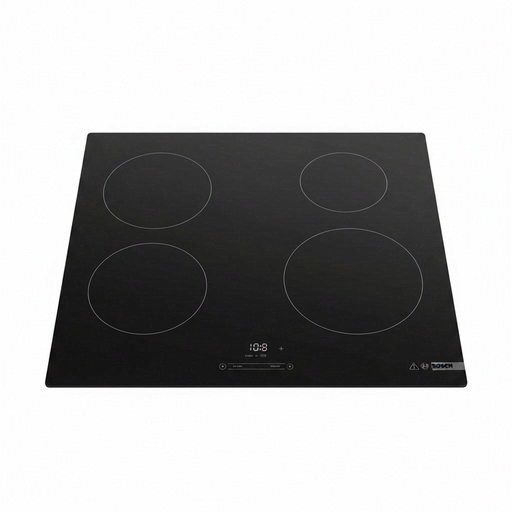
Why It's a Good Fit: For users who value brand quality, durability, and precise cooking results. This Bosch model offers proven technology and thoughtful features that make daily cooking noticeably easier.
With 17 power levels, it provides extremely fine heat regulation, thus avoiding the problem of imprecise temperature settings. The Restart function is a practical detail that, unlike complex smart features, offers direct utility.
The PowerBoost function on all four zones significantly speeds up heating. The frameless design allows for a flush-mount installation, creating a seamless and easy-to-clean look in the countertop.
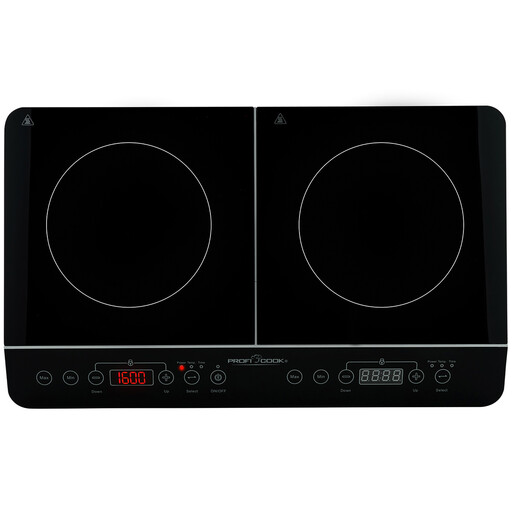
Why It's a Good Fit: The perfect solution for students, campers, small apartments, or as an additional cooking surface. This double induction hob is portable, versatile, and requires no complex installation.
It completely bypasses the pitfalls of complex installation and three-phase power requirements. As a portable induction hob, it simply plugs into a standard socket and is ready to use immediately.
Maximum portability and easy operation via the sensor-touch control panel. It offers precise control for a variety of dishes with 10 temperature levels (60°C–240°C) and a 180-minute timer.
We have compiled a complete, up-to-date list of products that fully meet these strict selection criteria and safety regulations.
A standalone induction hob has its own controls and can be installed in the countertop independently of an oven. An oven-dependent hob has no controls of its own and must be paired with a compatible oven, which is used to control it. Standalone models offer significantly more flexibility in kitchen design.
You need ferromagnetic cookware. This means the base of the pot or pan must be magnetic. You can easily test this: if a standard magnet sticks to the bottom of the pot, the cookware is suitable for induction. Pots made of cast iron, enamelled steel, or special induction-ready stainless steel work well. Cookware made of pure aluminium, copper, or glass is not compatible.
Induction hobs are generally more energy-efficient than ceramic hobs. With induction technology, energy is transferred directly into the base of the cookware, whereas a ceramic hob first heats the glass surface, which results in heat loss. According to manufacturers and consumer organisations, the energy savings with induction can be up to 30% compared to conventional electric hobs, due to shorter heating times and more precise heat control.