Chutney makers using one pan
If you bring the tomatoes to the boil before letting them simmer, you’ll want easy-to-reach controls and a cooking zone that suits your pan.


If you’re making a pan of tomato chutney and want the worktop free again afterwards, a portable single hob is usually the obvious place to start. The key things to look for are a cooking zone that suits the base of your pan and easy-to-use low power settings. A double hob is worth considering if you regularly heat a second pan at the same time and have enough space and a suitable power connection. A built-in hob is better suited to a shared kitchen that’s equipped for the long term.
If you bring the tomatoes to the boil before letting them simmer, you’ll want easy-to-reach controls and a cooking zone that suits your pan.
If you want to clean and put the hob away after use, check its dimensions, stability and power connection before you buy.
If you regularly heat a second pan alongside your chutney, you’ll need room for a double hob and should also consider the shared power supply.
A good fit if: You make chutney in one pan and want to free up the worktop afterwards.
Consider: There’s no second zone for heating another pan at the same time. The power settings don’t guarantee an even simmer for a particular recipe.
A good fit if: You regularly heat a second pan at the same time and have enough space.
Consider: According to the manufacturer, the Severin DK 1031 measures 59 × 35.5 cm and has a stated total power output of 3,400 W. This isn’t necessarily the output per zone.
A good fit if: You want to equip the shared kitchen with several cooking zones for the long term, and the installation and power connection have been agreed.
Consider: You can’t put a built-in hob away after making chutney. Requirements vary depending on the model you choose.
| Buying criterion | What to check | Who should pay particular attention |
|---|---|---|
| Controlled simmering | Compare how easy the low power settings are to use. Treat a timer as a way to keep track of time and switch the hob off, not as a substitute for watching and stirring. According to their manufacturers, the CASO Touch 2000 and Rommelsbacher CT 2020/IN each have ten power settings. | If I want to simmer chutney under control after bringing it to the boil, I look for easy-to-use low settings. Around 29% of consumers put simmering at the top of their list. |
| Worktop space and storage | Consider the overall dimensions, stability and space needed for the cable. According to their manufacturers, the Rommelsbacher CT 2020/IN measures 29.50 × 36.10 cm and the Severin DK 1031 measures 59 × 35.5 cm. | If I need to free up the shared worktop after cooking, I compare the appliance’s size before buying. Around 23% of consumers prioritise worktop space and storage. |
| Choosing the right pan for chutney | Check that the pan has a magnetic, flat base and measure its diameter; don’t just measure the rim. CASO specifies a pan size range of 12–24 cm for the Touch 2000, while Rommelsbacher specifies a cooking zone of 120–230 mm for the CT 2020/IN. | If I want to keep using my existing pan, I check that its base matches the cooking zone. Around 18% of consumers put pan compatibility at the top of their list. |
| Power connection and safe use | Check the rated power, connection details and installation instructions for the specific appliance. Das sichere Haus warns of the risk of fire if high-powered appliances overload a multi-socket extension lead. | If I share a kitchen with others, I check whether high-powered appliances will be used at the same time. Around 18% of consumers prioritise the power connection and safe operation. |
| A second pan at the same time | Compare your need for two zones with the space available, the total power output and the connection requirements of the specific model. The 3,400 W stated for the Severin DK 1031 is the appliance’s total power output. | If I regularly heat a second pan alongside my chutney, a double hob is worth considering. Around 12% of consumers put cooking two things at once at the top of their list. |
Rated power and power settings are product specifications, but they don’t tell you how evenly a particular chutney will simmer.
Compare how easy it is to turn the heat down after bringing the pan to the boil, and check that your pan is compatible with the cooking zone.
An extra zone takes up more space. According to the manufacturer, the Severin DK 1031 measures 59 × 35.5 cm.
Choose two zones if you genuinely need to cook with two pans at once, and make sure you have enough space and a suitable power connection.
A larger hob can take up more of a shared worktop, either temporarily or permanently.
For induction cooking, the material and size of the pan base must suit the cooking zone. The Federal Office for Radiation Protection also warns that a pan may be unsuitable if it’s made from the wrong material, has an uneven base or is the wrong size.
Before buying, check that the base is magnetic and flat, then compare its diameter with the specifications for the hob you’re considering.
If your existing pan isn’t compatible, you may need another pan suitable for induction cooking.
Cooking and filling jars isn’t the same as preserving sealed jars. Hygiene and the method you use matter, regardless of the hob.
If you’re making chutney to store, follow a tried-and-tested guide for your specific recipe and method. The Federal Centre for Nutrition explains the difference.
The portable single-zone Touch 2000 is one option to compare if you’re making chutney in one pan and have limited worktop space.
The CT 2020/IN is a portable single hob. Its dimensions and controls may be useful considerations when you need to put it away in a shared kitchen.
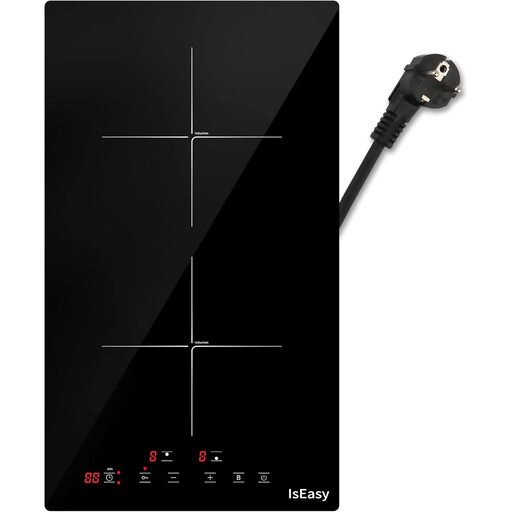
The single-zone KP 1032 and double-zone DK 1031 illustrate the choice between one and two portable cooking zones.
The Kult X Mono is a portable single-zone option if a larger stated pan size range or a longer timer would suit the way you cook.
The SIKP 2200 B1 is a portable single hob with specifications for pan size range and cable length that you can compare with your own setup before buying.
This selection includes portable single and double hobs, as well as a built-in hob. The right option depends on whether you want to heat just your chutney or a second pan at the same time.
 No image available
Described as a tabletop induction hob with a timer; its eight temperature settings may be useful when making a single batch of chutney.
The product name lists 800–3,500 W, a timer function and overheat protection. Induction-compatible cookware is required; the material and size of the base must suit the cooking zone.
 No image available
For a permanently equipped kitchen where you want to heat a second pan alongside your chutney; described as suitable for built-in or freestanding use.
The product description lists nine heat settings, separate timers, a child lock and a residual heat indicator. For built-in installation, it specifies a cut-out of 270 × 490 mm and a 16 A fuse. Induction-compatible cookware is required.
 No image available
Described as a portable single-zone hob for heating one pan and putting the appliance away afterwards.
The product name lists 2,100 W, 28 cm, nine heat settings and an 8-hour timer. The product description specifies magnetic cookware measuring 12–26 cm; check that your pan’s base diameter falls within this range.
 No image available
Its two cooking zones suit a cooking routine where you want to heat a second pan alongside your chutney.
The product description lists dimensions of 48 × 23.5 × 7.5 cm and functions for keeping warm, boiling, simmering, frying and slow cooking. Induction-compatible cookware is required; the description doesn’t guarantee a particular chutney-making result.
 No image available
Described as a portable single-zone hob for making one dish on the worktop.
The product name lists 1,000 W and five power settings, and describes the hob as suitable for simmering and low-temperature cooking. Induction-compatible cookware is required; the material and size of the base must suit the cooking zone.
Check that the pan’s base is magnetic and flat, then compare its diameter with the size range for the specific hob. For example, CASO specifies 12–24 cm for the Touch 2000; this isn’t a universal limit for all hobs.
A portable hob must be set up on a stable surface and connected according to its instructions. Check the space available, the power connection details and which other appliances will be running at the same time. Don’t overload a multi-socket extension lead. Das sichere Haus warns of the fire risk from an overloaded extension lead.
No. A timer can switch the appliance off after a set time, but it doesn’t monitor the chutney’s temperature or prevent it catching while it cooks.
No. The Federal Centre for Nutrition distinguishes between cooking chutney and filling jars, and preserving sealed jars. It also stresses the importance of clean containers and tried-and-tested instructions. The hob alone can’t guarantee that your recipe will keep.
The Federal Office for Radiation Protection notes that magnetic fields can affect these implants, and that their sensitivity depends on the implant and its settings. Ask a medical professional to assess your personal risk rather than relying on general appliance specifications as proof that it’s safe for you to use.