For a pan of pears in a small kitchen, a portable single induction hob is a sensible place to start, provided the pan base and available space are suitable. When poaching, the key is to keep the heat low after bringing the liquid to the boil. The NDR recipe calls for the pears to steep for 20–25 minutes, without letting the liquid boil. Power levels, pan sensors and temperature probes are different ways of controlling heat, but none of them alone guarantees that the poaching liquid will stay at a constant temperature. A double hob is most useful if you want to use two zones at once and have enough space.
Which hob is right for you?
For gentle poaching
If you want to let pears steep in hot liquid without bringing it back to the boil, pay particular attention to how the hob controls low heat. The NDR recipe calls for the pears to be poached over a low heat, and different hobs use different methods to control it.
For kitchens with limited worktop space
If you have little worktop space to spare, compare the appliance dimensions and consider whether you really need a second cooking zone. For example, SEVERIN’s product information gives different dimensions for its single and double hobs.
For cooks with a pan they already own
If you want to keep using your pear pan, check that its base is suitable for induction and fits the hob’s specified cooking area. TÜV SÜD explains that induction requires ferromagnetic cookware.
What to look for when buying
| What matters |
What to check when buying |
Who it matters to |
| Gentle heat |
Compare low-heat controls, probes or sensors, and timers for the specific model. Keep an eye on the poaching liquid and adjust the heat as needed. |
If I want the pears to gently steep after the liquid comes to the boil, I need to keep an eye on it and adjust the heat when necessary. Around 36% of consumers say gentle heat matters most to them. |
| Worktop space and cooking zones |
Compare the appliance dimensions and the space it needs with the room you have available. Only choose a second zone if you really plan to use both at the same time. |
If I want to heat something else alongside the pear pan, I need a second zone and enough worktop space. Around 29% of consumers say worktop space is their main concern. |
| Compatibility with a pan you already own |
Check that your pan is induction-compatible and compare its base diameter with the specifications for the specific model. Make sure the pan is large enough for the pears to sit in the liquid. |
If I want to keep using my existing pear pan, its base needs to work with the induction hob. Around 21% of consumers say pan compatibility matters most to them. |
| Features you need |
Consider whether you’ll actually use a temperature probe or a particular type of heat control. Weigh up the features against the need to adjust the heat manually for the specific model. |
If I’m mainly using the hob for a pear pan that I’ll be keeping an eye on, I don’t want to pay for features I won’t use. Around 14% of consumers say getting the right features without unnecessary extras matters most to them. |
Common selection mistakes
-
Assuming the temperature setting is the temperature of the poaching liquid
A temperature or power setting doesn’t prove that all the pear-poaching liquid will stay at a constant temperature. The NDR recipe says not to let the liquid boil again after bringing it to the boil.
Check how the specific model controls the heat, and keep an eye on the liquid while the pears are poaching.
-
Looking only at the cooking-zone diameter
Your pan needs to be suitable for induction and compatible with the specific model. A double hob can also take up considerably more worktop space than a single hob.
Check your pan base against the model specifications and measure the space the appliance will take up before you decide.
If your existing pan isn’t induction-compatible, you may need to buy a suitable replacement.
-
Confusing a low power setting with steady, even heating
ROMMELSBACHER explains that, on the CT 2010/IN, power levels 1 to 6 are achieved by switching the heat on and off at timed intervals. This behaviour can’t automatically be assumed for other models.
If gentle heating is important to you, find out how the specific model you’re considering controls the heat, and check the liquid while you cook.
Key brands at a glance
CASO Design
CASO Design’s product pages describe single hobs with power-level controls or an additional temperature probe.
- CASO Design lists ten power and temperature settings for the Touch 2000. For the TC 2400, it specifies a FineTemp setting from 40–160 °C and a temperature probe supplied with the hob.
- These manufacturer specifications refer to different models and don’t independently prove that the entire quantity of pear-poaching liquid will stay at a constant temperature.
ROMMELSBACHER
ROMMELSBACHER describes a sensor on the CTS 2000/IN that measures heat data at the pan. The CT 2010/IN is another single hob with power-level controls.
- The manufacturer’s description of the CTS 2000/IN specifies a sensor on the pan. For the CT 2010/IN, it lists ten power levels and ten temperature settings from 60 °C to 240 °C.
- A sensor on the pan isn’t the same as a probe in the food. ROMMELSBACHER says that power levels 1 to 6 on the CT 2010/IN use timed on-and-off heating; this doesn’t automatically apply to the CTS 2000/IN.
SEVERIN
According to SEVERIN’s product information, the KP 1071 and DK 1031 give you the choice of one or two cooking zones.
- SEVERIN lists a timer and pan detection for both models.
- SEVERIN gives the dimensions of the double DK 1031 as 59 × 35.5 cm and those of the single KP 1071 as 28.1 × 35 cm. These specifications aren’t based on measured performance when poaching.
Steba
Steba offers the IK 35 as a portable single hob and the IK 200 as an alternative with two cooking zones.
- Steba lists nine power levels from 200 to 2,000 W, a timer of up to 180 minutes and dimensions of 4.5 × 29 × 37 cm for the IK 35. The two zones on the IK 200 can be used and adjusted independently.
- Manufacturer claims about precise cooking results aren’t independent proof of temperature control when poaching pears.
Induction hobs at Joybuy
This selection includes portable single and double induction hobs for one pan or for heating two things at once. Heat settings, appliance dimensions and guidance on compatible pan sizes vary by model.
 No image available
3500W induction hob with IGBT technology
For one pan on a countertop cooking surface; the product description lists cast iron and stainless steel as suitable cookware.
The description lists eight temperature settings from 80 °C to 270 °C, eight power levels and a timer of up to three hours. Check your pan base against the cookware specifications.
View at Joybuy
 No image available
IsEasy portable induction hob, 2100 W, 28 cm
For one pan and a hob you can put away when not in use; the product description gives the dimensions as 35 × 28 × 4.4 cm.
It has nine heat settings and a timer of up to eight hours. The description says it’s suitable for magnetic cookware with a diameter of 12–26 cm.
View at Joybuy
 No image available
Induction hob with two cooking zones and five temperature settings
If you want to use two cooking zones at the same time, the product title identifies this model as a double hob.
The title lists five temperature settings. The product description gives the dimensions as 48 × 23.5 × 7.5 cm, so make sure you have enough room for the appliance.
View at Joybuy
 No image available
Portable countertop induction hob, five power levels, 1000 W
For a compact cooking surface; the product description gives the dimensions as 21.5 × 21.5 × 4.7 cm.
The title and description list five heat settings; the description also mentions a rotary control.
View at Joybuy
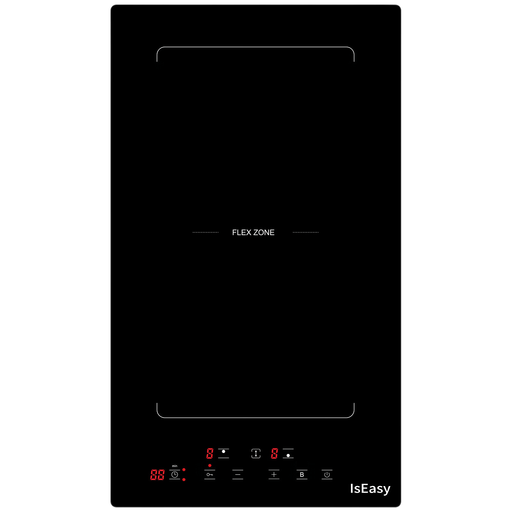 No image available
Induction hob with flex zone and two cooking zones
If you need two cooking zones, the product information describes a model with a flex zone.
The description says the flex zone suits cookware from 12 to 28 cm. It also lists two cooking zones and a maximum power of 3400 W. Magnetic cookware is required.
View at Joybuy
Frequently asked questions
How do I use an induction hob to poach pears?
Bring the poaching liquid to the boil first, then turn down the heat so it doesn’t continue boiling. The NDR recipe says to let the pears steep over a low heat for 20–25 minutes. Keep an eye on the liquid and adjust the setting as needed.
Will any pan work on an induction hob?
No. TÜV SÜD explains that induction requires ferromagnetic cookware. Also compare your pan’s base diameter with the specifications for the specific model. The Federal Office for Radiation Protection recommends using cookware of a suitable size and placing it correctly.
What should I consider if I have a pacemaker or another electronic implant?
The Federal Office for Radiation Protection notes that electric and magnetic fields can affect electronic implants. Your doctor should assess your individual risk; this doesn’t mean that a particular person or hob can be guaranteed suitable.
What’s the difference between a guarantee and your statutory rights if a product develops a fault?
Your statutory rights are a legal claim against the seller; a guarantee is an additional voluntary service with its own terms and conditions. The Verbraucherzentrale consumer advice centre recommends keeping the two separate and checking guarantee terms independently.
Can I put a broken induction hob in my household rubbish?
No. The Federal Ministry for the Environment explains that waste electrical equipment must be collected separately and taken to an authorised collection point. Retailer take-back is subject to the applicable requirements.


