What should you look for when buying?
For porridge you’re taking with you, the key considerations are low-power control, the number of cooking zones and whether your pan is compatible with the specific appliance.
| Buying priority |
What to check |
Who this matters most to |
| Controlled simmering |
Compare the power control at low settings and how the specific model works. |
If I want to keep cooking the porridge on a low heat after bringing it to the boil, good control matters more to me than a high maximum power rating. Around 36% of consumers put controlled simmering first. |
| Footprint and flexibility |
Check the appliance dimensions, a safe place to position it and the number of cooking zones. |
If I need a hob for one pan but don’t want a built-in model, a suitable hob that I can position flexibly is important to me. Around 29% of consumers prioritise flexible positioning and a compact footprint. |
| Cooking two things at once |
Check the number of cooking zones, as well as the appliance, cut-out and connection dimensions. |
If I regularly cook porridge and another dish at the same time, I need space for both pans. Around 21% of consumers prioritise being able to cook two dishes at once. |
| Pan compatibility and additional costs |
Compare your pan material and base diameter with the specifications for the model. |
If I want to keep using my existing pan, I’ll check it’s suitable for the hob first. Around 14% of consumers prioritise pan compatibility and potential additional costs. |
Key brands at a glance
The examples below refer to the specific model ranges named and aren’t a general assessment of each brand’s entire range.
Rommelsbacher
Portable single induction, illustrated by the CT 2010/IN, for use with a compatible pan.
- According to the manufacturer, the CT 2010/IN has ten power settings, a 180-minute timer and one cooking zone for pan bases measuring 120–230 mm.
- According to Rommelsbacher, power at settings 1 to 6 is controlled by switching on and off at timed intervals. Check how this works with your pan and the way you cook.
CASO Design
Portable single induction, illustrated by the S-Line 2100, if the pan size and available space are suitable.
- CASO lists twelve power settings, a 1–180-minute timer, a compatible pan diameter of 12–24 cm and a maximum load of 6 kg for the S-Line 2100.
- The manufacturer’s description of precise control doesn’t independently prove that porridge will simmer evenly.
SEVERIN
The KP 1071 is a portable single hob; the DK 1031 is a double hob with two cooking zones.
- According to the manufacturer, both of these models have a timer with an automatic shut-off.
- The DK 1031 measures 59 × 35.5 cm, so it takes up more space than the KP 1071, which measures 28.1 × 35 cm. This comparison applies only to these models.
Bosch
A built-in hob with several zones, illustrated by the PXX675DC1E, for a suitably planned kitchen.
- Bosch lists four cooking zones and two flexible zones for the PXX675DC1E.
- The model is listed without a plug and requires the specified installation space. You won’t necessarily need extra zones just to cook porridge in one pan.
Siemens
A built-in hob with several zones, illustrated by the EH645BFB6E.
- Siemens lists four cooking zones and a timer with an automatic shut-off for this model.
- According to the product specifications, the frying sensor on this model doesn’t prevent food from burning. A timer also doesn’t guarantee that porridge can be cooked unattended.
Joybuy products for porridge and cooking two dishes at once
Here you’ll find induction hobs with one or two cooking zones, for making porridge on its own or cooking two dishes at once. When comparing models, check the pan dimensions they accommodate and which features and settings really matter for the way you cook.
 No image available
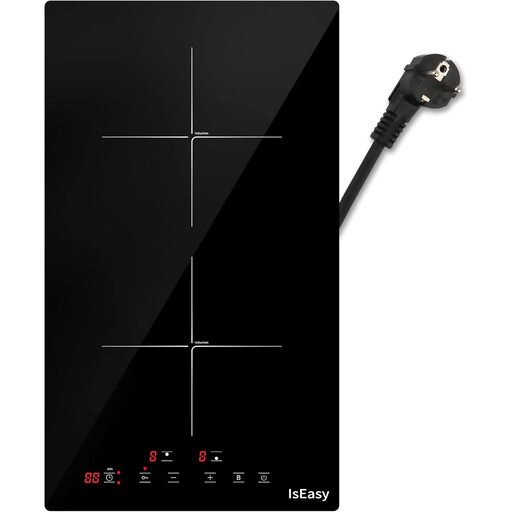
IsEasy Domino two-zone induction hob
Two cooking zones let you make porridge and another dish at the same time.
The product name lists 3400 W, 29.5 cm, a timer, child lock and booster function. Described as suitable for both built-in and plug-in use.
View at Joybuy
 No image available
Induction hob with two cooking zones
Two independently controlled cooking zones are designed for preparing two dishes at once.
The product description lists five temperature settings and functions for keeping warm, boiling, simmering, frying and slow cooking. Check that the settings described are right for the way you want to cook.
View at Joybuy
 No image available
Portable single induction hob
One cooking zone for cooking in a single pan, if you don’t need a second zone.
The product name lists five power settings and 1000 W.
View at Joybuy
 No image available
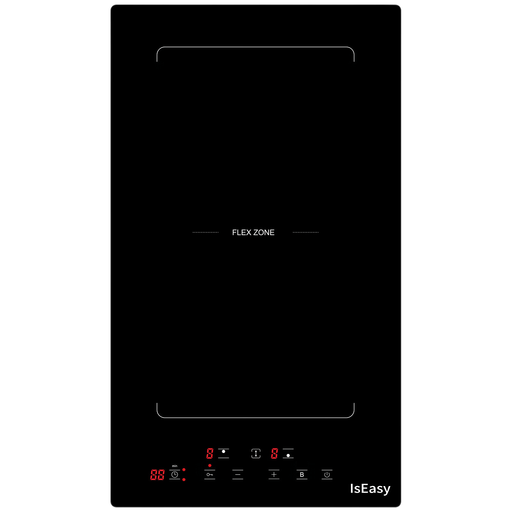
Induction hob with flexible zone
The product description lists two cooking zones and a flexible zone, which is specified for cookware measuring 12–28 cm.
The description gives a maximum power rating of 3400 W. Check your cookware dimensions against the specifications for the flexible zone.
View at Joybuy
 No image available
Portable induction hob with porridge programme
The description lists porridge and soup programmes for cooking on a single zone.
It lists 3500 W, ten temperature settings and a timer of up to three hours. The fact that a programme is listed doesn’t mean porridge can be cooked unattended.
View at Joybuy
Frequently asked questions
Can I use my usual porridge pan on any induction hob?
No, you can’t assume that. Compare the material and diameter of the pan base with the specifications for the specific model: Rommelsbacher requires a ferromagnetic base for the CT 2010/IN, while CASO specifies a pan diameter of 12–24 cm for the S-Line 2100.
How can I check whether an induction hob can control the heat well enough to cook porridge gently?
Compare the information on how the specific model controls power, and watch how it works with your pan the first time you use it. According to the manufacturer, settings 1 to 6 on the Rommelsbacher CT 2010/IN are controlled by switching on and off at timed intervals; this doesn’t automatically apply to other models.
Can I put freshly cooked porridge straight into my bag while it’s still warm?
For hot food that will be stored for longer, the Federal Institute for Risk Assessment (BfR) recommends cooling it to below 7 °C as quickly as possible. If you’re batch-cooking, plan for access to refrigeration where you’ll eat and keep the containers chilled during transport, for example in a cool bag.
What should I check before connecting a built-in induction hob?
Check the installation dimensions and connection requirements for the specific appliance before planning your kitchen. Bosch states that the PXX675DC1E is supplied without a plug and should be connected by a qualified electrician. In Germany, § 13 NAV sets out who is permitted to carry out work on electrical installations; confirm the connection requirements before installation.
What should I bear in mind if I have a pacemaker or another electronic implant?
General information about an appliance can’t provide a personal assessment. The Federal Office for Radiation Protection notes that electric and magnetic fields can affect these implants and that a doctor should assess the individual risk.


