
Lieferung heute & morgen

Qualitätsgarantie

Willkommens-Angebote freischalten: KOSTENLOSE Lieferung | Bis zu 80 % RABATT | Kostenlose 30-Tage-JoyPlus-Testphase
App herunterladen
A high-quality, non-stick pan for an induction hob is a foundational investment for any modern kitchen. It promises fast, even cooking and effortless cleaning. However, the market is flooded with products whose marketing promises often fall short in practice. Many buyers find that after just a few months, their expensive purchase loses its non-stick properties, the base warps, or the heat distribution is poor.
As your Joybuy Product Recommendation Officer, I'll help you recognise the typical pitfalls and make an informed decision. We will focus on the technical features that truly matter, rather than on exaggerated advertising claims.
To avoid a bad purchase, you should focus on three objective criteria. These determine the performance, longevity, and safety of your new frying pan.
For optimal performance on an induction hob, a fully ferromagnetic base is essential. Look for the following features:
The choice of non-stick surface directly impacts the cooking experience and maintenance.
Regardless of the material, to keep the coating scratch-resistant, you should only use utensils made of wood, silicone, or plastic.
An oven-safe pan significantly expands your cooking options. Dishes can be seared on the hob and then finished in the oven.
Here are some recommendations tailored to specific user profiles that meet the criteria mentioned above.
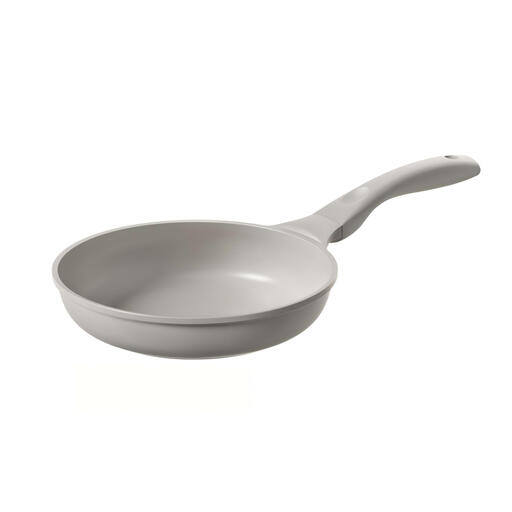
Why This Fits Their Persona: Ideal for daily use in smaller households or as a first solid pan for an induction hob. It offers modern, health-conscious technology without the cost of a complete set.
The pan features a ceramic coating explicitly declared as PTFE/PFOA/PFAS-free (avoids Trap 3) and a base designed for all hob types, including induction, for even heat distribution (avoids Trap 1).
The non-toxic ceramic coating allows for healthy cooking with little oil and is very easy to clean. The heat-insulating Bakelite handle ensures safe handling.

Why This Fits Their Persona: Those who cook regularly and versatilely need reliable, durable tools. This induction pan set covers most use cases with two common sizes and relies on proven brand quality for lasting performance.
The SiliTherm universal base is designed for optimal heat conduction on induction hobs (avoids Trap 1). The robust stainless steel construction promises greater durability than simple aluminium pans (avoids Trap 2).
The pans are oven-safe up to 260°C (500°F) and feature a wide pouring rim for drip-free pouring. The stainless steel body is robust and easy to clean.
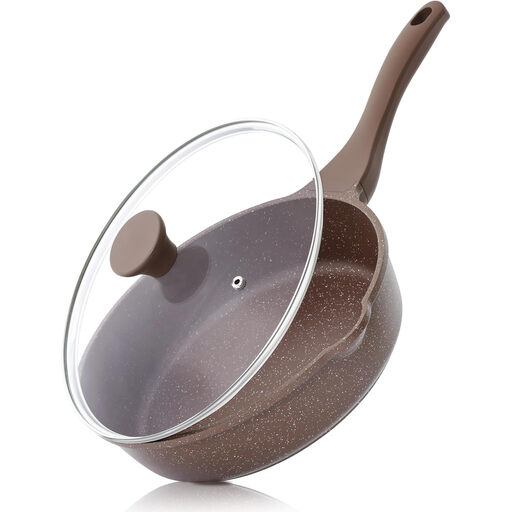
Why This Fits Their Persona: For families who prepare larger quantities and value versatility. This deep pan with a lid is perfect for one-pot meals, curries, or stews. The non-toxic nature of the materials is a top priority.
According to the manufacturer, the granite coating is made without PFOA, PFOS, lead, or cadmium (avoids Trap 3). The solid base ensures good performance on induction hobs (avoids Trap 1).
The high sides and included glass lid make it extremely versatile and reduce splattering. The large capacity is ideal for family-sized portions.
We have compiled a complete, up-to-date list of products that fully meet these strict selection criteria and EU/UK safety regulations.
1. How long does a non-stick induction pan last? The lifespan heavily depends on the quality of the coating and its care. With proper use (no metal utensils, no overheating, hand washing preferred), a high-quality ceramic pan or a multi-layer PTFE pan can last two to five years. Cheaper models often show significant signs of wear in less than a year.
2. Can I use my induction pan in the oven? This is only possible if the manufacturer explicitly labels the pan as oven-safe. Be sure to pay attention to the specified maximum temperature, which is often limited by the handle material. Stainless steel handles are generally more heat-resistant than those made of plastic or Bakelite.
3. Why does my "induction-compatible" pan heat up slowly or unevenly? The problem usually lies with the pan's base. Either the ferromagnetic layer is too thin, or its diameter is too small for your hob's sensor. A simple test: hold a magnet to the bottom of the pan. If it sticks strongly across the entire surface, the induction suitability is good. Weak adhesion indicates poor energy transfer and inefficient performance.