
Lieferung heute & morgen

Qualitätsgarantie

Willkommens-Angebote freischalten: KOSTENLOSE Lieferung | Bis zu 80 % RABATT | Kostenlose 30-Tage-JoyPlus-Testphase
App herunterladen
Finding a new coated pan for your induction hob seems simple. Yet, it often turns out after just a few months that the non-stick effect is fading, the base is warping, or the heat is being distributed unevenly. Many marketing claims prove to be misleading, leading to frustration in the kitchen. Before you make a decision, you should be aware of the most common pitfalls.
To avoid these problems, it is wise to focus on three core technical features.
The type of non-stick coating determines not only how well food releases but also the longevity and health safety of your induction frying pan.
An induction hob generates heat through a magnetic field. For a pan to work, its base must be ferromagnetic. But that alone is not enough for good performance.
The right size and features are what make a pan truly practical for everyday use.
Based on these criteria, we have selected a few models from our range for different user profiles.
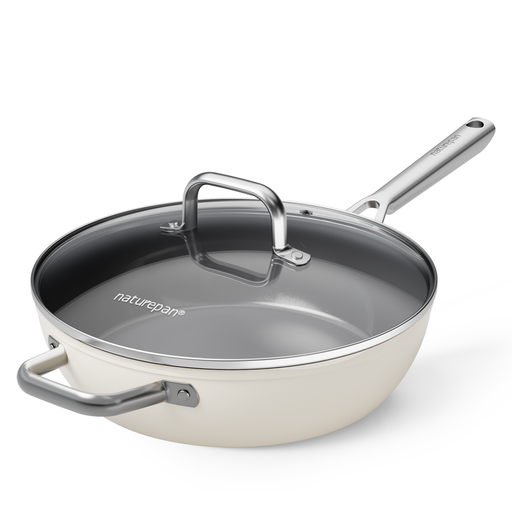
Why This Fits Their Persona: Ideal for users who prioritise non-toxic materials. The pan is explicitly declared PTFE/PFOA/PFAS-free and, with its 28 cm size, high sides, and lid, is suitable for a wide variety of everyday dishes.
Goes beyond the simple "PFOA-free" claim by avoiding the entire PFAS chemical group. The ceramic coating is reinforced with diamond and titanium particles, which increases its durability compared to simple ceramic pans.
High Versatility: Oven-safe up to 260°C and includes a lid, making it suitable for frying, braising, and finishing in the oven. The optimised base ensures even heat distribution on induction hobs.
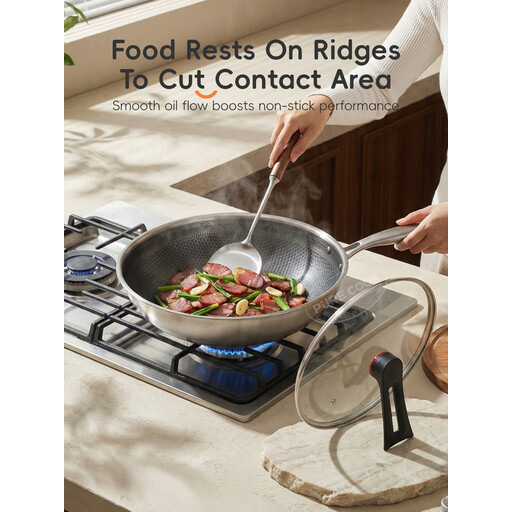
Why This Fits Their Persona: Perfect for ambitious cooks who want to do more than just fry. This wok allows for stir-frying, deep-frying, and steaming in one vessel and is designed for intensive use thanks to its robust construction.
Bypasses the problem of short-lived coatings with a physical non-stick surface. The stainless steel honeycomb structure protects the cooking surface and even allows the use of metal utensils without impairing its function.
Robust Construction: The three-ply construction of 304 stainless steel ensures very fast and even heat distribution, ideal for the high temperatures required for wok cooking. Compatible with all hob types.
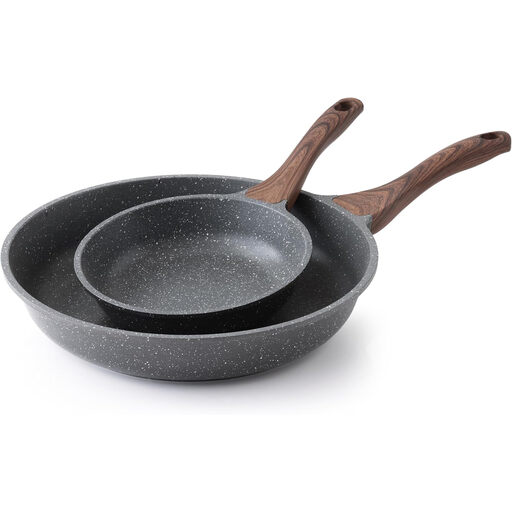
Why This Fits Their Persona: This pan set provides a solid starter kit for beginners or small households. With two different sizes, it covers most daily cooking needs without breaking the bank.
The magnetic stainless steel base is specifically designed for induction, ensuring good compatibility and heat conduction. The coating is manufactured without the intentional addition of PFOA, which secures a basic health and safety feature.
Excellent Value for Money: You get two pans in common sizes for omelettes and larger dishes. The die-cast aluminium body is robust and does not warp as easily as thin pressed metal.
We have compiled a complete, up-to-date list of products that fully meet these strict selection criteria and German safety regulations.
1. How can I tell if my pan is truly suitable for induction? A simple test: Hold a magnet to the bottom of the pan. If it sticks strongly and across the entire surface, the basic requirement is met. A thick, flat base is another indicator of quality. Pans with thin bases tend to buzz on induction hobs and distribute heat poorly.
2. How do I extend the life of the non-stick coating? Avoid the three main mistakes: excessive heat (preheating an empty pan), using metal utensils, and thermal shock (placing a hot pan under cold water). Hand washing with a soft sponge is almost always gentler than the dishwasher, even if the pan is declared dishwasher-safe.
3. Is a ceramic pan better than one with a PTFE coating? Both materials have their merits. A ceramic pan is often the first choice for users who want to be guaranteed to avoid all fluorine-based chemicals (PFAS). It is very heat-resistant but can be more sensitive to impacts and scratches. Modern, multi-layer PTFE coatings (without PFOA) are often more durable and offer very long-lasting non-stick performance. The decision depends on your personal priorities.