
Lieferung heute & morgen

Qualitätsgarantie

Willkommens-Angebote freischalten: KOSTENLOSE Lieferung | Bis zu 80 % RABATT | Kostenlose 30-Tage-JoyPlus-Testphase
App herunterladen
Buying a new induction pan seems simple—until you place it on the hob. The steak sears unevenly, the pancake sticks, and after just a few months, the base warps. Many of these issues stem from exaggerated marketing claims and hidden defects. As your Joybuy Product Recommendation Officer, I'm here to help you identify these pitfalls and make an informed decision.
We will focus on the three most common frustrations that arise when purchasing a new frying pan for induction cooking:
To avoid the problems mentioned above, you should check three technical features before buying. These are the key determinants of your new pan's performance and longevity.
The base is the most critical component of an induction pan. It must meet two criteria: it must be ferromagnetic so the hob's magnetic field can generate heat, and it must be thick and dimensionally stable.
The choice of material depends on what and how you plan to cook. Each option has specific advantages and disadvantages.
The standard 28 cm pan is a versatile all-rounder for most households. However, for specific applications, specialised shapes can make cooking easier:
Instead of presenting an overwhelming list, we have selected products for three typical user profiles. Each recommendation solves the initial problems in its own way.
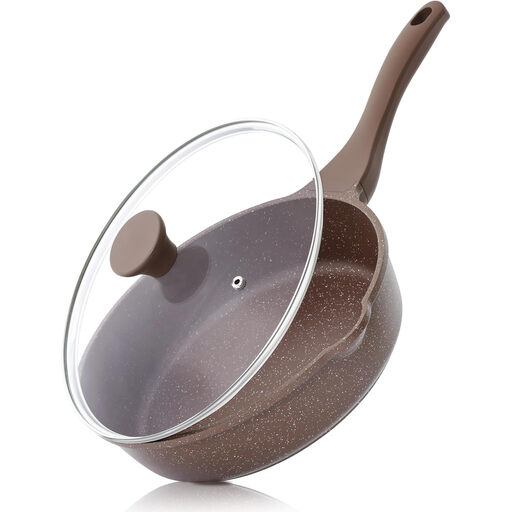
Why This Fits Their Persona: This deep pan is an everyday multi-tasker. With a 30 cm diameter and high sides, it's suitable for frying, simmering, and sautéing. The non-stick coating and included lid make it especially practical for novice cooks and busy families.
The base is explicitly designed for induction, ensuring excellent heat conduction. According to the manufacturer, the granite non-stick coating is free of PFOA, PFOS, lead, and cadmium, going beyond the mere PFOA-free standard.
High versatility thanks to its deep design and lid. The smooth, rivet-free interior makes cleaning significantly easier.

Why This Fits Their Persona: Anyone who values durability and precise searing results will be well-served by this set. The combination of a robust stainless steel exterior and a durable non-stick interior offers flexibility. Its oven-safe design expands its use for many recipes.
The SiliTherm universal base is specifically designed for optimal heat distribution on all hob types, including induction. This prevents the typical hot spots and energy loss associated with the "suitable for all" trap.
The combination of two popular sizes (24 cm and 28 cm) covers almost all daily needs. The robust stainless steel construction and oven-safe properties make the set a durable investment.
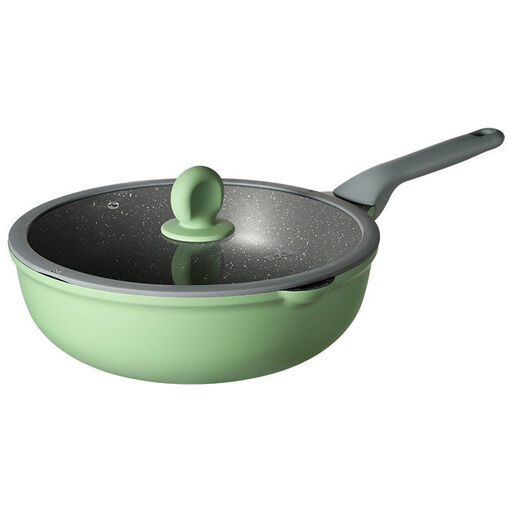
Why This Fits Their Persona: For authentic stir-frying, a dedicated wok pan is essential. This 32 cm model offers ample space to prepare meals for the whole family. Its characteristic shape enables the typical high-heat cooking method where ingredients are kept in constant motion.
The composite base is explicitly rated for all hob types, including induction, ensuring the even heat distribution that is crucial for wok cooking. The stone-based non-stick coating simplifies cooking and cleaning.
Generous 32 cm diameter for large portions. The special wok shape is optimised for stir-frying, a task difficult to achieve with a standard frying pan.
We have compiled a complete, up-to-date list of products that fully meet these strict selection criteria and German safety regulations.
1. How can I tell if my old pan is induction-compatible? The easiest way is the magnet test. Hold a standard magnet to the base of the pan. If the magnet sticks firmly, the base is ferromagnetic and therefore suitable for induction hobs. If it doesn't stick, or only very weakly, the pan will not work on an induction hob.
2. How do I properly care for a coated induction pan to extend its lifespan? Avoid overheating the empty pan, especially with your hob's boost function. Use utensils made of wood, silicone, or plastic to prevent scratches. Although many pans are advertised as dishwasher-safe, washing by hand with a soft sponge and mild detergent is gentler and significantly extends the life of the non-stick coating.
3. Why is the base of my pan warping on the induction hob? Warping is usually caused by thermal shock (e.g., rinsing a hot pan with cold water) or by heating it too quickly and intensely. With low-quality pans, the material cannot withstand the stress and deforms permanently. Look for a thick, multi-layered base and always heat your pan slowly and evenly.