
Lieferung heute & morgen

Qualitätsgarantie

Willkommens-Angebote freischalten: KOSTENLOSE Lieferung | Bis zu 80 % RABATT | Kostenlose 30-Tage-JoyPlus-Testphase
App herunterladen
The search for the right pan for an induction hob can quickly become overwhelming. The market is filled with promises of durability and perfect non-stick performance. However, not every pan advertised as "induction-compatible" delivers convincing results in practice. As your Joybuy Product Recommendation Officer, I'll help you identify the crucial features and avoid common purchasing traps.
Many buyers invest in a new pan, only to find after a few months that the base has warped, the heat is distributed unevenly, or the coating is already failing. Two common problems lead to these disappointing experiences:
To avoid a bad purchase, don't be guided by marketing terms, but focus on verifiable technical specifications. Three parameters are crucial for the performance and longevity of an induction pan.
The base is the most important component for performance on an induction hob. Look for a fully ferromagnetic base. A simple magnet test can provide clarity here: if a magnet holds strongly and evenly across the entire base, the fundamental requirement for good energy transfer is met. A thick, warp-resistant base (often designed as a sandwich or encapsulated base) also prevents warping during rapid temperature changes and ensures even heat distribution.
The choice of coating depends on your cooking habits and priorities.
The right size and shape depend on your household and cooking preferences. A coated frying pan with a 28 cm diameter is a versatile workhorse for most households. For dishes with a lot of liquid or for braising, a high-sided induction sauté pan with a lid is the better choice. Those who enjoy Asian cooking will benefit from a special wok pan, whose shape allows for optimal heat distribution for stir-frying. A pan set can be a cost-effective solution to cover different sizes and types. Ensure the pan is easy to clean, ideally through a high-quality coating and a rivet-free handle attachment on the inside.
Based on these objective criteria, we have selected a few products from our range that offer a suitable solution for specific requirement profiles.
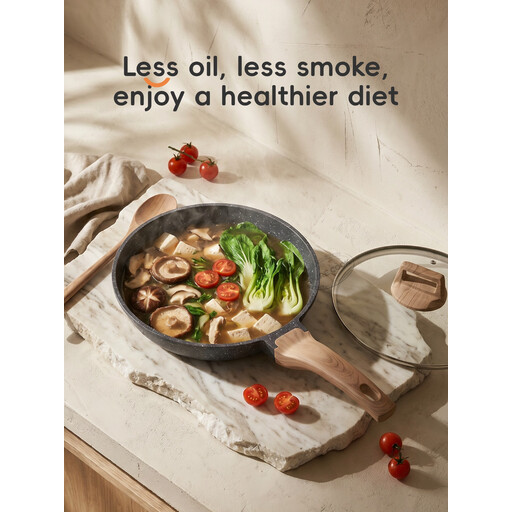
Why This Fits Their Persona: Ideal for one to two-person households or as a supplementary pan for small dishes. It offers a solid basic setup for getting started with induction cooking without requiring a large budget.
The aluminium alloy body ensures fast and even heat conduction, which avoids a common weakness of budget-friendly pans. Its induction compatibility is explicitly designed for efficient use.
Lightweight and easy to handle. The non-stick coating and included glass lid make it versatile for frying and steaming.

Why This Fits Their Persona: Perfect for users who prioritise non-toxic materials. Its deep shape makes it the ideal sauté pan for healthy stews and vegetable-rich dishes.
The Ti-Ceramic coating is explicitly stated as PFAS-free and non-toxic, thus bypassing the uncertainty associated with some non-stick materials. The cast aluminium body ensures stability and good heat conduction.
The coating allows for cooking with minimal oil. The set also includes a matching wooden spatula and a scrubber, which facilitates proper, gentle care from the very beginning.
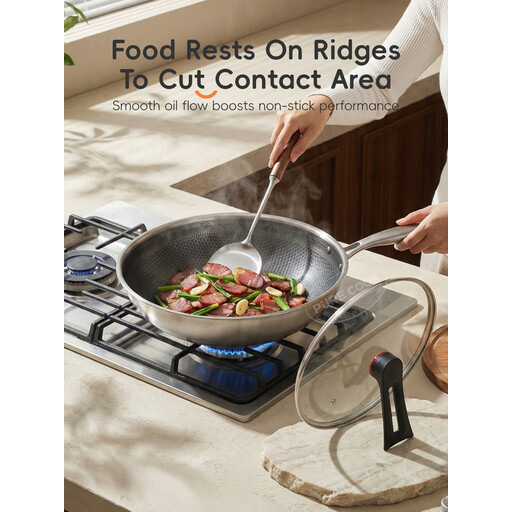
Why This Fits Their Persona: For cooks who seek versatility and durability. This wok does not rely on a chemical coating and is suitable for high-heat searing, deep-frying, and braising.
Instead of a delicate coating, this wok creates a physical non-stick barrier with a stainless steel honeycomb structure. This bypasses the problem of a rapidly wearing coating.
Extremely robust and scratch-resistant, even when using metal utensils. The three-layer construction of 304 stainless steel ensures fast, even heat distribution, ideal for the demands of an induction stove.
We've compiled a complete, up-to-date list of products that fully meet these strict selection criteria and German safety regulations.
The easiest way is to look for the induction symbol (a stylised coil) on the packaging or the bottom of the pan. To check the quality, perform the magnet test: a standard magnet should stick firmly across the entire surface of the base. This indicates a strongly ferromagnetic base, which is necessary for efficient heat transfer.
Proper care is crucial. Avoid heating the empty pan on the highest setting. Use utensils made of wood, silicone, or plastic to prevent scratches. Allow the pan to cool completely after use before cleaning it with warm water and a soft sponge. Even though many pans are declared dishwasher-safe, hand washing significantly extends the life of the non-stick coating.
Not necessarily. A ceramic pan is a great choice for health-conscious cooks as it is free of PTFE and PFOA. It is also often very heat-resistant. However, the non-stick properties of some models may wear out faster than those of high-quality PTFE pans, and they are more sensitive to thermal shock or impacts. The choice depends on your personal priorities: maximum freedom from toxins (ceramic) or maximum non-stick properties with gentle handling (PTFE).