
Lieferung heute & morgen

Qualitätsgarantie

Willkommens-Angebote freischalten: KOSTENLOSE Lieferung | Bis zu 80 % RABATT | Kostenlose 30-Tage-JoyPlus-Testphase
App herunterladen
The search for a suitable induction wok pan can quickly become overwhelming. Many models promise compatibility, but in practice, they often reveal weaknesses that can ruin the cooking experience. From uneven heat distribution to coatings that wear out quickly, the pitfalls are numerous. As your Joybuy Product Recommendation Officer, I'm here to help you identify the crucial features and make an informed decision that suits your kitchen and cooking style.
Before we explore the solutions, it's important to understand the most common problems that arise during the selection process. These often lead to disappointment and unnecessary expense.
To avoid these problems, you should focus on three key technical factors. These are crucial in determining the performance and longevity of your wok pan.
For optimal performance on an induction cooktop, a flat base is essential. This is the only way to ensure direct contact with the cooking surface. However, the construction of this base is what's truly critical:
The material of the wok's body is just as important as its base. Two main materials have become standard:
The choice between a coated and an uncoated wok pan largely depends on your personal preferences and cooking style.
Based on the criteria above, we have identified a few models from our range that are a great fit for specific user profiles.
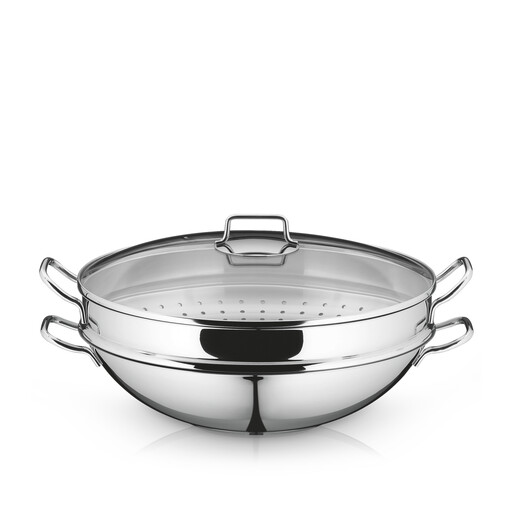
Why this model is a great fit: This wok set is ideal for families or anyone who values versatility. With a 36 cm diameter, steaming insert, and draining rack, it covers steaming and deep-frying in addition to stir-frying. It's a complete solution for preparing healthy and varied meals.
According to the manufacturer WMF, the TransTherm universal base ensures even heat distribution and is explicitly designed for high performance on induction, which avoids the "pseudo-induction base" effect.
The set includes a wok with a lid, steaming insert, and rack, making it a multifunctional cooking system. The material (Cromargan stainless steel) is durable and dishwasher-safe.

Why this model is a great fit: For home chefs who prioritise maximum heat and durability. This uncoated wok pan allows for high-heat searing to create authentic roasted flavours and is extremely long-lasting with proper care. The metal lid is also designed for high temperatures.
As an uncoated model, it completely bypasses the problem of short-lived coatings. Furthermore, the 3-ply construction (stainless steel-aluminium-steel) prevents the base from warping under intense heat.
The multi-ply construction ensures very fast and even heat conduction throughout the entire body of the wok. The metal lid features an adjustable steam vent for better control over the cooking process.
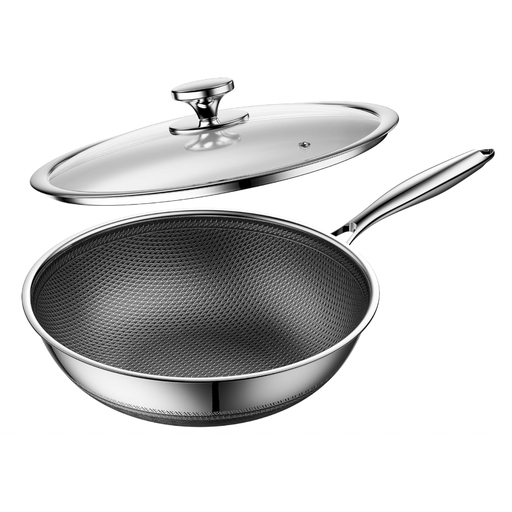
Why this model is a great fit: This model combines the durability of a stainless steel wok with innovative non-stick technology. It's ideal for users who want easy handling and cleaning but wish to avoid potentially harmful chemicals like PFAS/PFOA.
According to the manufacturer, the hybrid technology with laser-etched stainless steel and a ceramic coating is free of PFAS/PTFE/PFOA and more resistant to high temperatures than conventional coatings.
The three-layer construction with an aluminium core ensures fast and even heat distribution. The pan is dishwasher-safe and oven-safe up to 260°C (lid up to 148°C), which increases its versatility.
We have compiled a complete, up-to-date list of products that fully meet these strict selection criteria and rigorous safety standards.
1. Does an uncoated induction wok need to be seasoned? Yes, an uncoated wok made of stainless steel or carbon steel should be seasoned before its first use. This process creates a natural, protective non-stick layer (patina) that prevents food from sticking and protects the pan from corrosion. The exact instructions vary depending on the material and manufacturer.
2. Why isn't my wok getting hot enough on my induction cooktop? The most common issue is an unsuitable base. Either the material is not sufficiently ferromagnetic, or the magnetic surface area is too small for the cooking zone. Ensure that the wok's base diameter matches the size of your induction cooking zone and that the base is fully magnetic. A warped base can also break contact with the cooktop, severely reducing heating performance.
3. What is the ideal diameter for a wok pan? The choice of diameter depends on your household size and typical portion sizes.