
Lieferung heute & morgen

Qualitätsgarantie

Willkommens-Angebote freischalten: KOSTENLOSE Lieferung | Bis zu 80 % RABATT | Kostenlose 30-Tage-JoyPlus-Testphase
App herunterladen
A high-quality induction wok can transform your cooking—from quick, aromatic stir-fries to gently steamed vegetables. But the market is flooded with models whose performance claims often fall short in practice. Many buyers are frustrated to find their new pan heats unevenly, the coating peels off after a short time, or it's simply unsuitable for their induction hob.
As your Joybuy Product Recommendation Officer, I'm here to help you identify these pitfalls. Instead of falling for marketing hype, we'll focus on the crucial technical features. Here are the most common problems that lead to a bad purchase:
To make an informed decision, you should check three core parameters. These determine the performance, durability, and versatility of your future wok.
For induction hobs, a multi-ply base construction (also known as a "sandwich base" or "tri-ply") is the deciding factor. Pure stainless steel pans conduct heat relatively slowly. A high-quality induction wok therefore combines several materials:
Manufacturers like WMF use terms like Cromargan combined with an aluminium core, while Zwilling relies on technologies like SIGMA Clad. This construction ensures that the heat isn't just concentrated at the base, but that the entire walls of the pan heat up quickly and evenly—a prerequisite for authentic wok cooking.
The choice between a coated wok and an uncoated wok depends on your cooking habits and your willingness to perform maintenance.
Uncoated Stainless Steel Wok:
Coated Wok:
The size and included accessories determine its practicality for daily use.
Instead of making a one-size-fits-all recommendation, we have selected models that suit different user profiles and specifically avoid the pitfalls mentioned earlier.

Why it's a great fit: Ideal for anyone who values maximum performance and durability. The uncoated WMF wok is designed for the highest temperatures, enabling the intense searing essential for authentic Asian dishes.
The 3-ply construction (Cromargan/Aluminium/Steel) ensures excellent, rapid heat distribution, bypassing the "induction-compatible" trap. As an uncoated model, there is no coating that can wear out.
Extremely robust and heat-resistant. Includes a metal lid with a steam vent for heat regulation. Oven-safe.
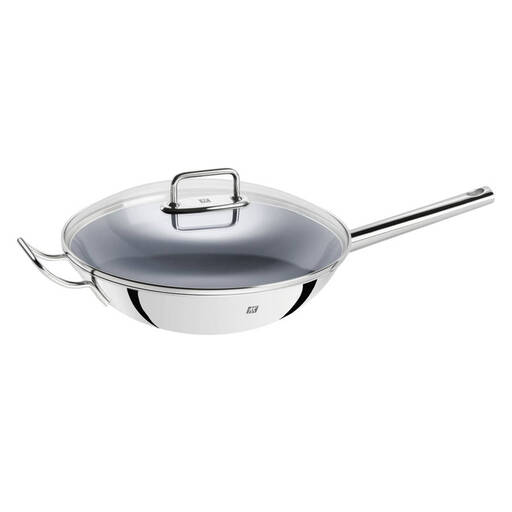
Why it's a great fit: For cooks who appreciate convenience and versatility. This Zwilling wok combines the benefits of a robust stainless steel construction with an easy-to-clean and scratch-resistant ceramic coating.
The Ceraforce ceramic coating is a durable alternative to standard non-stick sealants. The SIGMA Clad 3-ply base guarantees optimal performance on induction.
Dishwasher-safe for easy cleaning. Includes a glass lid and steaming rack for maximum versatility.
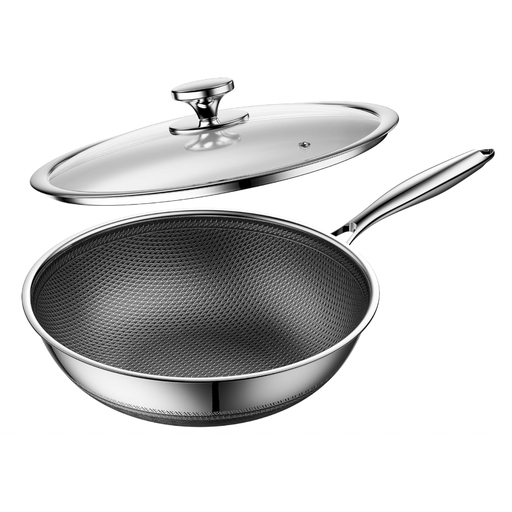
Why it's a great fit: A modern solution for those who want non-stick functionality without traditional chemical coatings. This wok is explicitly free of PFAS, PFOA, and PTFE.
The hybrid technology with an engraved stainless steel pattern protects the underlying ceramic non-stick layer from scratches. The three-layer construction ensures induction performance.
Completely PFAS-free for health-conscious cooking. The robust construction is dishwasher and oven-safe (up to 260°C).
Our selection includes a wide variety of woks that meet our criteria for performance and quality, from induction models to traditional designs for other types of hobs.
1. Can I use an uncoated stainless steel wok without everything sticking? Yes, it's possible with the right technique. The key is preheating. Heat the empty, dry wok over medium-high heat. Do the water drop test: sprinkle a few drops of water into it. If they dance across the surface like beads before evaporating, the correct temperature has been reached. Only then should you add the oil, swirl it around, and then add your ingredients.
2. What should the base diameter of my wok be for my induction hob? For optimal energy transfer and even heat distribution, the flat base diameter of the wok should match the size of one of your induction cooking zones as closely as possible. Many manufacturers provide a recommendation, e.g., "optimal for hobs with a ? 22 cm diameter." Measure your cooking zones to choose the right size when you buy a wok.
3. Are woks with lids really more useful? A lid significantly increases a wok's functionality, making it a true all-rounder in the kitchen. In addition to classic high-heat stir-frying, a wok with a lid also allows for steaming, braising, blanching, and keeping food warm at lower temperatures. For anyone who wants to prepare more than just stir-fries, a lid is a very sensible addition.