
Lieferung heute & morgen

Qualitätsgarantie

Willkommens-Angebote freischalten: KOSTENLOSE Lieferung | Bis zu 80 % RABATT | Kostenlose 30-Tage-JoyPlus-Testphase
App herunterladen
An induction wok pan needs to do more than simply work on a magnetic hob. A flat base, the right size, a suitable material and care requirements that fit your cooking routine are all important. Check these points before you buy to avoid unnecessary costs and disappointment later.
A round-bottomed wok may work well on a gas hob, but on an induction hob it can often be unstable or heat up only in the small central area. An induction wok needs a magnetic base that sits as flat as possible on the hob. Also check that the base diameter suits the cooking zone. On large models such as a 36 cm wok, the usable heating area may be smaller than the top rim.
A coated wok can make it easier to release delicate foods and is often suitable for frying with little fat. However, the coating needs proper care. Sharp metal edges, overheating and harsh cleaning products can damage the surface. An uncoated wok made from stainless steel or carbon steel is more heat-resistant, but calls for the right cooking technique.
A wok with a lid can also be used for steaming, braising and keeping food warm. A glass lid lets you keep an eye on your food, while a metal lid is generally more robust and may have a steam vent, depending on the model. If you also want to steam food, look for a compatible steamer insert. A wok set with an insert, rack and lid can be more practical than buying each item separately – provided you’ll actually use the accessories.
A stainless steel wok is corrosion-resistant and, in many cases, dishwasher-safe. Multi-layer designs with an aluminium core can distribute heat more evenly. However, uncoated stainless steel needs to be preheated correctly and used with enough oil to help prevent food from sticking.
A carbon steel wok responds quickly to changes in temperature and is suitable for high heat. It needs to be seasoned before first use and maintained regularly afterwards. Dry it straight after washing and apply a thin layer of oil. These models are generally not suitable for cleaning in the dishwasher.
A coated model is worth considering if easy cleaning and gentle frying are your priorities. Check the specific information about the coating, maximum temperature and suitable kitchen utensils. Claims such as “scratch-resistant” shouldn’t encourage you to use any sharp-edged utensil.
The stated top diameter doesn’t necessarily reflect the usable base area. This is especially important with induction, so compare the base diameter with the position of the heating area.
A wok for all hob types should be explicitly approved for induction, gas, electric and ceramic hobs. Different temperature limits may apply to the lid. According to WMF product information, the Macao set is heat-resistant up to 250 °C without the lid and up to 180 °C with the glass lid. Keep these limits in mind before using it in the oven or at high heat.
The claim “dishwasher-safe wok pan” is reliable only if this feature is explicitly stated in the product details. Coated models and woks with plastic or Bakelite handles may need to be washed by hand. Stainless steel parts are often easier to care for, but should still not be cleaned with harsh scouring products.
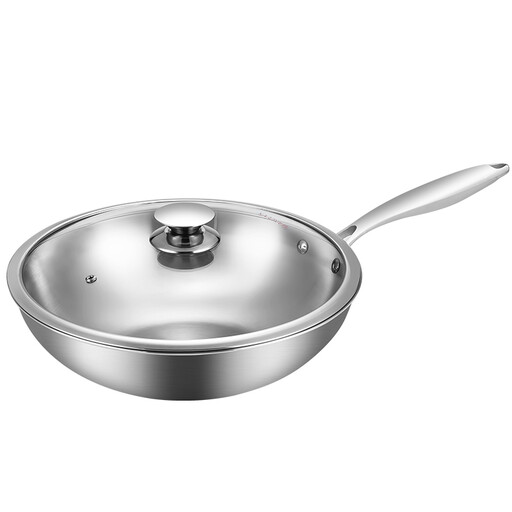
Why this product suits this cooking style: Its compact size is ideal for smaller households and everyday portions. According to the product details, the wok is suitable for gas, electric, ceramic and induction hobs.
The product description clearly states that it has a multi-layer construction and is suitable for several hob types. This makes it easier to check its induction compatibility before buying.
304 stainless steel with no non-stick coating listed; according to the product details, it is dishwasher-safe and suitable for several hob types.
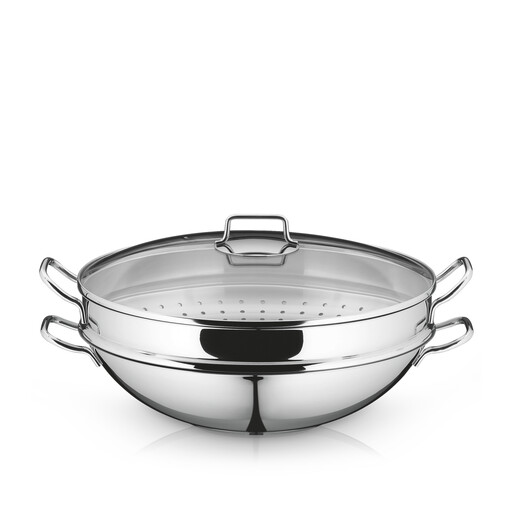
Why this product suits this cooking style: The set includes a wok pan, glass lid, roasting rack and steamer insert. It’s designed for households looking to fry, steam and braise using one system.
According to WMF product information, the base and wok are suitable for induction, gas, electric and ceramic hobs. The temperature limits for the wok and lid are listed separately.
36 cm size with a 4.5 l capacity; the steamer insert and roasting rack let you do more than simply fry.
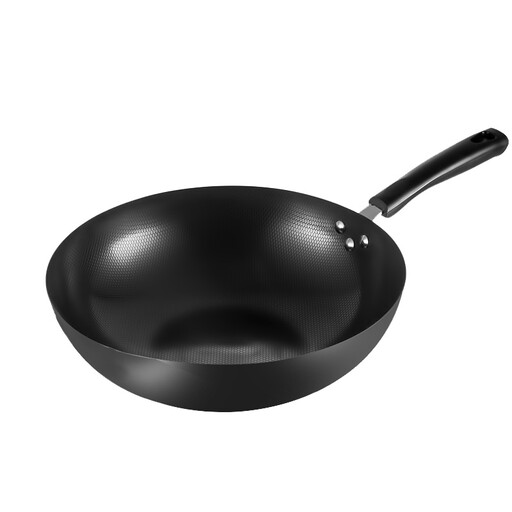
Why this product suits this cooking style: This model is for cooks who want to use high heat without a conventional non-stick coating and are happy to maintain the surface themselves.
The care requirements are clearly stated: the wok needs to be seasoned before first use, then dried and lightly oiled after washing.
Uncoated carbon steel; according to the product description, it is suitable for gas, electric, ceramic and induction hobs. Hand-washing helps preserve the surface.
We’ve put together a complete, regularly updated list of products that meet these strict selection criteria and the safety regulations in force in the EU.
A 28 to 30 cm wok is often large enough for two to three portions. Families may prefer a 32 cm model. A 36 cm wok offers more capacity, but you should only choose one if the induction zone covers the base sufficiently and you have enough storage space.
That depends on the model, the base construction and the cooking zone. A flat, magnetic base makes contact with the induction hob. For even results, the wok shouldn’t be much larger than the active heating area. You should also follow the manufacturer’s maximum temperature guidance.
A coated wok is often easier to clean after cooking, but needs gentle utensils and should not be exposed to excessive heat. A stainless steel wok is generally more robust and may be dishwasher-safe, but without a coating it can be more prone to sticking. Carbon steel needs the most regular care, but can be used at high temperatures once properly seasoned.